OpenAI's annualized revenue is $50 billion, about $20 billion less than previously reported figures, a discrepancy related to how different AI companies account for overall sales.
The big picture: The $70 billion figure, widely reported in September by Axios and other media outlets, was based on information shared with investors in an attempt to create a more direct comparison to rival Anthropic, Axios has learned.
Anthropic includes revenue from cloud partner sales in its tally.
Zoom in: Both companies are GAAP compliant, but they account for revenue through partner sales differently.
If a customer pays $100 for an AI service through a cloud provider, Anthropic's accounting method allows it to record the full $100 as top-line revenue, per Francine McKenna, accounting professor and author of the newsletter The Dig. The cloud provider's cut is then listed as an expense.
OpenAI records only its share of certain partner sales.
The difference comes down to how each company views its role in the transaction — including who controls the customer relationship and is responsible for delivering the product, according to McKenna.
Between the lines: The $70 billion ARR figure for OpenAI was an attempt to "gross up" its revenue number based on an interest from investors in having an apples-to-apples figure using Anthropic's methodology, sources said.
Reality check: Annualized revenue, when sales from a given period are projected out for a year, is a commonly used figure in Silicon Valley. But in public markets, investors will prefer actual revenue rather than financial constructs that are far more appropriate for early-stage startups.
What to watch: Anthropic has reportedly told investors it realized an operating profit in the second quarter, per the Financial Times, but those figures have excluded stock-based compensation.
They also largely preceded an array of computing deals signed by the company that are set to cost hundreds of billions of dollars, according to The Information.
Beware of claims about "profit" as well, at least until they come with the financial documents typical in an earnings release.
Chipotle shares jumped Thursday after a report that Starbucks has considered a bid to acquire the burrito chain.
Why it matters: The potentially seismic deal would pair the world's biggest coffee chain with one of the most powerful players in the fast-casual sector.
The NFL wants sports prediction markets to be regulated at the state level, putting the league opposite Kalshi, Polymarket and the Trump administration.
Why it matters: As the most powerful force in American sports, the NFL's opposition could pose a significant threat to the prediction market companies' fight to offer sports contracts on their own terms.
Vice President JD Vance announced a crackdown Thursday on the ability of Big Tech companies to sponsor workers seeking green cards to live and work in America.
Why it matters: The move blocks a path to permanent residency for affected workers but does not suspend the H-1B program, which allows skilled foreign workers to work temporarily in the U.S.
President Trump on Thursday called anyone who uses "Artificial Intelligence" instead of "Super Intelligence" "THE ENEMY!" — even as the White House continues using the term "AI."
Why it matters: Trump's push to rebrand AI as "super intelligence" clashes with established terminology in the technology industry.
Vice President JD Vance said Thursday that the Trump administration is suspending Microsoft, Adobe and several other IT firms' ability to hire foreign-born workers for permanent residency in the U.S.
Why it matters: The move will affect hundreds of companies owned by the tech giant, escalating the Trump administration's crackdown on immigrant labor.
President Trump said Thursday the U.S. will not attack Iran ahead of the Nov. 3 midterm elections.
Why it matters:Trump had been considering for several days resuming major combat operations before the midterms. However, his past statements about his intentions in Iran haven't always matched what he ultimately did.
If major combat operations resume, they're expected to include large-scale strikes on Iranian energy facilities, infrastructure and nuclear targets, sources say.
Cristin Culver operates as a communications department of one, advising founders and CEOs through launches, funding rounds and messaging resets.
Why it matters: For founders, the value proposition is clear: senior-level counsel that is nimble, individualized and directly available without having to onboard a full agency team.
New polling finds Americans don't want companies to take public stances on every issue, but some topics — and demographic groups — might call for it.
Why it matters: The communications challenge for brands isn't as simple as "speak up" or "stay quiet." It's about knowing if and when customers want a well-defined message from them.
President Trump said he will help pay for his administration's campaign-style ads after the Democratic National Committee sued Wednesday over their use of taxpayer money.
Why it matters: Trump's funding announcement does not address the DNC's central allegation that the administration illegally used taxpayer money to finance the ads.
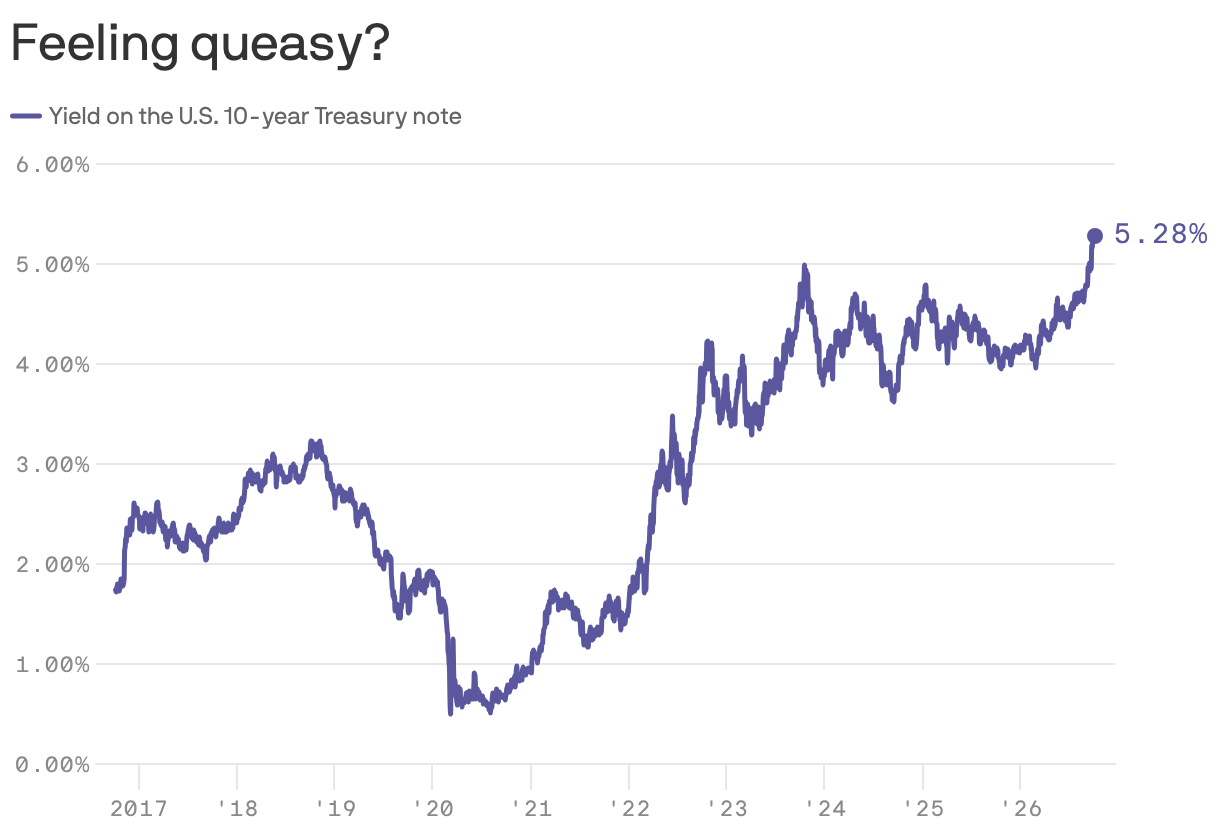
The recent sharp surge in Treasury yields may reflect the feedback loop dynamics that can sometimes take over in the bond market.
Why it matters: The spike in yields represents a big shift in the financial terrain beneath investors' feet.
The impact of so-called convexity hedging could be playing an important role in it.
How it works: Bond prices fall when interest rates rise.
But for technical reasons, the prices of some kinds of bonds — like packages of U.S. home loans wrapped up into mortgage bonds — can fall harder and harder as rates go higher and higher.
This particularly tricky feature of mortgage bonds is known as convexity, or more properly, negative convexity, because price drops get more extreme as rates rise.
Zoom in: Anyhoo, these mortgage bonds contain a sizable chunk of the roughly $13 trillion U.S. mortgage market. And their value has been falling fast as yields on Treasury notes and bonds have surged.
Without going into too much detail, one thing mortgage bond investors do when they find themselves in this situation is to try to sell Treasury bonds, thus reducing some of their portfolio's exposure to rising rates.
Or they can effectively do the same thing, via the derivatives market, with a product known as a swap from a Wall Street trading desk. (Often, the trading desk will then have to go into the market and sell Treasury securities to offset its own risk as a result of the swap.)
The big picture: You can see how this would increase pressure on the Treasury market, thereby worsening the yield increases that started the whole thing going in the first place.
This is a negative convexity loop, or as one of the greatest quotes in the history of the Treasury market put it back in 2007: "This is a good old-fashioned mortgage puke."
The bottom line: It's impossible to say that the recent run-up in rates is directly attributable to any one dynamic.
But the chatter in the bond market is that a good old-fashioned mortgage puke has likely played a role.
Gallatin AI raised a $50 million Series A, with defense-tech frequent fliers 8VC and Silent Ventures pitching in, CEO Woody Glier told Axios.
Why it matters: This isn't another drone builder. The California startup is, instead, focused on digitizing and streamlining the nitty-gritty of military logistics and sustainment.
"A lot of the logistics data that is generated today is very manual," Glier said. "It's very messy — literally like clipboard and pen and paper."
Bryan Johnson, the face of the longevity movement, wants to make staying alive more important than making money.
The famous/infamous biohacker spends over $2 million a year on his health, talks about living forever and publicly tracks everything from his erections to his sperm strength.
Why it matters: As Johnson fights to "live forever," he's doing so with a wink to his 8 million social media followers, a link to his business in his bio and a knack for drawing attention to himself.
AI's conquest of computer programming offered an early demonstration of what happens when models become good enough at a specialized field that experts can no longer treat them as a novelty.
Mathematics appears to be next.
Why it matters: OpenAI's latest mathematical results — which involved releasing hundreds of new proofs generated by a powerful, unreleased model — demonstrate that the startling advances of AI are likely to continue moving across entirely new fields.
Republican super PACs are flooding the airwaves in once-safe states, and pulling down ads for races that look like lost causes. President Trump, his approval ratings near record lows, is popping up in some of America's reddest states.
Why it matters: The polls showing Democrats headed toward a blue wave on Nov. 3 may not be quite right. But money — and how campaigns and PACs spend it — rarely lies. Nor do the contrails of Air Force One.
When it comes to health care and longevity, "Don't Die" influencer Bryan Johnson says AI is not ready for primetime.
"We are in an in-between state where AIs are brilliant and dumb. They make really stupid mistakes all the time. I would never trust my health to an AI," he said in an exclusive interview with "The Axios Show" on Monday.
Why it matters: Johnson is a successful tech founder, is close to a number of top AI execs and is at the forefront of a movement to prolong and improve health that's grown into an obsession for many in Silicon Valley. That is to say, his perspective on AI and health is tested and well-honed.