A congressional staff report from the House Committee on Science, Space, and Technology indicates that the Russian-backed propaganda group, the Internet Research Agency that was charged in the Mueller probe, worked on social media platforms to influence energy policy in the U.S., according to the WSJ.
What happened: IRA staffers posted photos and messages on Facebook, Twitter, and Instagram 9,000 times between 2015 and 2017 to encourage protests of pipeline construction in the U.S., abandoning fossil fuels use, and worked to elevate climate change disputes and controversies. It is not clear that the campaign had any influence on U.S. energy policy and many of the posts were shared by “a handful of followers,” per the WSJ.
The Pentagon on Thursday responded to Russian President Vladimir Putin's announcement that Russia has an "invincible" nuclear arsenal by stating that the United States is "fully prepared" in the event that Russia launched a nuclear attack. Pentagon spokeswoman Dana White told reporters, "This is not about defense. This is about deterrence."
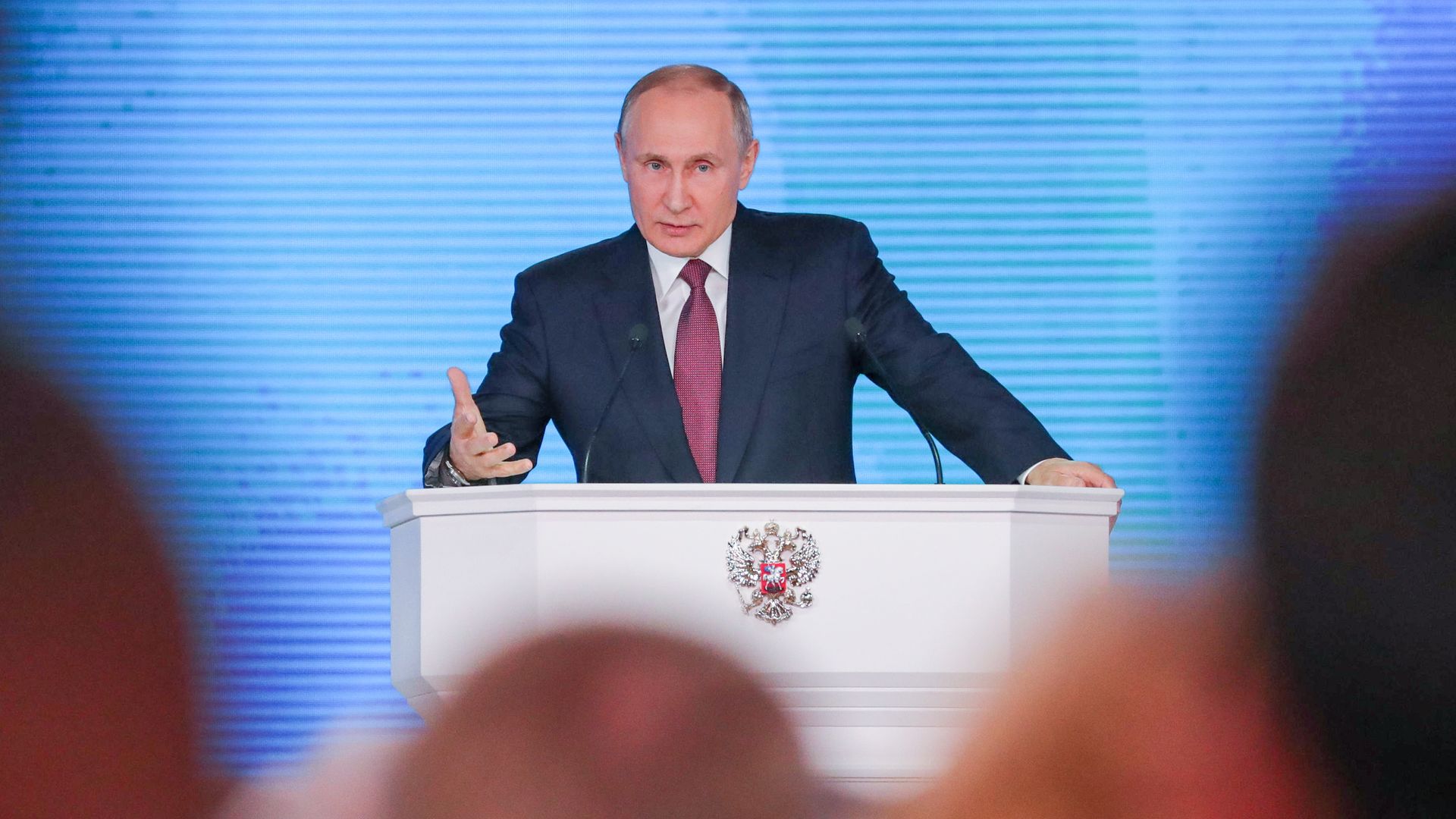
The backdrop: In a speech earlier today, Putin said that Russia had tested new nuclear weapons, including a new missile and an underwater drone. The Russian president made the announcement at his annual state of the nation address in Moscow — his last speech before Russia's presidential election on March 18.
A Polish law making it illegal to attribute crimes committed during the Holocaust to Poland officially comes into effect today, though it is still being reviewed by a constitutional tribunal.
The big picture: Israel considered withdrawing its ambassador over the matter, forcing a Polish delegation to visit in an effort to diffuse the situation. And the United States has strongly objected to the law, which the State Department has warned would “inhibit discussion and commentary on the Holocaust." As a result, Poland’s Deputy Minister of Foreign Affairs Marek Magierowski traveled to Washington to meet with Jewish groups and U.S. officials.
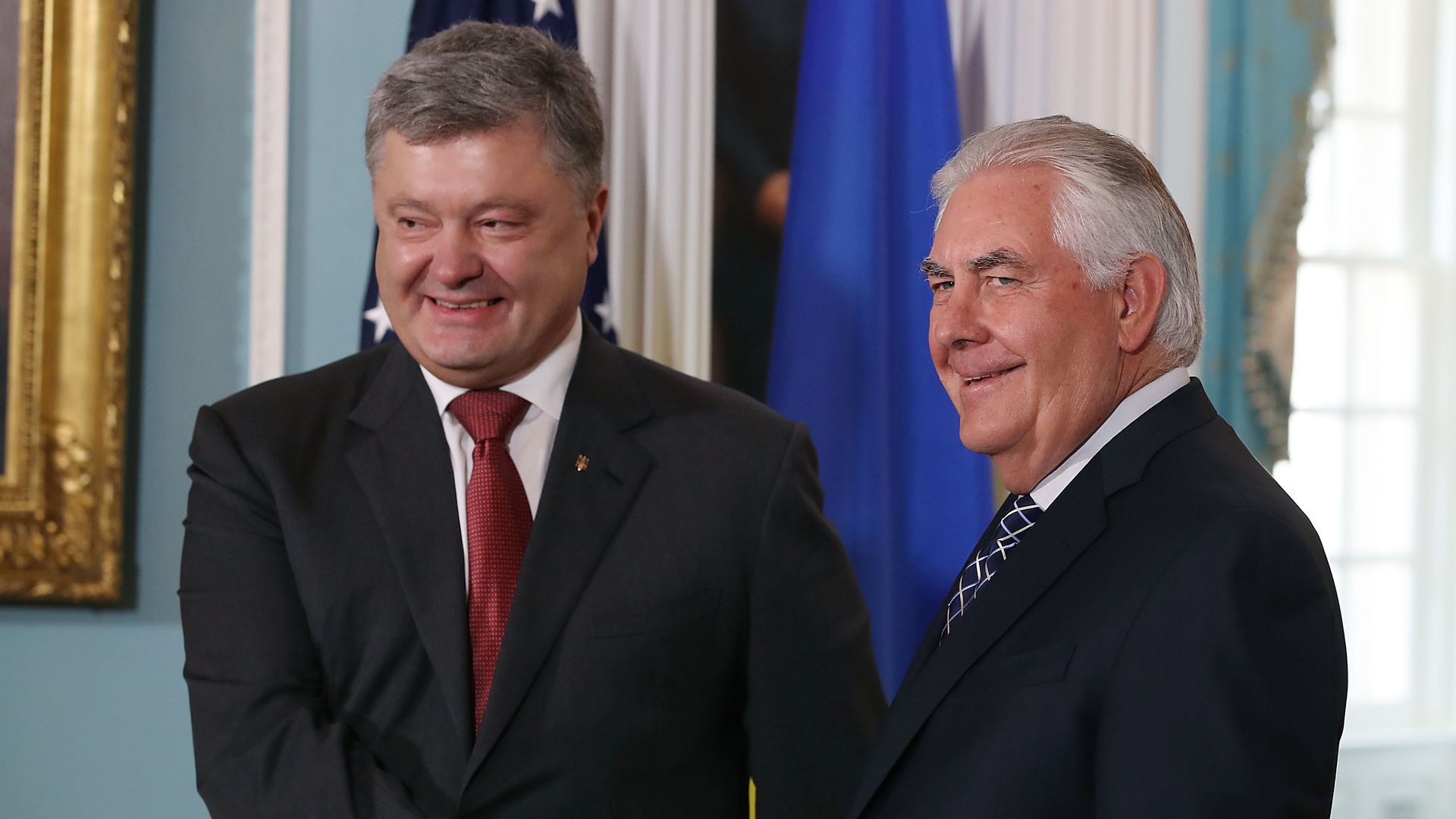
Tensions between the United States and Russia look set to escalate as Ukrainian president, Petro Poroshenko, has announced that he expects sophisticated weaponry from the US, including Javelin anti-tank missiles as well as heavy sniper rifles, to start arriving “in a very few weeks”.
Why it matters: The decision in December by the US government to provide Ukraine with “enhanced defensive capabilities” for the conflict in the east of the country against pro-Russian separatists could destabilize the shaky ceasefire that currently exists. Russian President Vladimir Putin warned in September that any decision by the US to supply defensive weapons to Ukraine could reignite the conflict.
India has taken back its claim from China as the world's fastest growing economy, with its GDP rising 7.2% this quarter on the back of a robust industrial rebound, according to The Economic Times. China reported a GDP growth of 6.8%.
Why it matters: The bounce-back is significant and indicates stability in India's eight core sectors, including coal, cement, electricity and steel. But even still, some experts say India's slowdown was self-inflicted — pointing to the government's overnight demonetization of the 500 and 1000 rupee bank notes, for example — and that 7% growth in a country where "a million young people join the job market every month" isn't enough.
Russian President Vladimir Putin said Thursday that Russia has tested new nuclear weapons, reports the BBC, including a new missile and an underwater drone. Putin made the announcement at his annual state of the nation address in Moscow, his last speech before Russia's next election on March 18.
"[A] low-flying, difficult-to-spot cruise missile with a nuclear payload with a practically unlimited range and an unpredictable flight path, which can bypass lines of interception and is invincible in the face of all existing and future systems of both missile defense and air defense."
The key players in Brexit negotiations have finally begun to outline their visions of the end game this week, ahead of a widely anticipated speech tomorrow from Prime Minister Theresa May.
The state of play: The European Union issued its draft agreement for Brexit yesterday, elements of which have been rejected outright by May's government. Meanwhile intraparty disputes over Brexit are as much of a worry for May as international ones.
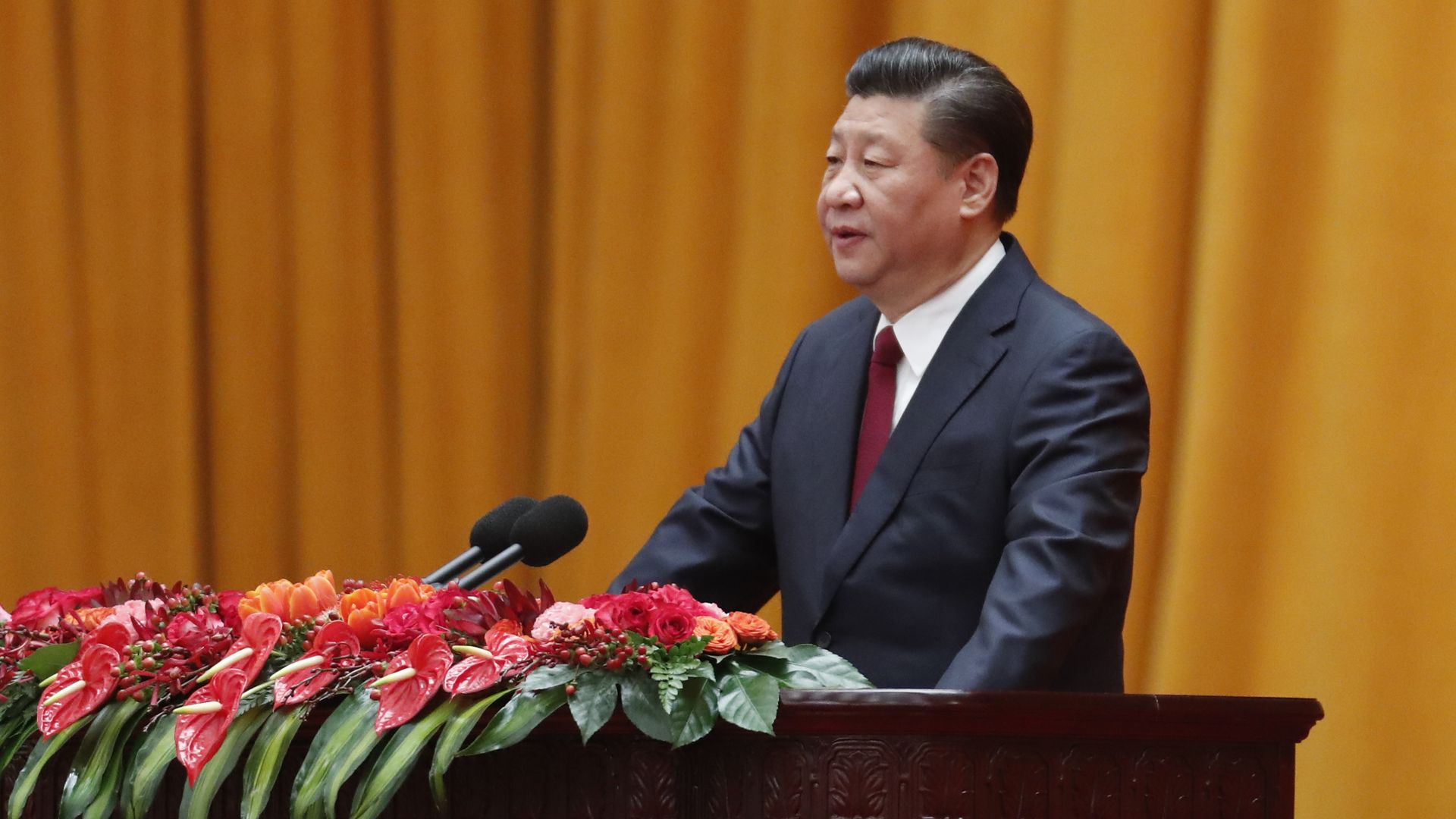
The only surprising thing about the proposal advanced by China’s Communist Party to eliminate term limits for the country’s president and vice president is that anyone is surprised.
Throughout his first term, President Xi Jinping worked assiduously to enhance his power and prolong his tenure at the expense of the collective leadership. The important question now is where will an untethered Xi focus his attention?
Jews in Ethiopia have threatened to stage a mass hunger strike if the Israeli government slashes immigration funding intended to help them reunite with their relatives in Israel, the The Associated Press reports.
The backdrop: Israel airlifted about 14,500 Ethiopian Jews in 1991 during a civil war in Ethiopia, and in 2015 it vowed to bring remaining Ethiopian Jews to join their relatives, the AP reports. But that effort has been reportedly stalled. Per the AP, there are about 8,000 Jews in Ethiopia who have relatives in Israel.
Deutsche Welle reports that Fancy Bear, the believed-Russian hackers behind the DNC hacking in 2018, hacked the computer networks of Germany's internal ministry and dwelled in the network for as much as a year. German officials confirmed to Reuters that a hack took place, but made no such attribution.
Why it matters: Though Germany was mum about who was behind this most recent hack, its parliamentary body, the Bundestag, announced in 2016 it had been attacked by Fancy Bear.
Israel is concerned by what it sees as a policy difference with the U.S. on countering Iranian military entrenchment in Syria, officials say. The issue is going to be discussed again in the White House meeting between Prime Minister Netanyahu and President Trump on Monday.
The bottom line: A senior Israeli official who deals with the Iranian activity in Syria told me the U.S. is not doing enough to help counter Iranian entrenchment. He added that there is a big gap between the American rhetoric against Iran and the action.
"It is comfortable for the Americans to let us be their sub-contractor against Iran in Syria. We are very worried", the official told me.
Fancy Bear, the believed-Russian espionage group thought to be behind the hacks of the Democratic National Committee and Democratic Congressional Campaign Committee, appears to be targeting North American and European foreign affairs officials, including a European embassy in Moscow, according to a Palo Alto Networks report.
Why it matters: No matter what the intent, any attack from Fancy Bear will stir up questions about Russia and the U.S.'s inaction after the 2016 election. Though cyber espionage is generally considered fair game by most foreign countries — it's the leaking of information and other malicious damage associated with Russian campaigns that is problematic — Fancy Bear's 2016 exploits make it harder to treat as a traditional espionage actor.
The details: The diplomats were sent Microsoft Excel files laced with malware in emails that appear to be calendars for upcoming events from the industry publication Jane's Defense Weekly.
A believed-Iranian hacking group nicknamed Chafer that previously focused on domestic surveillance has been turned loose on the international air transport industry, according to a new report from Symantec.
The bottom line: Iran has other options in its cyber offensive, including more sophisticated government-lead groups. But with this rapid expansion of Chafer's portfolio, "[m]ore then likely, their mandate will broaden in the next few years," said Symantec Technical Director Vikram Thakur.
Kim Jong-un and his family used illegally-obtained passports from Brazil in order to apply for Western visas, Reuters reports.
Why it matters: One senior Western security source told Reuters the passports showed "the desire for travel and points to the ruling family's attempts to build a possible escape route." The ruling family of the reclusive nation used the passports, which were full of fake information, to travel to Japan, Hong Kong, and Brazil.
Sen. John Cornyn (R-TX) on Monday sent a letter to Treasury Sec. Mnuchin, asking that the Committee for Foreign Investment in the U.S. (CFIUS) review Broadcom's proposed takeover of Qualcomm. His big concern is that the deal could result in a controversial Chinese company with effective control over U.S. telecom infrastructure, via future development of 5G technology.
Why it matters: This is a highly unusual request, and not only because the two chipmakers haven't yet agreed to merge.
Chinese censors took swift action to ban certain words and phrases from Weibo, China's version of Twitter, amid fallout from the Communist Party's proposal to do away with presidential term limits, the Guardian reports.
The big picture: The move shows just how swift China's autocratic regime can be, especially as use of the letter "N" was blocked from the service for a period of time. Victor Mair, a China expert at the University of Pennsylvania, wrote in a blog post that the decision came about “probably out of fear on the part of the government that ‘N’ = ‘n terms in office’, where possibly n > 2.”
China’s communist party has moved to eliminate presidential term limits, in a shock move that opens the way for President Xi Jinping to dominate Chinese politics for the next decade or more.
The big picture: When you rule over more than a billion people, the question of if, when, and how you leave power — or don’t — is naturally a big one, but Xi isn’t the only leader whose succession plans carry strong intrigue. Here’s what’s on your mind if you’re