Amid the worst stock market plunge since the financial crash, stark new questions are arising about the concentration of global profit and wealth in a few "superstar" firms, and the economic power that they wield.
Among concerns about Google, Facebook, Amazon, Apple and others is the historic scale of wealth at the apex of some industries, alongside decades-long wage stagnation for the middle and lower classes.
As companies progress from experiments with a few autonomous vehicles to pilot deployments of hundreds of them, early-stage startups — whose technologies and teams can give fleet operators unique advantages in quickly fielding AVs at scale — are being pre-emptively acquired at high prices.
Why it matters: While the broad deployment of AVs may still be years away, the race to capture market share is already transforming both venture investments and the types of startups that receive them.
Microsoft said Friday it plans to continue seeking work with the U.S. military on a range of projects, including a controversial cloud computing contract.
Why it matters: Some employees have raised concerns, particular as powerful new technologies like artificial intelligence could enable autonomous warfare.
The Federal Trade Commission approved a settlement Friday with Uber Technologies over allegations that Uber deceived consumers about its privacy and data security practices.
Why it matters: The settlement is the latest consequence for Uber's free-wheeling behavior under then-CEO Travis Kalanick. Under the two data breaches, Uber did not disclose the second to consumers or the FTC for more than a year.
Facebook said Friday is had removed more than 80 accounts, pages and groups associated with “coordinated inauthentic behavior that originated in Iran and targeted people in the U.S. and U.K."
Why it matters: The company's response to disinformation campaigns aimed at Americans is being closely watched ahead of the midterm elections.
It was a story that many saw coming, but was still shocking to read: After a year of reporting, the New York Times offered up a blistering report on how Google failed to take strong action against male executives it concluded had behaved improperly with women.
Why it matters: The story confirms a wide belief in Silicon Valley that Google is the Big Tech company with the most skeletons in its closet in this area, having been home to a number of workplace romances involving married executives.
Constant Washington shocks have resulted in the underplaying of one of the most consequential stories of our time: Big Tech is facing rising scrutiny and controversy, with many Americans rethinking their online relationships.
With tech having lost its luster, the industry is now facing more skepticism from all directions, Axios chief tech correspondent Ina Fried points out.
Amazon reported its earnings Thursday with updates on its devotion toward advertising and "sales related to our other service offerings," which made nearly $2.5 billion in net sales in just the third quarter of 2018, The Atlantic reports.
Why it matters: Amazon has streamlined its ads to work on nearly every platform so advertisers can purchase ads in a bundle of Alexa, Kindle, Amazon.com banners and on television. Amazon's ad business has more than doubled from Q3 of 2017, when it made $1.12 billion. Brands have since upped their ad spending on Amazon by 250%.
China bought 36% of all factory robots in the world last year, more than any other country including the U.S., and intends to ramp up its own production of them — another sign of its determination to be the pre-eminent technological superpower.
Why it matters: With the U.S. and China locked in a race to master artificial intelligence and quantum computing, robotics are a third, quieter competition between them. Mastery of any or all the three technologies is seen as key to geopolitical and economic power in the coming decades.
Airbnb has hired a new chief technology officer: Aristotle (Ari) Balogh, previously a Google executive and Yahoo's CTO, replacing co-founder Nate Blecharczyk who shifted his focus to strategy last year.
Snapchat's parent company posted $298 million in revenue for 2018 Q3, significantly beating analyst expectations of $283.21 million, but its user base continues to shrink.
It reported 186 million daily active users, down 1% from the previous quarter when it had $88 million, also down from 191 million in 2018 Q1. It predicts a decline in the next quarter as well.
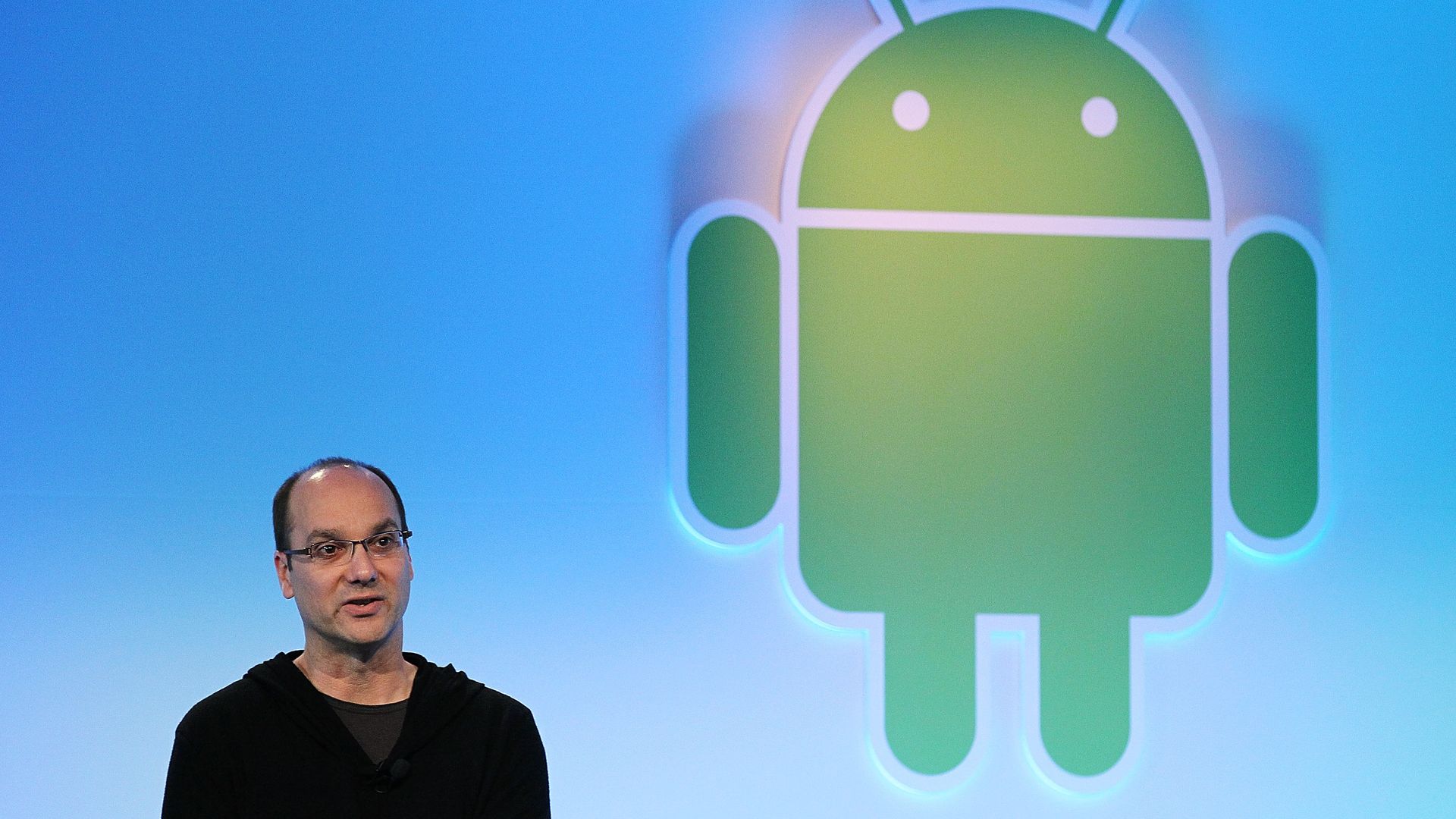
Android creator Andy Rubin's 2014 departure from Google took place after the company found sexual misconduct allegations against him credible, The New York Times reports.
Why it matters: Rubin was one of three executives that Google protected within the past decade after they were accused of sexual misconduct, according to the Times.
Twitter lost 9 million monthly active users last quarter, bringing its total user count down to 326 million monthly active users, the company reported Thursday during its third quarter earnings.
The big picture: Social media companies generally seem to have hit a point of saturation as Snapchat and Facebook both lost North American users this year for the first time. And, in July, Twitter purged millions of locked and fake accounts, causing the following of many high-profile users to drop significantly.
President Trump placed "a very big part" of the blame for the "Anger we see today in our society" on the news media and its "Fake News" reporting in a Thursday tweet — one day after pipe bombs were sent to prominent Democrats around the country.
"A very big part of the Anger we see today in our society is caused by the purposely false and inaccurate reporting of the Mainstream Media that I refer to as Fake News. It has gotten so bad and hateful that it is beyond description. Mainstream Media must clean up its act, FAST!"








/2018/10/26/1540547059449.gif?w=3840)