America is shedding its status as the default choice for foreign governments to park money, buy weapons and send students.
Why it matters: Even modest shifts away from the U.S. could chip away at advantages that have helped sustain American economic and geopolitical power for decades.
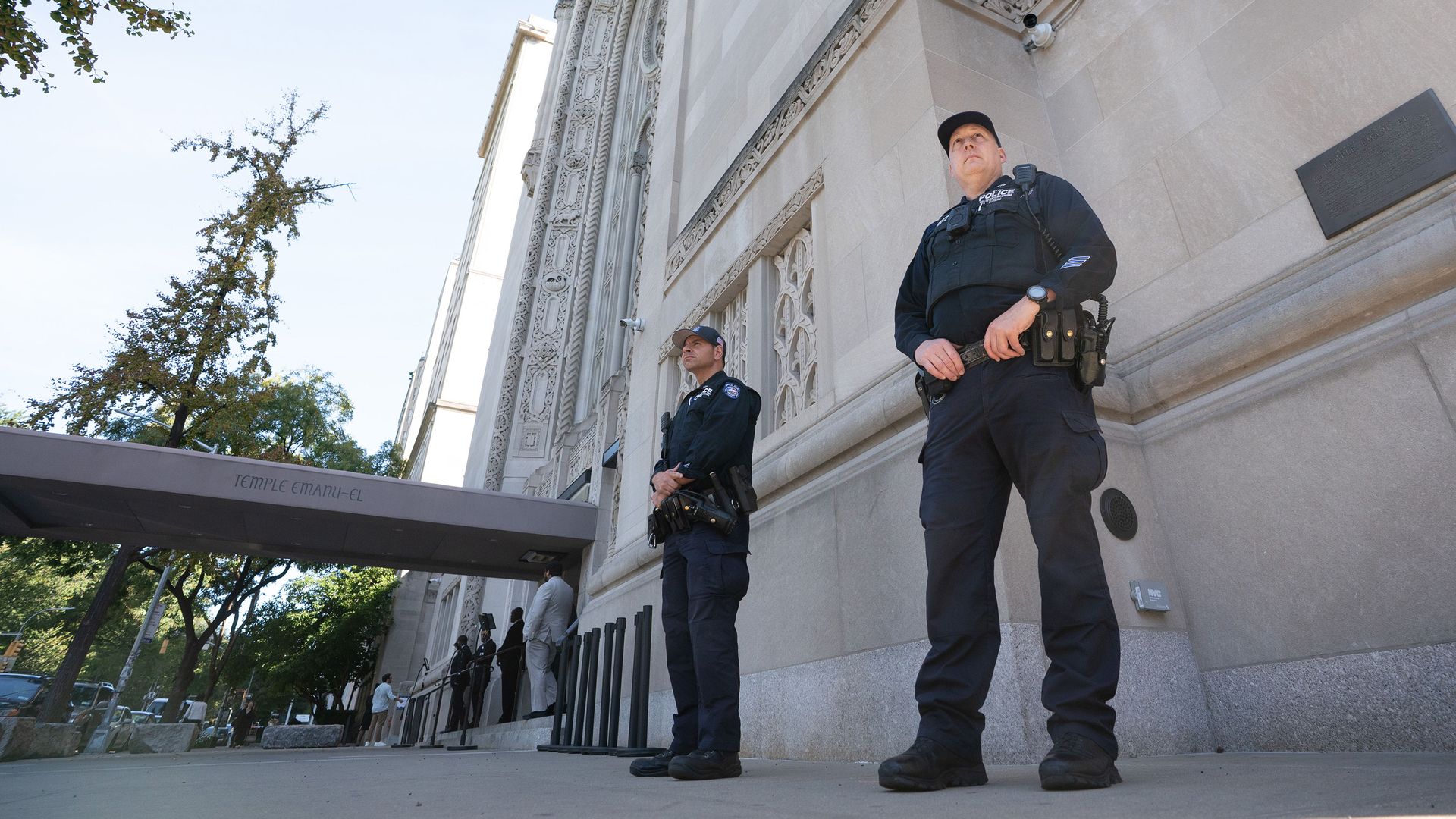
Antisemitic threats have pushed the nationwide cost of protecting Jewish synagogues, schools and community centers past $1 billion a year, new estimates revealas congregations prepare for big crowds during the High Holy Days, which began Friday with Rosh Hashanah.
Why it matters: Enhanced security has become a growing expense for Jewish communities, congregation leaders say, often taking up money that could pay for teachers, summer camps, elder care and other programs.
Suicide death rates among 10- to 14-year-old girls and boys nearly evened out from 2018 to 2024, according to new research published this week.
Why it matters: The research found that suicide death ratesbetween boys and girls nearly evened out during the years analyzed, bucking previous data showing boys had higher suicide death rates, though girls think about and attempt suicide more often.
A widow of a 9/11 victim used the annual reading of the names of those killed to plead with the Trump administration about Saudi Arabian officials' alleged ties to the terror attack, which the kingdom has dismissed.
The big picture: During the New York City ceremony for 9/11's 25th anniversary, Terry Strada slammed Saudi Arabia, which Axios' Barak Ravid reports is actively urging President Trump to assist them with U.S. military action.
An Afghan national who was the first-ever case before the federal Alien Terrorist Removal Court has been deported, the Justice Department announced Friday.
The big picture: The DOJ win before the previously dormant court could give the administration a path toremove people it links to terrorism while keeping much of its evidence secret, Axios previously reported.
A letter is circulating among House members urging Speaker Mike Johnson (R-La.) to bring back the House "immediately" and keep it in session until Congress passes AI safeguards, Axios has learned.
The contractor hired to renovate the Reflecting Pool says its repair work caused the pool's liner to peel and bubble, according to documents first reviewed by The New York Times.
Why it matters: President Trump has repeatedly blamed vandals for the pool's damage and has pushed to prosecute some of them, even after U.S. Attorney Jeanine Pirro dropped the cases.
Data: AdImpact; Note: AdImpact data includes dollars spent on video advertisements on broadcast, cable and social media as well as spending estimates on streaming platforms; Chart: Stef Kight/Axios
Republicans are outspending Democrats in almost every battleground Senate race this month as Majority Leader John Thune (R-S.D.) looks to the GOP's cash advantage to help hold his majority.
Why it matters: The post-Labor Day rush is here, with $390 million (and climbing) of Senate campaign ads headed for voters' TVs, tablets and phone screens.
Sen. Rick Scott said Friday he is "absolutely not" committing to backing John Thune for another term as Senate GOP leader.
Why it matters: It's a sharp change in tune for Scott (R-Fla.), who has repeatedly and publicly said he supports Thune (R-S.D.) and will not run for leader a third time.
The White House is doubling down on President Trump's promise to deliver $5,000 checks to American adults, arguing his record shows he can pull it off.
Why it matters: The Trump administration is teasing these massive checks as Americans' frustrations with the economy and rising costs grow ahead of the midterm elections.
Headline CPI rose 0.4% in August, its biggest monthly increase since May, with gasoline accounting for more than a third of the increase.
The Fed typically looks through temporary supply shocks, but a sustained energy surge risks spilling into other prices — and energy price pressures have only escalated further in September.
Zoom out: Central banking orthodoxy would suggest not responding to energy price shocks directly, but responding to the extent that swings in fuel prices are filtering through to broader prices.
Unfortunately for anyone seeking lower borrowing costs, there is evidence that this is indeed happening, risking energy-driven inflation becoming more entrenched.
Soaring diesel fuel prices are affecting the price of transportation of all sorts of goods, with the biggest effects on bulky or heavy items.
Airline fares were up 2.7% in August alone and are up 23.4% over the last 12 months.
Between the lines: If energy price relief were in progress, it would be easier to look through those price surges. No relief is in sight, however.
Those figures are already backward-looking. The energy shock has since worsened this month, with oil prices around $100 a barrel and diesel topping $6 a gallon for the first time on record — all pointing to more inflation pressure still to come.
The Centers for Disease Control and Prevention declared the cyclospora outbreak related to Taylor Farms lettuce over Friday, though the Food and Drug Administration says its investigation remains ongoing.
Data: Brennan Center for Justice; U.S. Census Bureau; Axios analysis; Map: Brad Jennings/Axios. Note: Race and ethnicity reflect how justices publicly identify, based on Brennan Center research.
More than three-quarters of U.S. states have a smaller share of justices of color on their high courts than the share of people of color in their population, per an Axios analysis of new Brennan Center for Justice data.
Why it matters: State high courts shape major decisions on voting, abortion, civil rights and criminal justice, yet their benches often don't reflect the communities they serve.
Consumer prices remained elevated in August as the Iran war's energy shock fueled a fresh burst of inflation.
Why it matters: The renewed price pressures are squeezing household budgets, with signs that underlying inflation is proving stubborn across the broader economy.
The data could strengthen the case for the Federal Reserve to raise interest rates next week.
Saudi Crown Prince Mohammed bin Salman (MBS) called President Trump twice Thursday, urging him to launch strikes against the Houthis as the Iran-backed group closed in on a vital Red Sea chokepoint, two U.S. officials told Axios.
Trump declined, and U.S. officials stressed the administration has no plans to intervene directly against the Houthis for now.
Why it matters: Oil prices surged Thursday as the Houthis seized a strategic coastal city in Yemen, pushing them closer to the Bab al-Mandab Strait — a vital artery for global trade and Saudi oil exports.
Less than two months before the midterms, Republicans are fighting roughly 200 legal battles to try to impact elections, including several cases in which the GOP isn't officially participating but is paying legal fees or advising on strategy.
Driving the news: The Republican National Committee's vast roster of cases includes efforts to tighten voter ID rules in Montana, decrease ballot drop-off locations in Georgia, increase scrutiny of voter lists in New Jersey and Delaware, and boost access for election observers and challengers elsewhere.
A week of extraordinary warnings about AI is shifting the fight in Washington from whether to regulate to how far policymakers are willing to go.
Why it matters: Washington and industry's failure to put basic guardrails around AI came into plain sight this week, spurring fresh momentum for regulatory action.
Twenty-five years after the Sept. 11 attacks, some lessons remain deeply ingrained in the national security apparatus — while others have faded.
The big picture: A vast majority of Americans say the attacks forever changed the country. But some key post-9/11 security norms — like airport screening, intelligence gathering and international cooperation — have evolved with new technology and shifting political whims.
America says "never forget" — but a growing share of Americans don't remember.
Why it matters: More Americans are coming of age with no firsthand memory of 9/11, creating emotional distance from the trauma and more room for dark humor and reinterpretation.
Anthropic insiders' warnings this week that AI could end humanity in the next decade have members of Congress frantically seeking answers and trying to cobble together some kind of response.
Why it matters: Federal lawmakers are at the "concepts of a plan" stage at this point, with congressional leaders showing little apparent urgency to mobilize.
DALLAS — Support for President Trump is dropping among millennials and Gen Zers — particularly young men. Vice President Vance is in charge of getting them back in the midterms.
Why it matters: The 42-year-old Vance, the first millennial VP, capped off the GOP's two-day convention here with a direct appeal to families with young children that emphasized the "birthright" of U.S. citizens.
"This is history, this is history." That's what photojournalist Spencer Platt was thinking 25 years ago as he photographed the events unfolding on the morning of 9/11.
Why it matters: Platt and fellow Getty photographer Mario Tama told Axios what it was like on the ground that day. Trained as photojournalists, their instinct was to move toward the danger to document history.