Higher oil and rates are set to test the markets

Add Axios as your preferred source to
see more of our stories on Google.
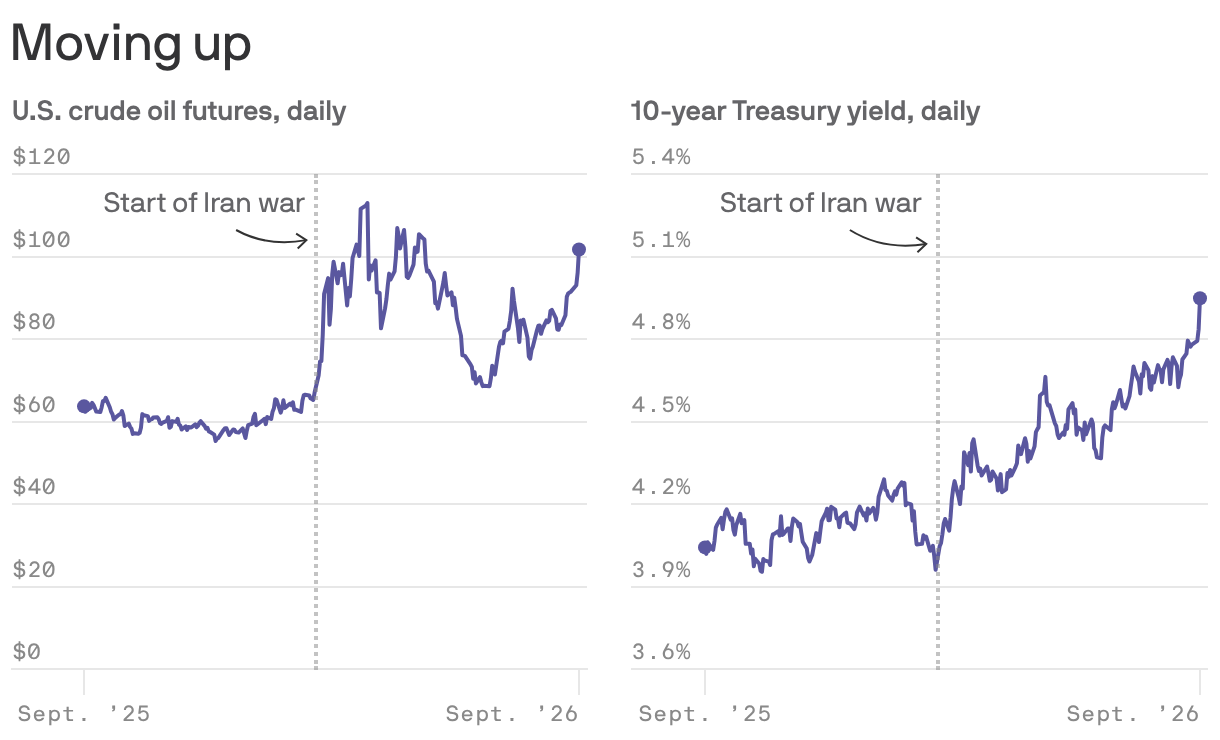
Oil prices surged and borrowing costs rose Thursday as the nervousness percolating through the global economy intensified.
Why it matters: Investors are now pricing in a higher-cost world that could test the resilience of the markets and hurt Americans' wallets.
The latest: U.S. benchmark crude oil spiked 8%, leapfrogging the $100 mark to $103 a barrel.
- Gasoline prices jumped to $4.30 a gallon, per AAA.
- The price of diesel — a critical cost for agriculture and shipping — crossed $6 a gallon at the pump for the first time ever, AAA said Friday morning.
The cost of money is also getting more expensive, as the yield on the U.S. 10-year Treasury note rose to more than 4.96%, its highest level since 2023.
- That has knock-on effects for consumer borrowing costs. The 30-year fixed mortgage rate jumped above 7% Thursday for the first time since last May 2025.
Yes, but: If you're looking for bright spots, at least the stock market didn't do too badly, with the S&P 500 falling just 0.58% Thursday.
- Yet the market's biggest driver — the AI trade — stumbled. Investors may be questioning how rising rates will weigh on a boom increasingly dependent on borrowed money.
- Even the energy sector, which in theory could benefit from spiking crude oil prices, didn't look particularly bullish. It dropped on the day, suggesting that investors are skeptical that the economy is strong enough to support such elevated energy costs over time.
What they're saying: "It seems from here that the pressures on long-end rates continue to build until action is taken (hike(s) and/or fiscal discipline), or until something breaks," Padhraic Garvey, regional head of research for the Americas at Dutch financial conglomerate ING, wrote in a note Thursday.
What we're watching: There's a lot that could break. The course of the conflict in the Middle East, swollen government deficits, AI debt, the midterm elections in the U.S. — any one of these factors could determine whether global investors grow more worried or less.
