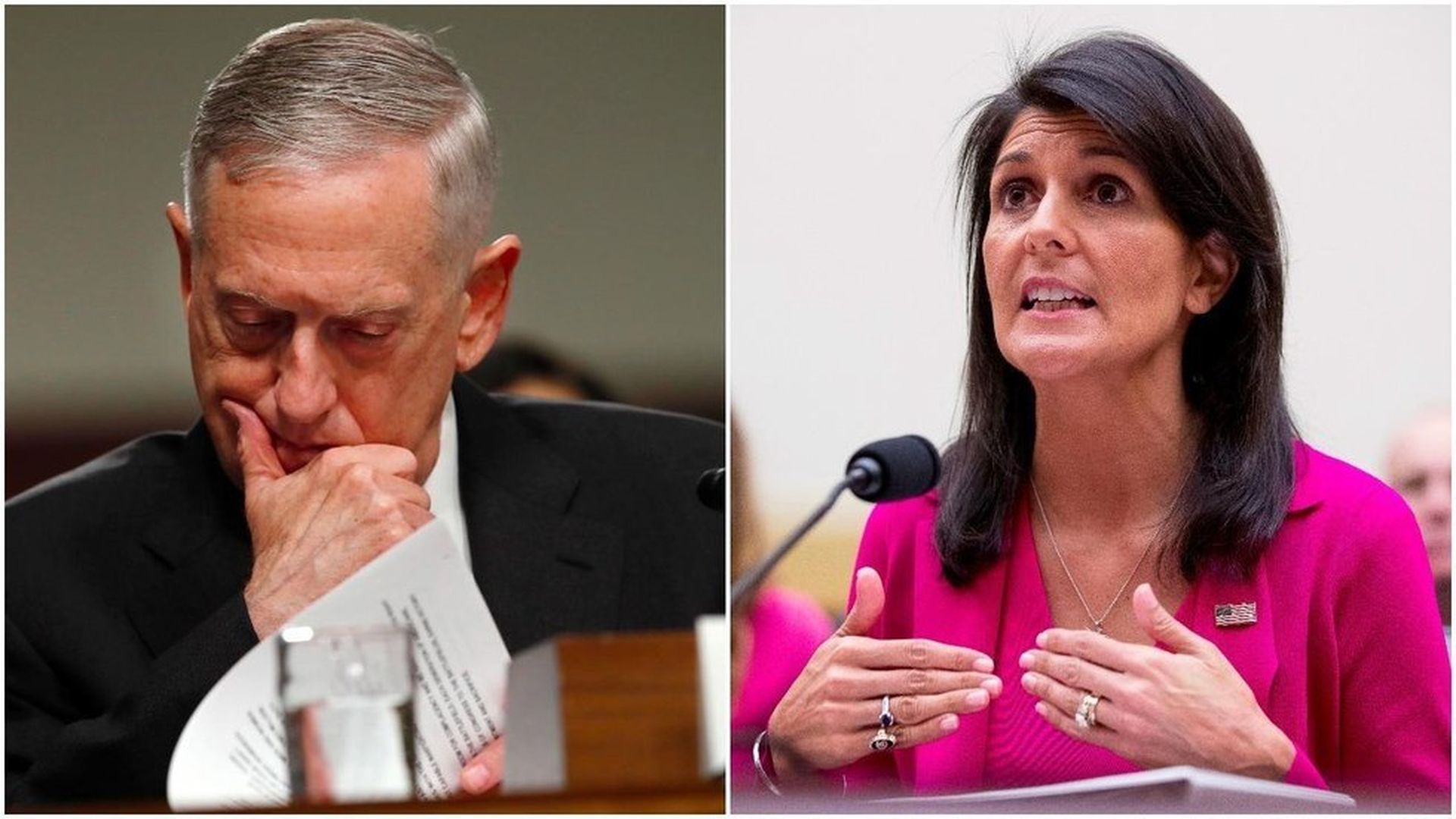
Both Defense Secretary Mattis and U.N. Ambassador Nikki Haley are claiming President Trump's warning to Syria over chemical weapons prevented an attack.
Mattis, while on his way to a NATO meeting in Brussels Wednesday, told reporters: "It appears that they took the warning seriously." When asked repeatedly how he knows Syria heeded the warning he said simply, "they didn't do it," three times.
Haley on Capitol Hill Wednesday, via The Guardian: "Due to the president's actions, we did not see an incident…I would like to think that the president saved many innocent men, women and children."
Our thought bubble: Reports on what prompted the White House statement Monday night that Syria was preparing for a possible chemical attack have been vague and at times conflicting. With so little known about the would-be attack, it's hard to assess whether the warning changed the regime's calculus.
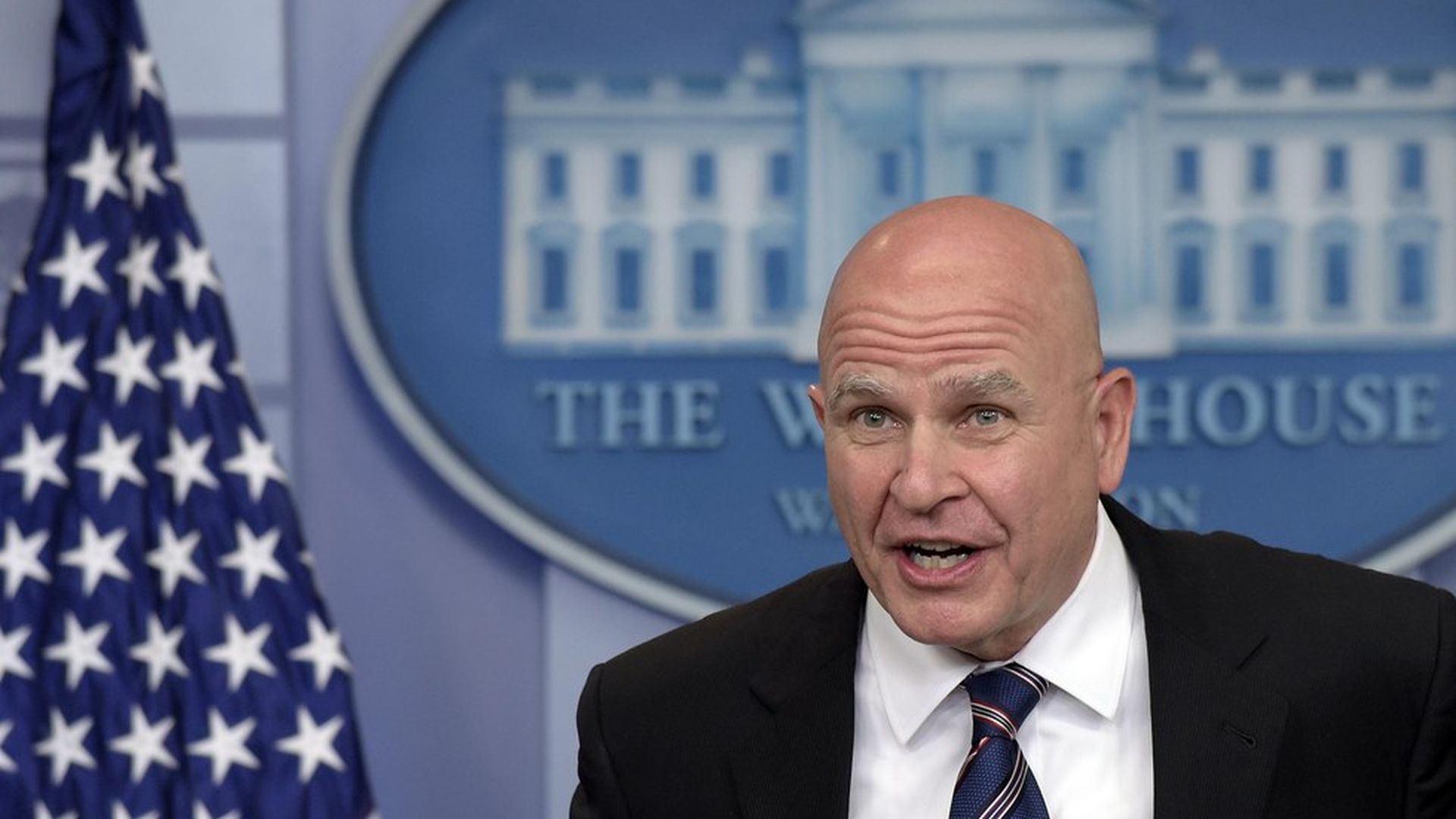
Trump's National Security Advisor H.R. McMaster laid out the way the U.S. is thinking about the North Korea problem Wednesday in three main points:
"The North Korea problem is not a problem between North Korea and the United States. It's a problem between North Korea and China — and the world."
A positive gain in the last few months has been "Chinese leadership's recognition that China does have a great deal of control over that situation mainly through the powers of the economic…relationship" with North Korea. This seems to diverge from Trump's stance that China has tried to exert influence but fallen short.
"Denuclearization of the peninsula is the only appropriate and acceptable" solution.
Read more from Axios' Expert Voices on what the U.S. can do about North Korea, here.
President Trump has shared videos on his official Instagram account from Project Veritas, the controversial right-wing outlet known for its deceptively-edited videos, that purport to show CNN figures — including contributor Van Jones — dismissing the federal government's Russia investigation. Trump captioned the videos, "CNN is fake news."
Sarah Huckabee Sanders yesterday: "There's a video out there circulating right now — whether it's accurate or not, I don't know — but I would encourage everybody in this room, and frankly, everybody across the country to take a look at it."
Note of caution:Per the Washington Post, Project Veritas is known for utilizing practices considered unethical in mainstream journalism, including using false identities and deceptive editing. For example, one video features a CNN producer saying there is "no smoking gun" in the Russia investigation but fails to note that he produces health and medical stories for the network — and is based in Atlanta, away from the epicenters of CNN's politics coverage in Washington and New York.
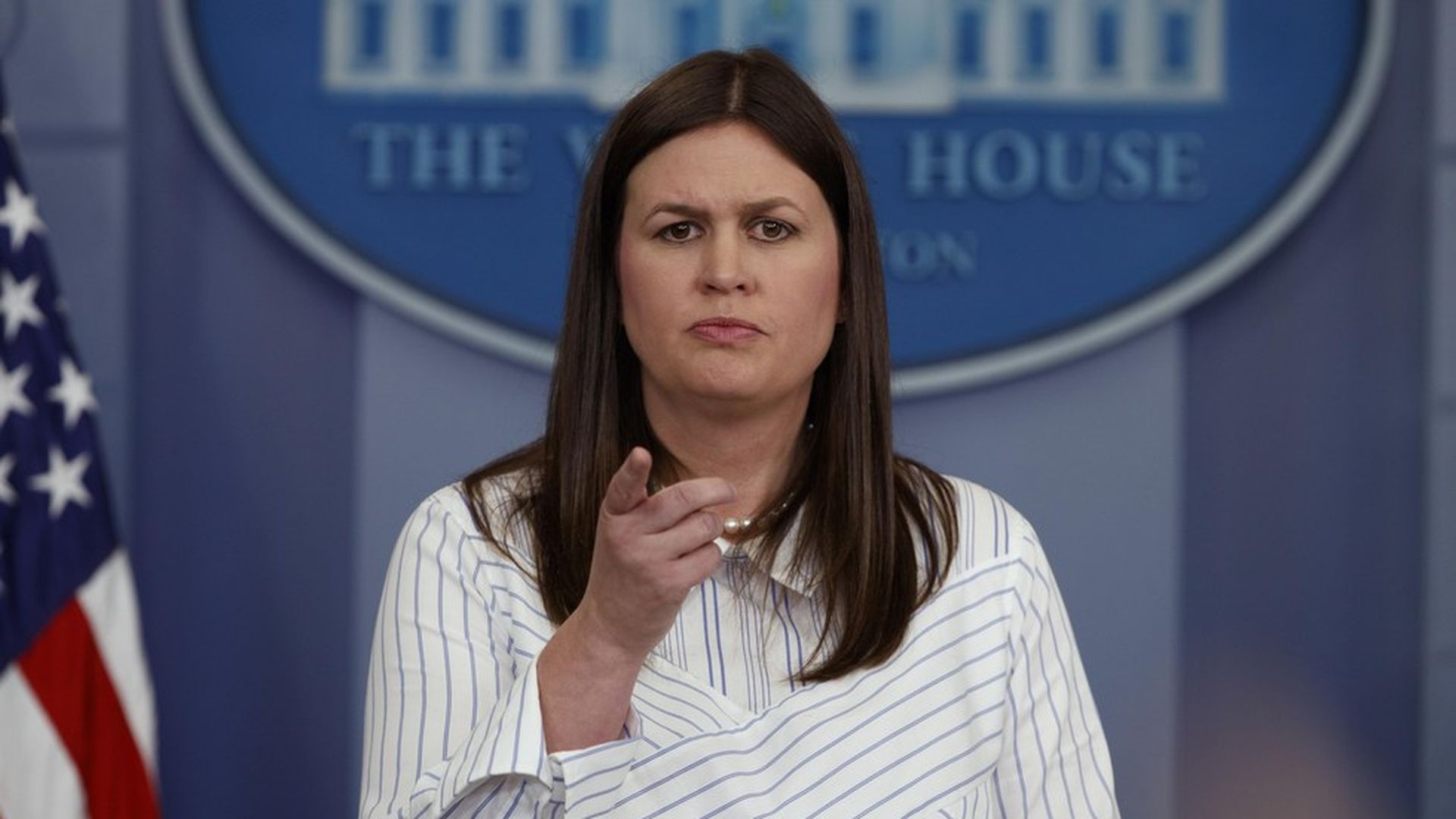
Deputy Press Secretary Sarah Sanders surprised reporters for a second day in a row when she appeared at the briefing podium Wednesday instead of Sean Spicer. Immigration and Customs Enforcement officials also spoke, with Sanders claiming that if the White House had announced the guests ahead of time, the media wouldn't have covered them. Other highlights from the off-camera briefing:
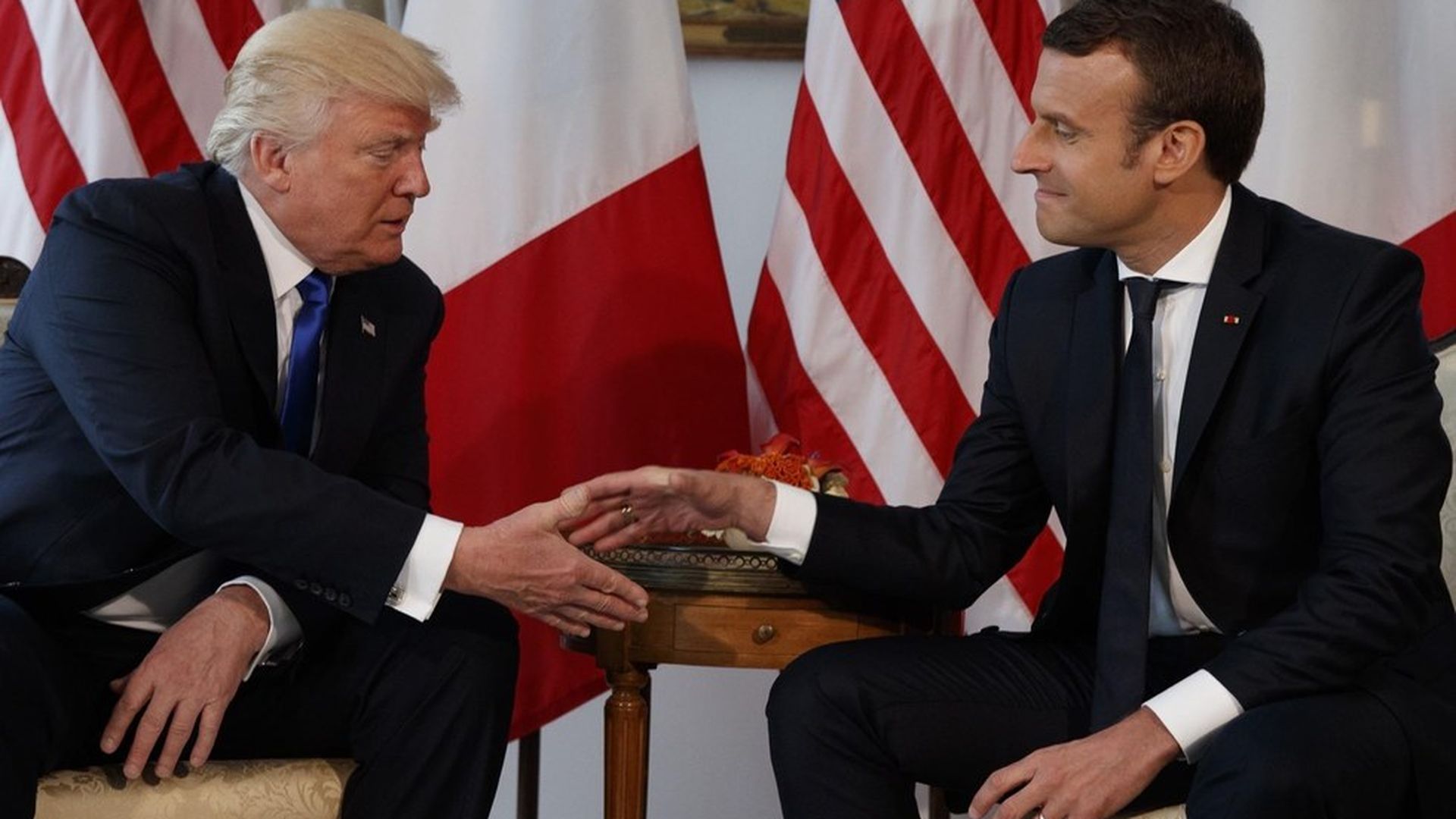
The White House announced this morning that President Trump has accepted yesterday's invitation from French President Emmanuel Macron to visit Paris for Bastille Day celebrations on July 14.
Beyond France's national day, which remembers the 1789 storming of the Bastille during the French Revolution, this July 14 also marks the 100th anniversary of the United States' entrance into World War I — making it a big day for both countries.
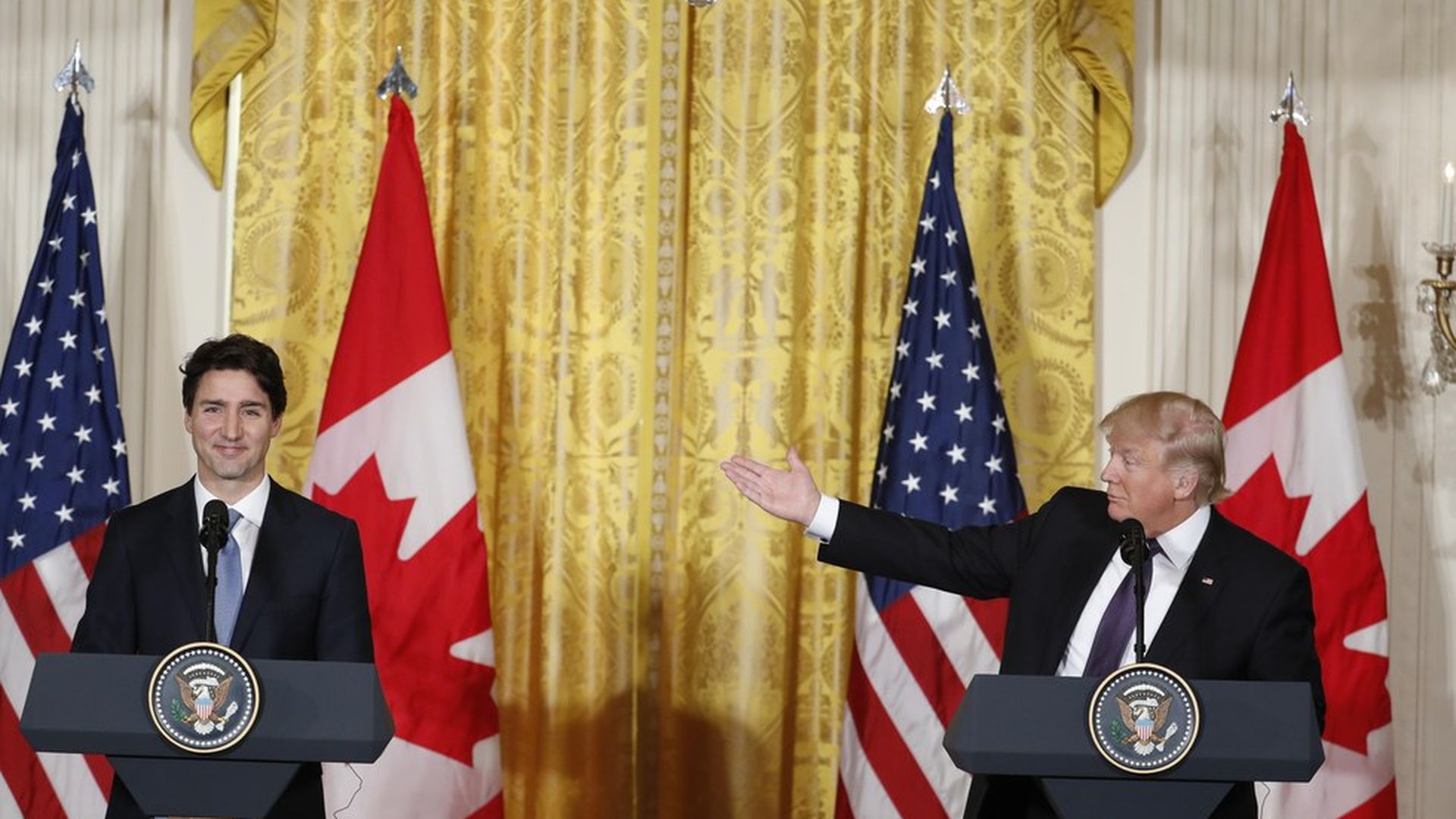
Last week in Iowa, President Trump called for a "total rewrite of our immigration system into a merit-based system," reminding everyone that his interest in looking to Canada as a model for how to rebuild the U.S. immigration system has not weakened.
The results: According to NYT's Jonathan Tepperman, Canada has one of the highest per-capita immigration rates in the world, about three times higher than the U.S. Yet at the same time their foreign-born population is more educated than that of any other country on earth. "Immigrants to Canada work harder, create more businesses and typically use fewer welfare dollars than do their native-born compatriots," writes Tepperman.
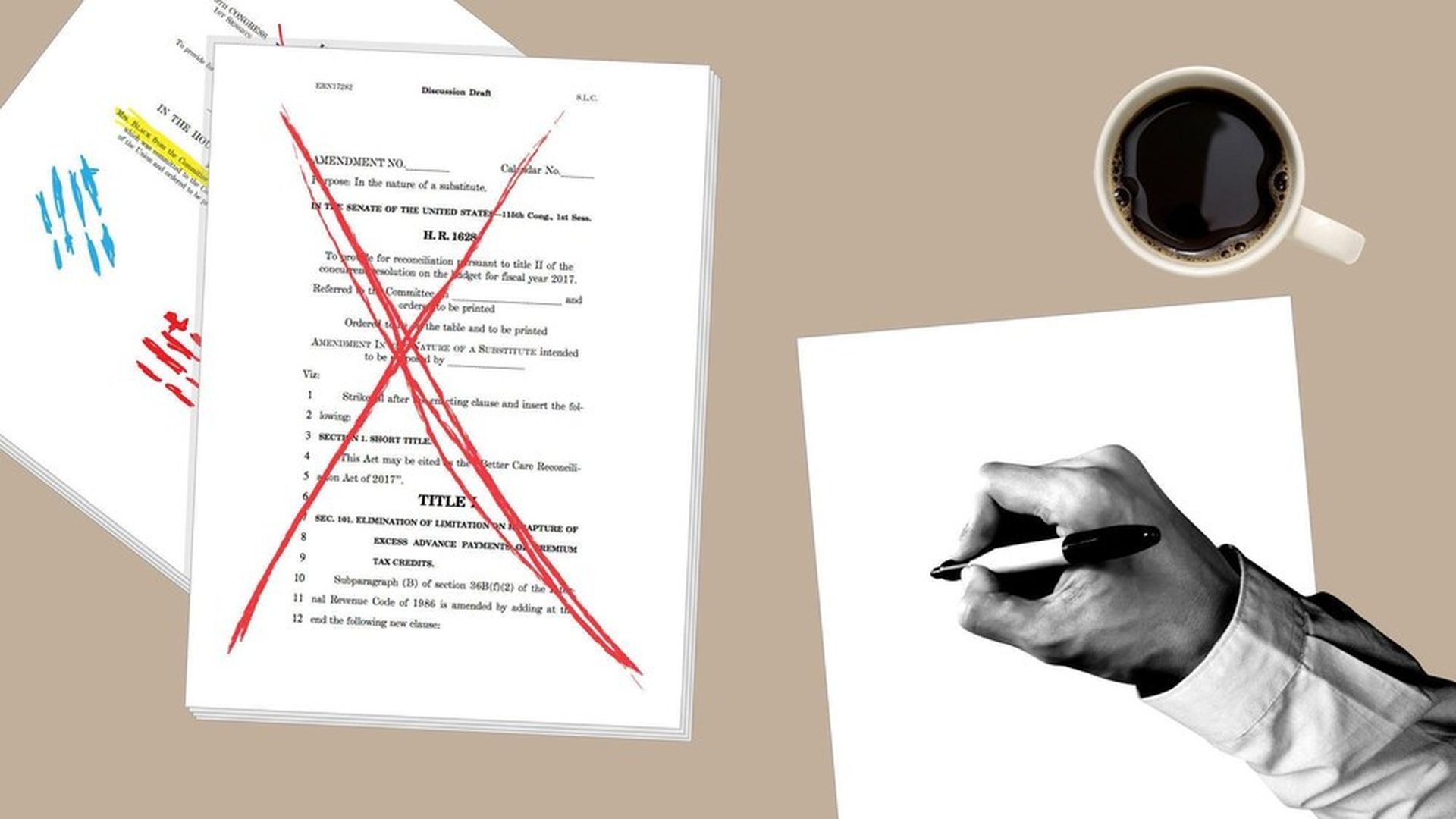
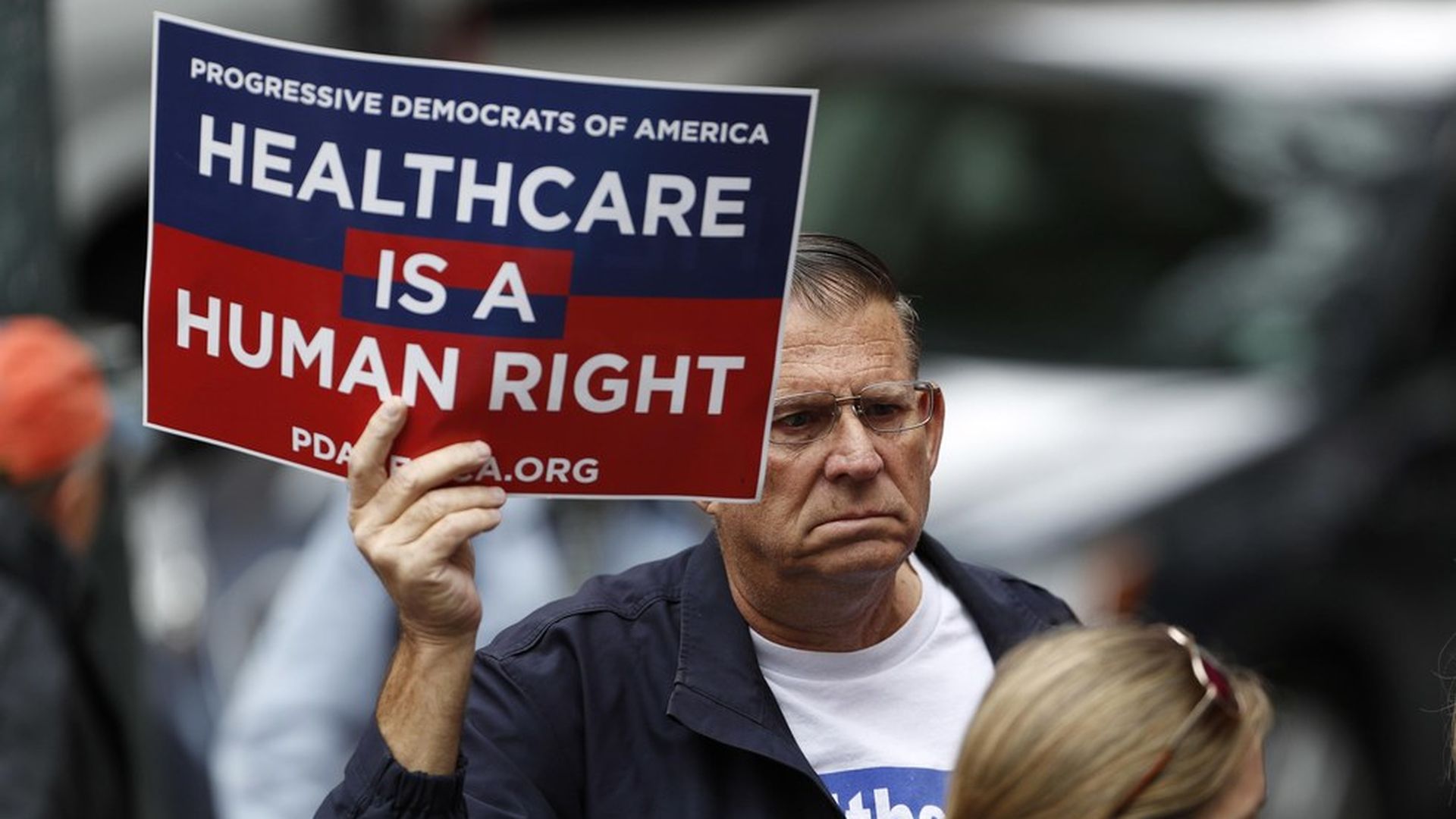
After scrapping their plan to hold a health-care vote this week, Senate Republican leaders' new goal is to get their party together around a new policy outline by Friday, so they can send that plan to the Congressional Budget Office over the July 4 recess and vote once they return.
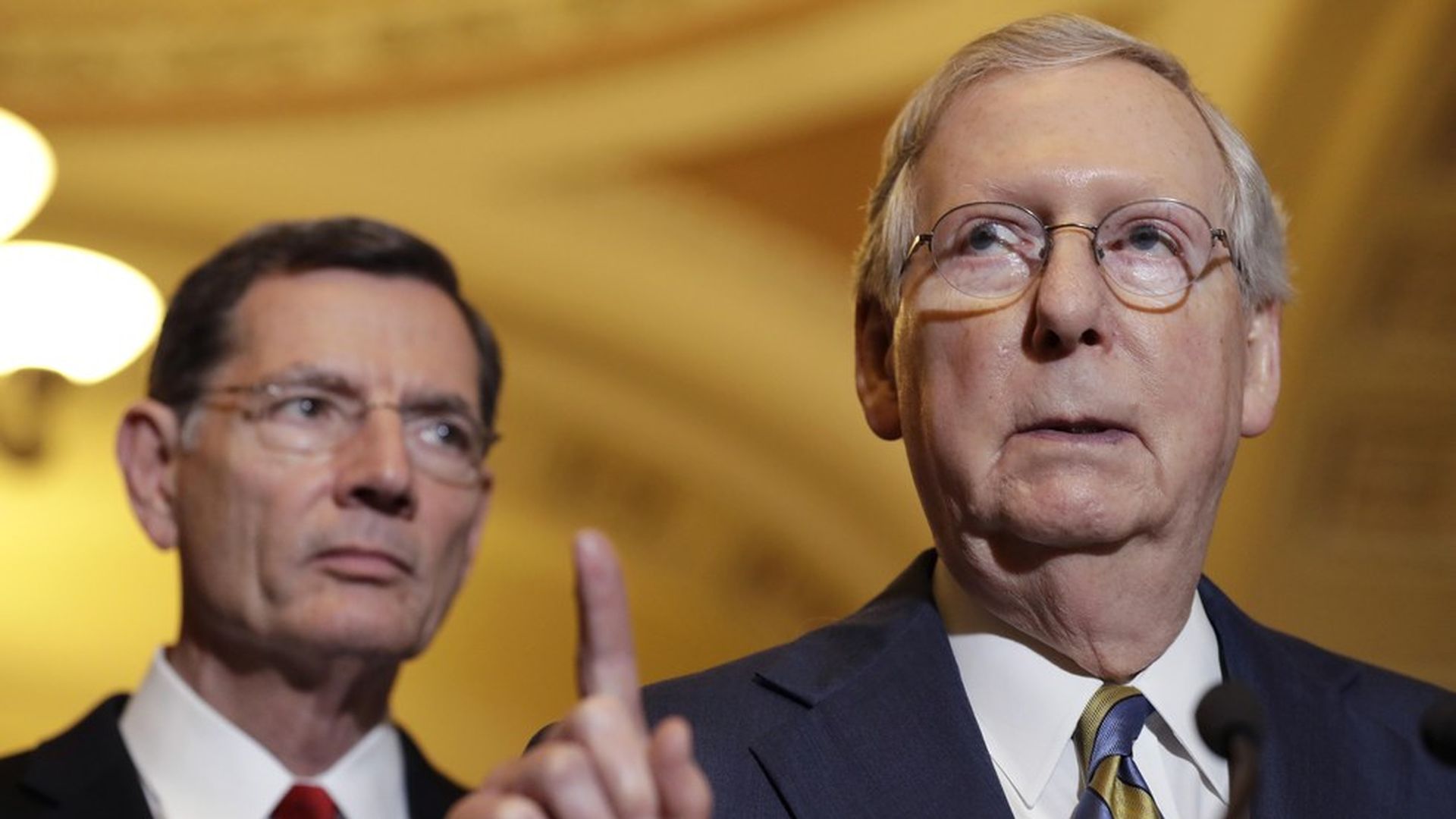
Will it work? It's true that McConnell is a legislative MacGyver — always able to make something out of nothing at the last minute. And it helps that he has about $200 billion at his disposal to help bring more votes on board. And yes, this is almost exactly what happened in the House, so don't read too much into one canceled/postponed vote.
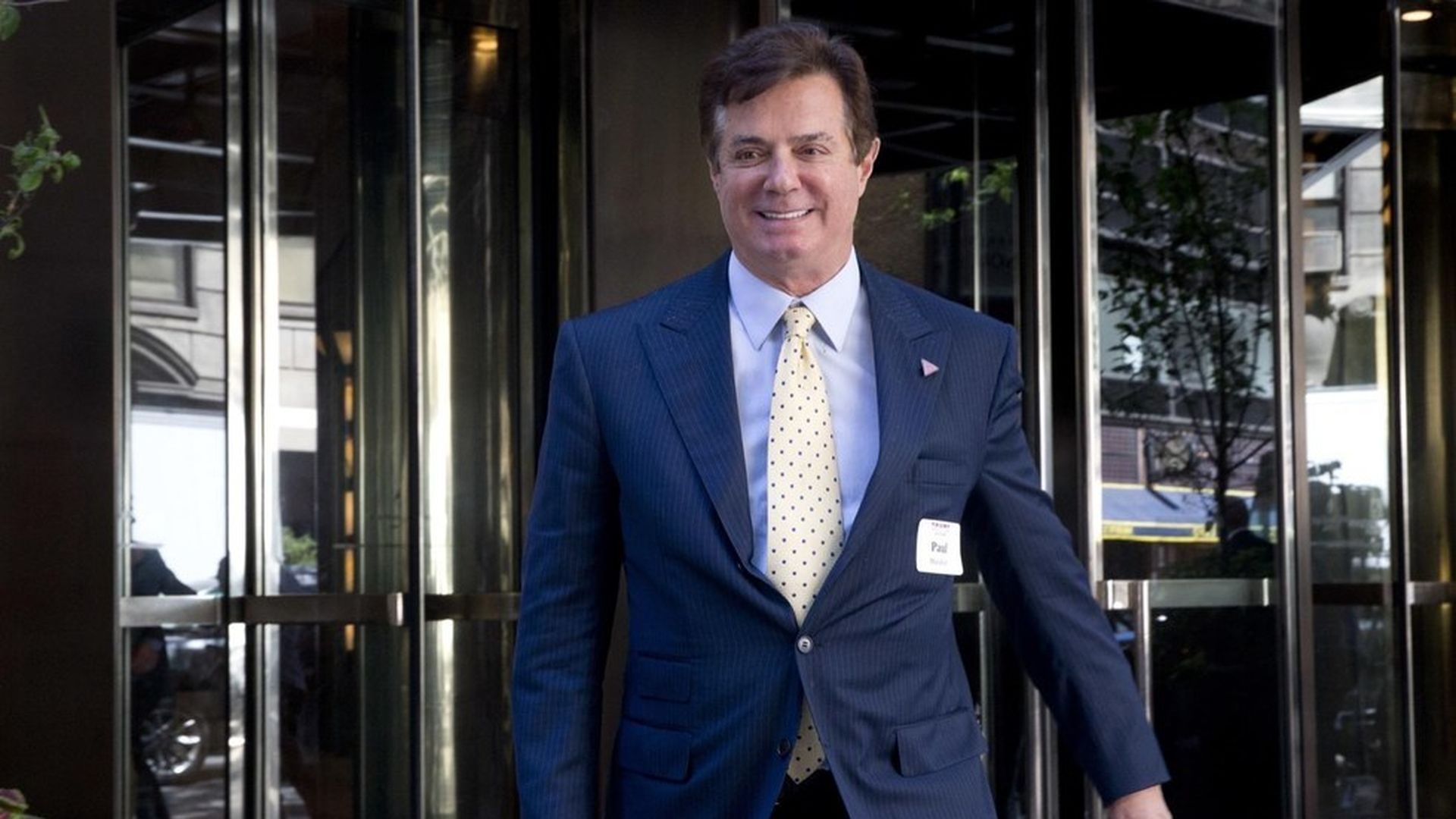
Former Trump campaign chairman Paul Manafort has retroactively filed forms with the Department of Justice disclosing his work as a foreign agent for a Ukrainian political party, per The Washington Post.
Manafort's consulting firm disclosed that it had received $17.1 million between 2012 and 2014 for its work for the Party of Regions, then led by exiled, pro-Russia former Ukrainian President Viktor Yanukovych.
Why it matters: Manafort didn't break any laws by filing his disclosure form retroactively — that would require clear intent, and his spokesman told the Post that the form's preparation started last September — but Manafort's work for foreign clients is already under scrutiny amid the ongoing Russia investigations.
President Trump reacted on Twitter this evening to the shelving of the Senate GOP's health care bill until after the July 4 recess, and his subsequent meeting with Republican senators at the White House — at which he said the final Senate bill was "going to be great."
After Mitch McConnell announced he would be delaying the health care vote, which appeared doomed to failure, President Trump brought the entire GOP caucus to the White House and told them, "we have really no choice but to solve this situation."
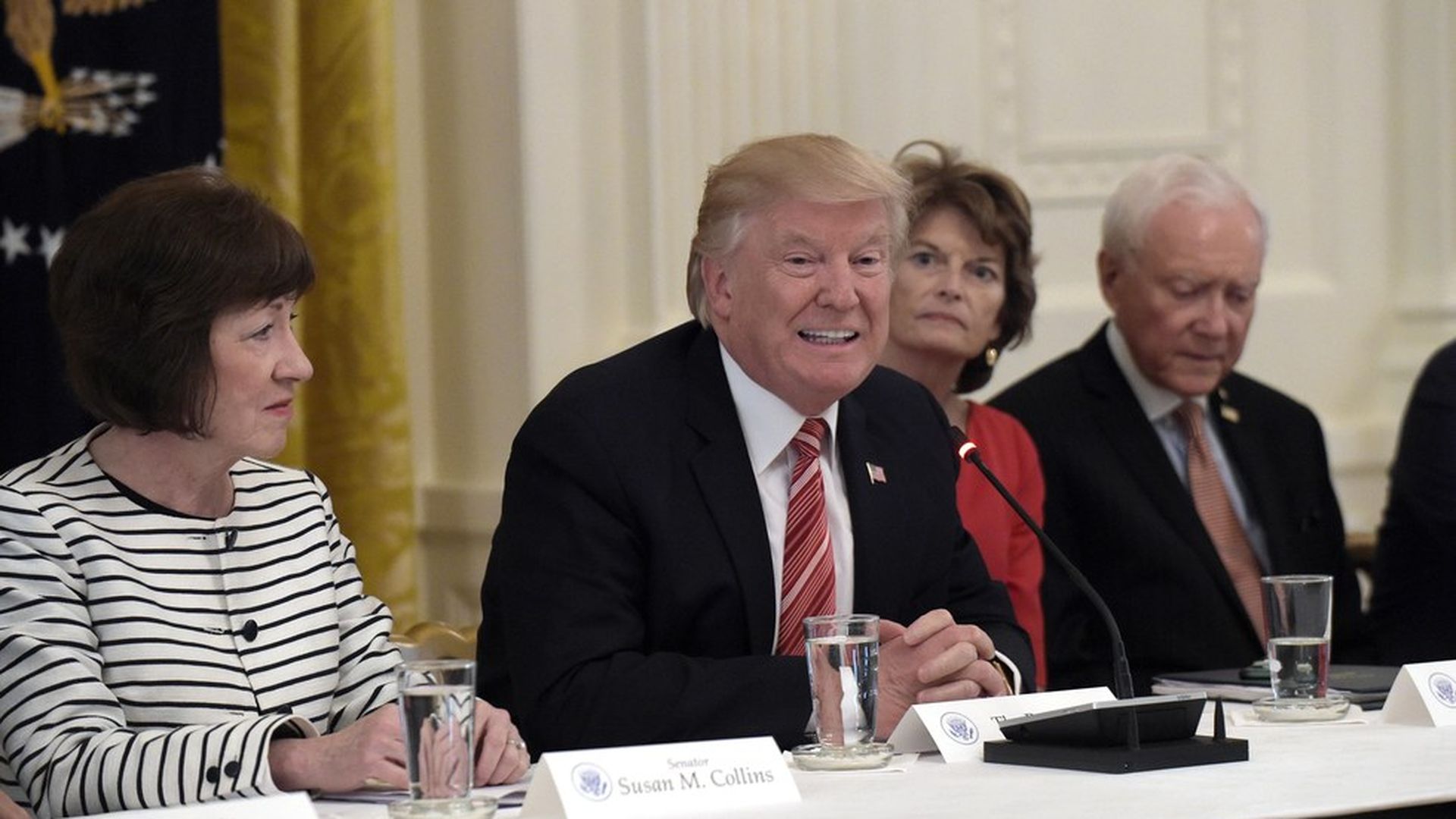
Many of the holdouts were given seats uncomfortably close to the president. Rand Paul, one of those holdouts, met privately with Trump and said the president seemed "open" to changes.
The White House released a statement Monday night that Syria's military would "pay a heavy price" if it launched a chemical weapons attack. Then BuzzFeed News and NYT reported that defense officials were caught off guard by the announcement. The WH narrative on chemical weapons and what to do about them continues to unfold, and some of the statements seem to contradict one another.
Why it matters: The apparent lack of coordination in setting the scene for another potential U.S. military strike in such a turbulent region could have dire consequences, especially since Trump showed in April his willingness to attack when it comes to chemical weapons use in Syria.
White House sources tell us to look for increasing signs that the afterglow of China President Xi Jinping's visit to Mar-a-Lago in April has long faded, and say the administration is going to be tougher on the world's second largest economy.
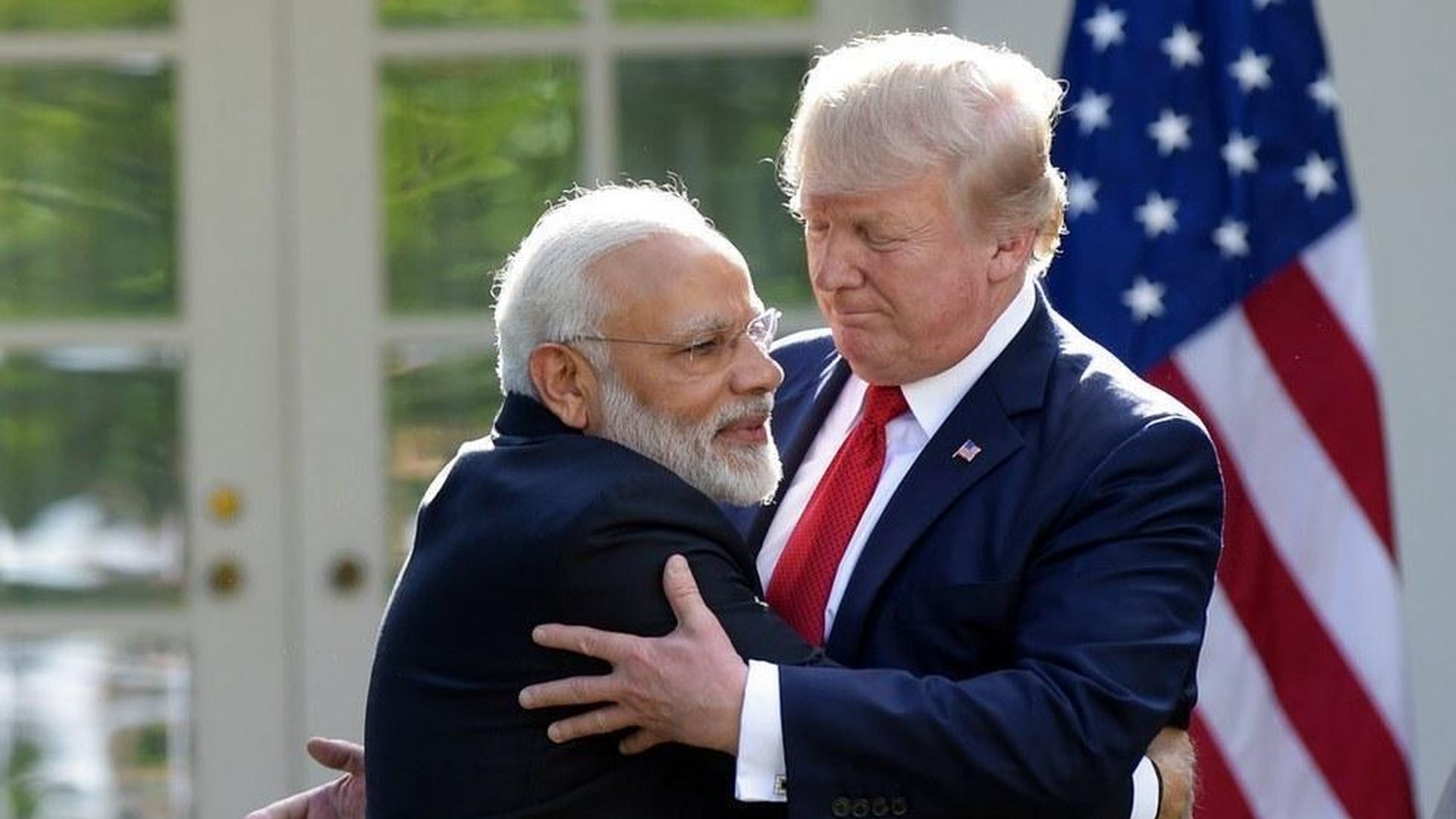
The sources say that at a time when Trump is losing patience with Beijing, he invited the leader of India — a huge China rival — to the White House. He and Prime Minister Narendra Modi, who rose on Trump-like forces, hugged in the Rose Garden yesterday.
Sound smart: Steve Bannon and his allies in key trade and policy positions have been agitating for a high-profile economic fight with China: It is central to their view of America First thinking.
$321 billion in net deficit reduction ($202 billion more than the House).
Average premiums would go down starting in 2020.
The markets would be stable through 2020, and stable after that "in most areas of the country."
The bad news:
22 million fewer people would have health coverage.
The increase in the uninsured would be "disproportionately larger among older people with lower income."
$772 billion in Medicaid cuts.
States would have to decide whether to put more money into Medicaid, cut doctors' payments, eliminate optional services, restrict eligibility, or all of the above.
Average premiums would go up before 2020.
People would pay "substantial increases" for services no longer considered essential benefits.
"Coverage for maternity care, mental health care, rehabilitative and habilitative treatment, and certain very expensive drugs could be at risk."
Annual and lifetime limits could return for those services, too.
Deductibles would be higher. (Closer to $6,000 for a benchmark plan, vs. $3,600 under the Affordable Care Act.)
Some "sparsely populated areas" would have no insurers.
Key quote: "As a result, despite being eligible for premium tax credits, few low-income people would purchase any plan, CBO and JCT estimate." - CBO score
Unless Senate Majority Leader Mitch McConnell can change some of his members' minds pretty quickly, it's looking like he might not have the 50 votes he'd need for a procedural motion that would bring his health care bill to the floor. The CBO's estimate that 22 million more people would be uninsured under the Senate bill was a steep — and maybe fatal — setback.
The proof: Sen. Susan Collins tweeted that she'll vote against the procedural motion to bring up the bill on Wednesday. Others have been making noise, too. If enough Republicans vote against it, the whole effort could end right there.