John Kerry, the top U.S. climate diplomat, wrapped up three days of climate talks with senior Chinese officials on Wednesday, calling them "productive" but noting the urgency of the work ahead for the world's two biggest carbon emitters.
Why it matters: Cooperation between the U.S. and China has proven in the past to be helpful in paving the way for successful climate negotiations. An agreement leading up to the Paris Climate Summit has been cited as an example.
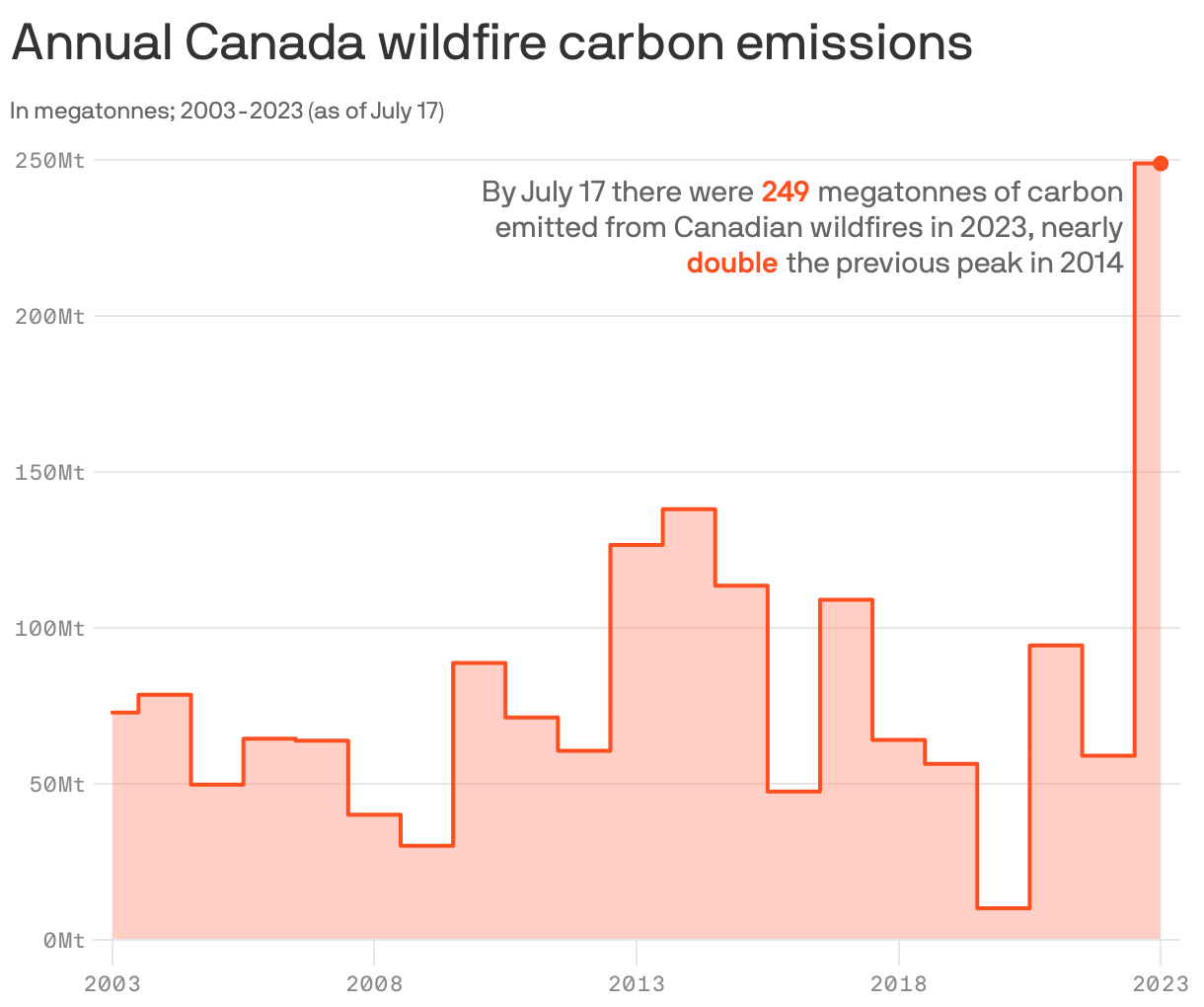
The simultaneous, record-shattering heat in the U.S., Europe and Asia may be getting all the headlines (more on these events below), but hotter and drier-than-average conditions are fueling the disaster unfolding in Canada.
Why it matters: As residents of the Midwest and East Coast have repeatedly learned this summer, Canada's devastating fires affect conditions elsewhere.
Record highs were set in the U.S., Europe and parts of Asia on Tuesday, in an example of simultaneous, compounding extreme weather and climate events — which scientists have been warning of for some time.
Why it matters: The heat waves pose an immediate risk to public health and economic output, and signal that climate change impacts are escalating faster than expected in some parts of the globe.
Vice President Kamala Harris and Israeli President Isaac Herzog will announce on Wednesday a joint climate initiative aimed at supporting "climate-smart agriculture" in the Middle East and Africa, according to White House officials.
The big picture: The initiative is also aimed at strengthening cooperation between Israel and its Arab neighbors and countries in Africa.
Phoenix's summer has officially gone from abnormally hot to record-breaking as the temperature at Sky Harbor International Airport hit 110°F for the 19th consecutive day, the longest streak ever recorded in the Valley.
U.S. Special Envoy for Global Food Security Cary Fowler told Axios he is "very concerned" about what El Niño could mean for crop production and resulting impacts on global food security.
Why it matters: A new UN report reveals that the number of food-insecure people worldwide has surged in recent years, while developing El Niño conditions are poised to exacerbate hunger in at-risk regions.
The weeks-long heat wave affecting a vast swath of the U.S. has been particularly noteworthy in one city that was not the subject of many extreme weather headlines this past week: Miami.
The big picture: The city is typically hot in June and July, but this spring and summer has been a different level of South Florida heat.
This summer's extreme weather across the United States has been a vivid reminder that no corner of the country is immune to the effects of a rapidly warming planet.
A "relentless" and historic heat wave continues to bring potentially deadly temperatures from the West and Southwest across the South Central states, with more records forecast to fall.
The big picture: Over 104 million people were under heat alerts on Tuesday morning, stretching across a dozen states from Nevada to Florida, according to heat.gov.









/2023/07/18/1689643069698.gif?w=3840)