A five-alarm fire tore through the economic establishment Friday after President Trump ousted the government's top labor statistician, accusing her — without evidence — of "rigging" a weak jobs report.
Why it matters: It's just one glaring example from a week that bore many authoritarian hallmarks — purging dissenters, rewriting history, criminalizing opposition and demanding total institutional loyalty.
President Trump said he has fired the commissioner of the Bureau of Labor Statistics after the independent government agency reported weak jobs numbers for July and the preceding month.
Why it matters: Trump is turning his ire about poor jobs numbers on the number-crunchers.
America is showing new signs of stagflation — inflation running hotter, the job market suffering new weakness, and economists warning both are at risk of getting worse in the months ahead.
Why it matters: The word "stagflation" revives miserable memories of the 1970s, when Americans faced a dreadful combination of higher prices and few job opportunities.
AI is supposed to displace millions of workers in the coming years — but when your toilet won't flush at 2am, you're not going to call ChatGPT.
Why it matters: The reshaping of the American economy promises to offer a kind of revenge for the blue-collar laborer, as white-collar workers become largely dispensable, but the need for skilled trades only grows.
Chinese hackers are targeting more sensitive U.S. targets than ever — not to smash and grab, but to bide their time.
Why it matters: Beijing is investing in stealthy, persistent access to U.S. systems — quietly building up its abilities to disrupt everything from federal agencies to water utilities in the event of escalation with Washington.
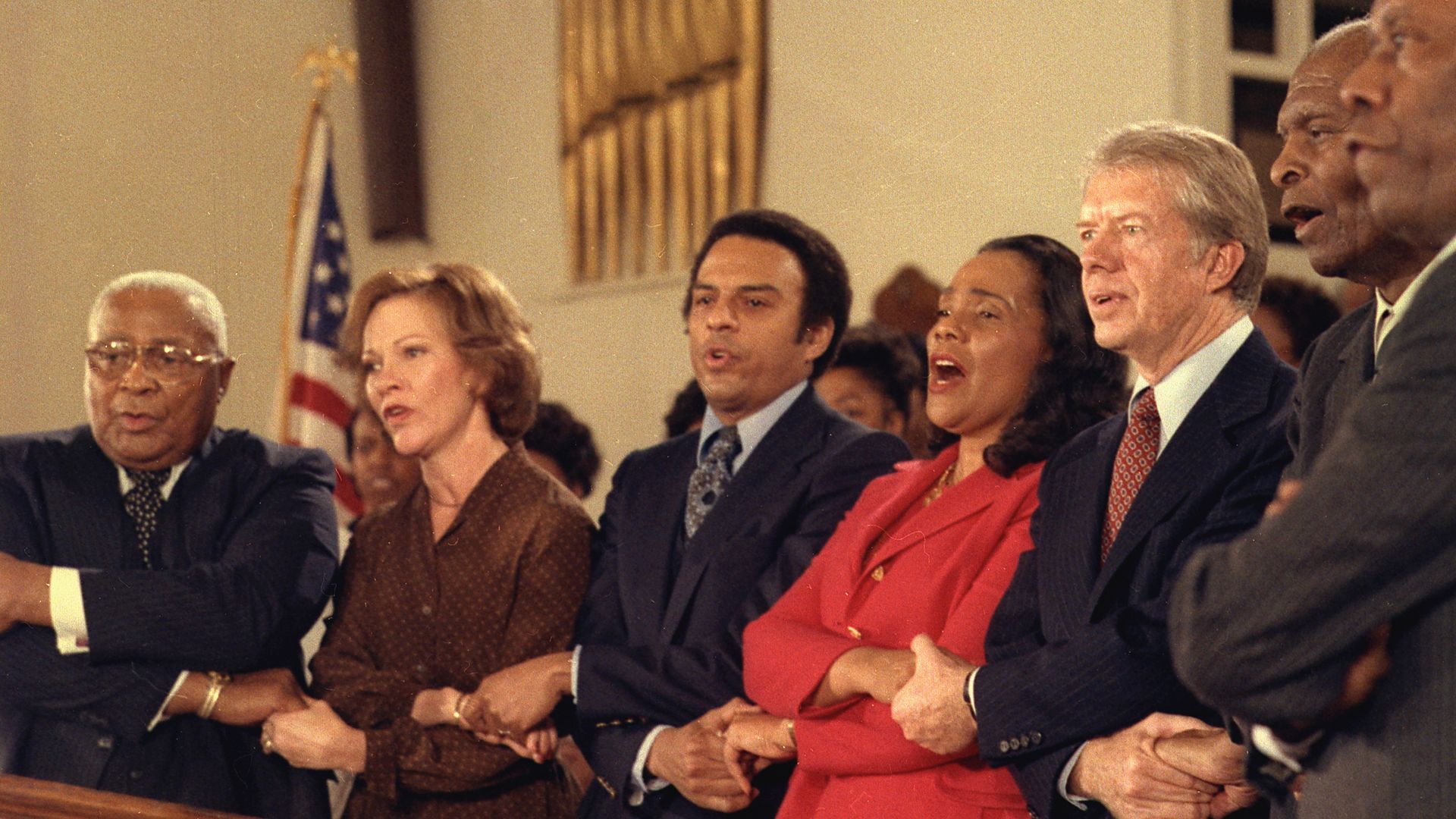
The Trump administration said Friday it will end a court-imposed decree initiated by the Carter administration that eliminated a test for federal job applicants and imposed diversity hiring requirements for federal agencies.
Why it matters: The move follows the administration'sdramatic change to the government's interpretation of civil rights-era laws to focus on "anti-white racism" rather than discrimination against people of color.
Top White House economist Stephen Miran tells Axios a key economic statistics agency needs "fresh eyes," but he stopped short of repeating President Trump's claim that Friday's jobs data was politically manipulated.
Why it matters: President Trump ordered the the firing of the Bureau of Labor Statistics commissioner on Friday after alleging — without evidence — that disappointing jobs numbers were "rigged."
Federal Reserve governor Adriana Kugler will resign her job next week, the Fed said in an announcement, giving President Trump an early opportunity to appoint a favored candidate for potential leadership of the central bank.
Why it matters: Kugler's spot was not scheduled to come open until January, and there are no other vacancies on the seven-member board.
President Trump put the Bureau of Labor Statistics commissioner in his crosshairs, saying he has directed his team on Friday to fire her following a weak jobs report.
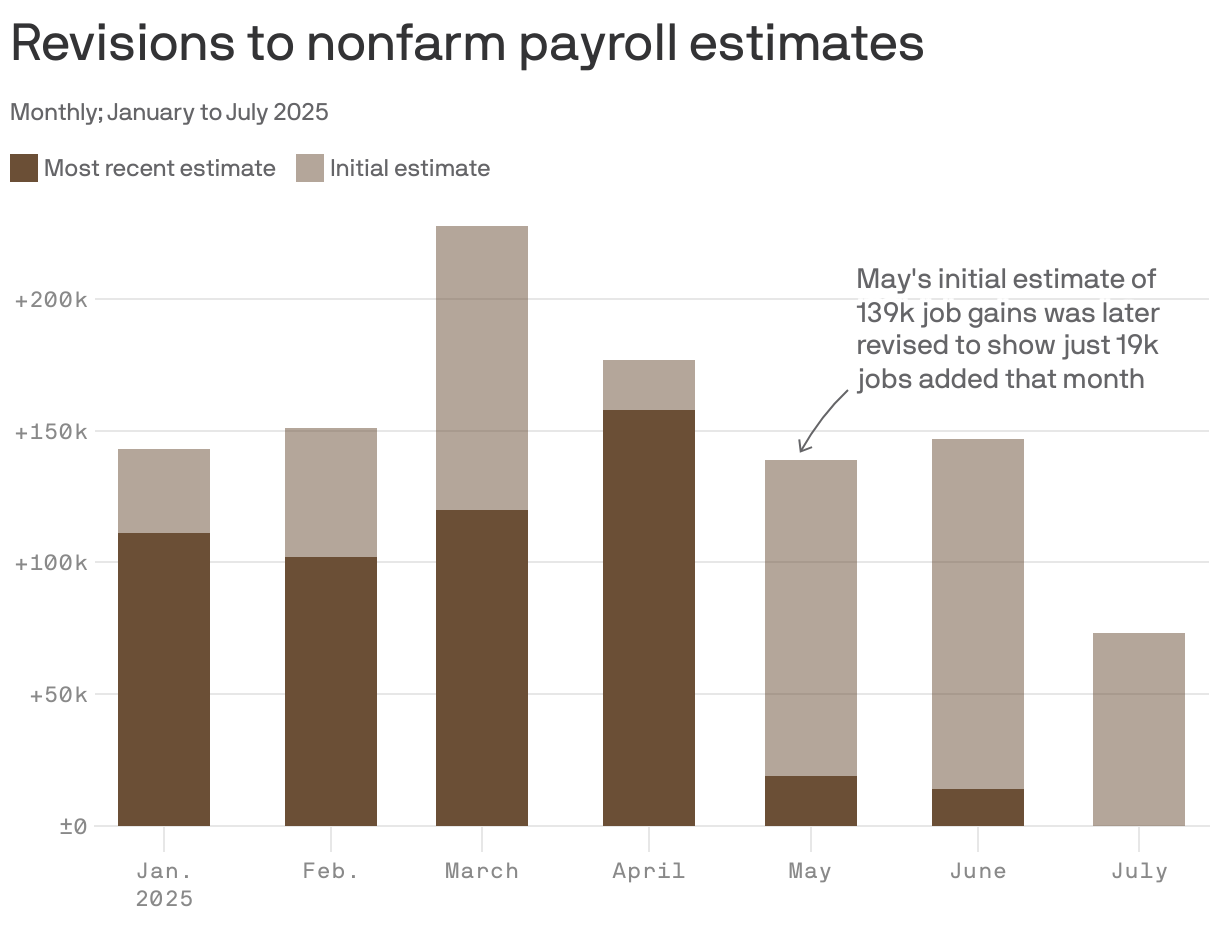
Why it matters: Trump accused the Bureau of erroneously reporting jobs data after it made a huge downward revision for May and June numbers, which is both normal and expected of the agency.
In one stroke, the BLS' stunning revisions shattered the picture of a surprisingly resilient Trump economy — and illuminated danger ahead for it.
Stocks are sinking and the VIX, a measure of volatility, is spiking, off the back of weak jobs data and new tariffs. Yet Wall Street is still bullish.
Why it matters: Strategists who spoke with Axios believe the long-term upside for the stock market outweighs any near-term weakness and suggest buying dips, especially in tech.
At the Federal Reserve policy meeting that concluded Wednesday, governors Christopher Waller and Michelle Bowman dissented from the decision to leave rates unchanged, believing that a rate cut was justified. It looks like they had a point.
The intrigue: At 8am ET Friday morning — half an hour before the jobs report — Waller and Bowman issued statements explaining their dissents.
It's clear they were worried about exactly the kind of labor market cracks that exploded into plain view with the new revisions.
Data: Bureau of Labor Statistics; Chart: Axios Visuals
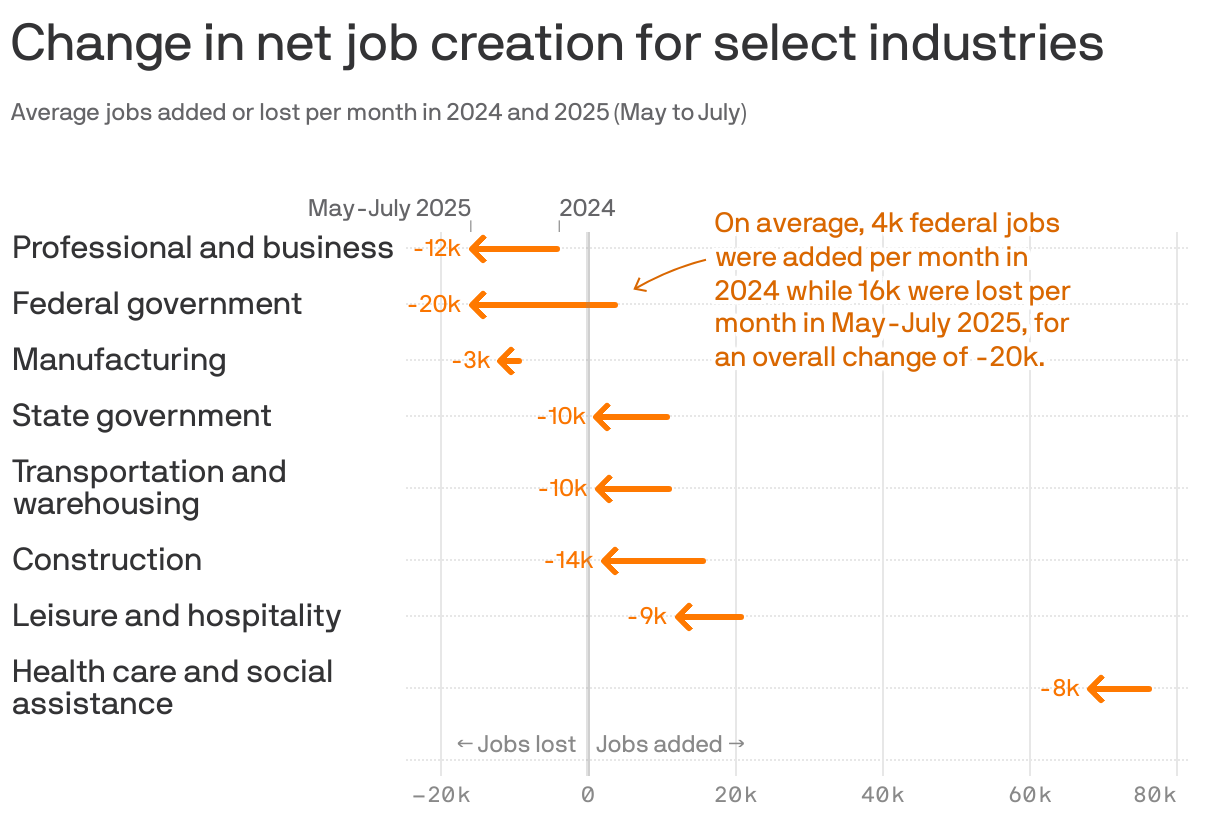
To understand what's causing weak job creation, it helps to unpack which sectors have decelerated most.
By the numbers: Last year, the economy added an average of 168,000 jobs a month. That has fallen to 35,000 over the last three months. But the slowdown is not even across sectors.
Note: The Labor Department estimates monthly jobs gains three times. The chart above shows the government's first and last estimates. Only two estimates are available for June, while one estimate has been released for July. Data: Bureau of Labor Statistics; Chart: Axios Visuals
America's remarkably resilient labor market was a mirage. Hiring came to a screeching halt in the last few months, suggesting more underlying economic weakness than it seemed.
Why it matters: It's rare that a single report drastically shifts our understanding of the economy's health, but that's what happened Friday at 8:30am ET.
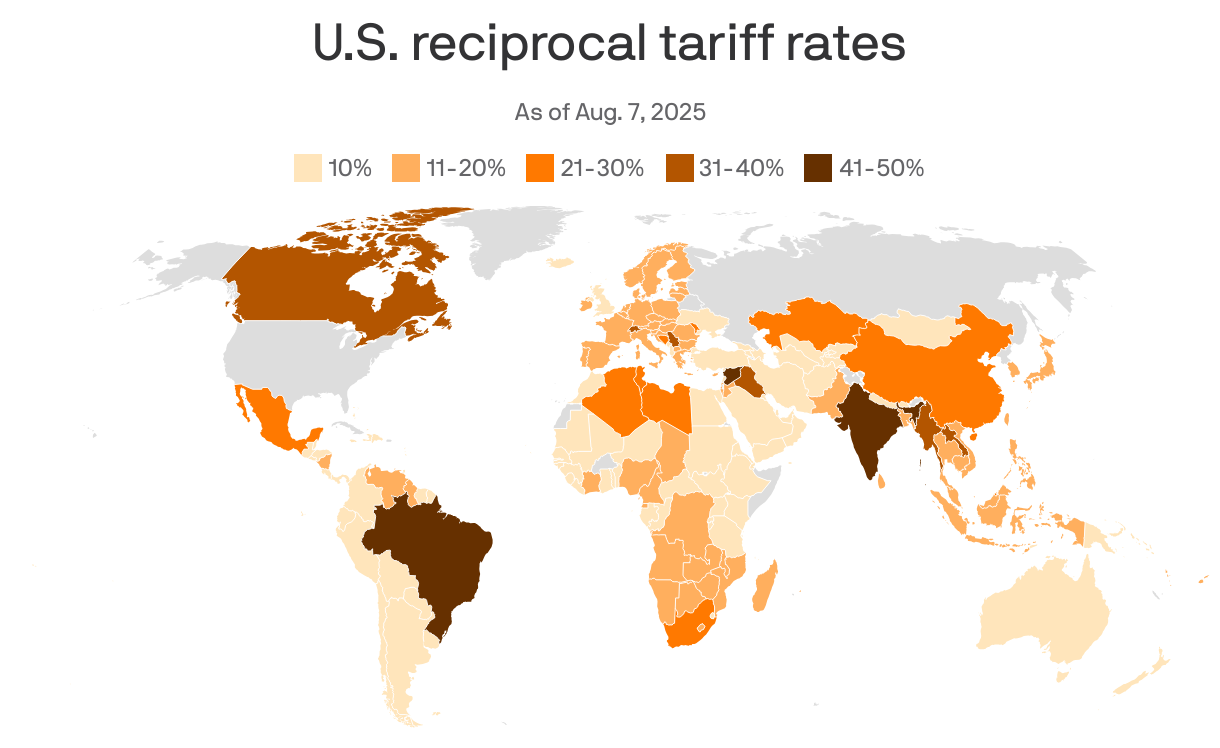
The Trump administration's dozens of reciprocal tariffs will start this month after drawn-out delays.
Why it matters: The tariffs — ranging from 10% to 50% — mark another escalation in President Trump's trade war, as the economy is showing signs of slowing.
The new tariff rates President Trump announced late Thursday are the highest in nearly a century and will cost the average family about $2,400 this year, the Yale Budget Lab said.
Why it matters: Combined with the surprisingly weak jobs report Friday morning, it's the latest sign that American households face a much more difficult economy in the months to come.
Interest starts accruing on Friday for student loan borrowers who enrolled in a Biden administration repayment plan.
Why it matters: 7.7 million borrowers enrolled in former President Biden's Saving on a Valuable Education (SAVE) Plan will start to see their student debt balances increase.
Tariff deadline day has arrived. The administration celebrated Thursday night by publishing a list of about 70 countries and their respective tariff rates, which are set take effect next Thursday.
Why it matters: As stocks continue hitting record highs, beneath the surface, tariff policy is reshaping market winners and losers. Investors looking to beat the index are racing to determine where the pain and opportunity will hit.
If you want a job safe from AI, consider becoming a trader. Robinhood's CEO tells Axios human traders will not be replaced by AI in the foreseeable future.
"Leguizamo Does America" director Ben DeJesus tells Axios the show proves that telling Latinos' stories doesn't just make audiences "feel good" — it's "good business."
Why it matters: The first season of "Leguizamo Does America" was the most viewed MSNBC original in over two years on Peacock.
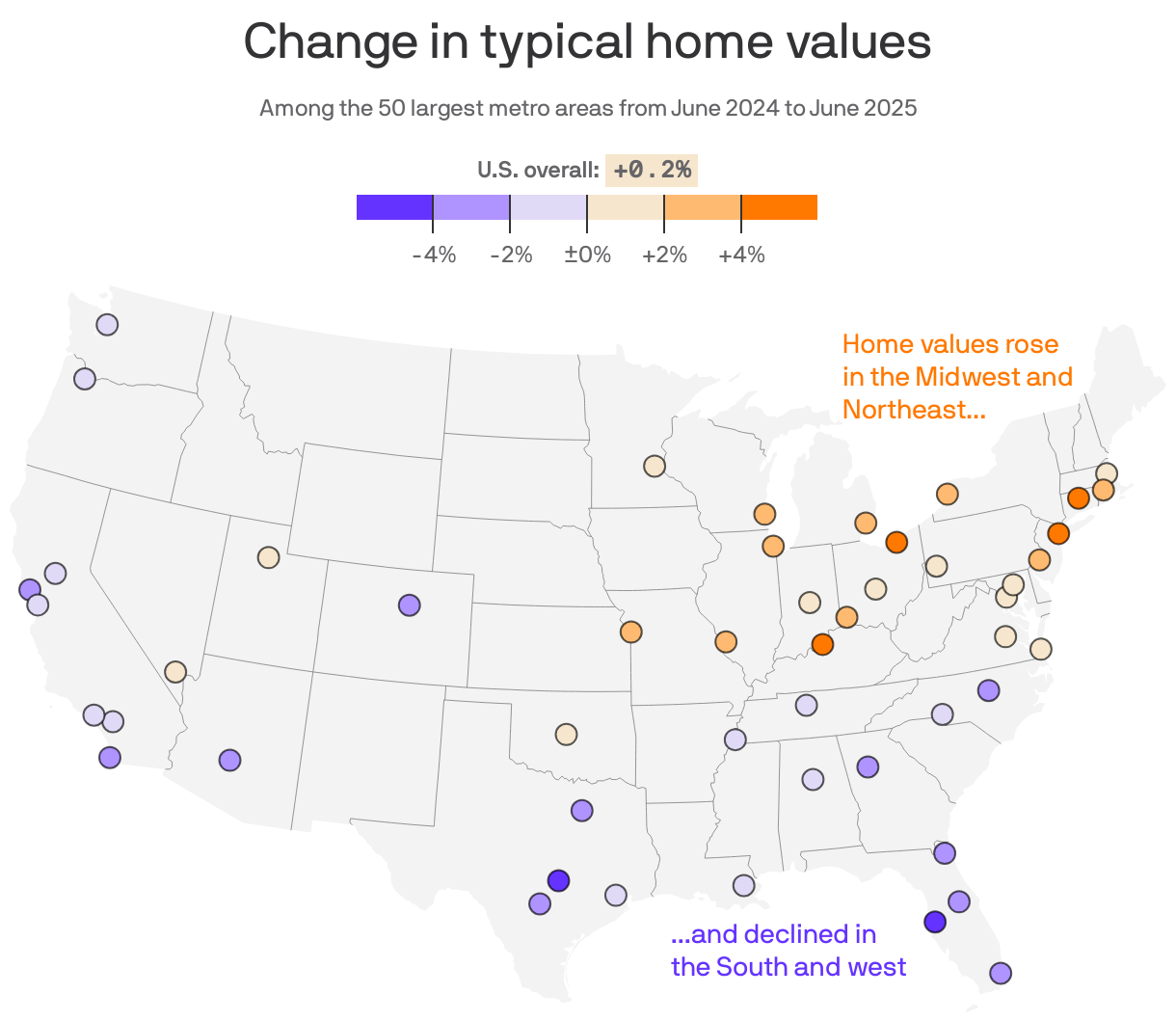
Data: Zillow; Note: Typical home value refers to the average of the middle third of Zillow home value estimates for every home in a given region; Map: Erin Davis/Axios Visuals
Real estate prices are all about "location, location, location," and right now that's particularly true — in half the country home prices are still going up, and in the other half they're falling.
Why it matters: The price data shows that the housing story is more complicated than affordability and still-high mortgage rates, which have cratered demand nationwide. Zoning laws, climate risks and economic vibes also play a big role.
President Trump's first term provoked the movement for a Green New Deal. His second term may have killed it.
Why it matters: Democrats aren't explicitly disavowing the Green New Deal, but they've abruptly stopped talking about it as they scramble to find new ways to talk about climate change.
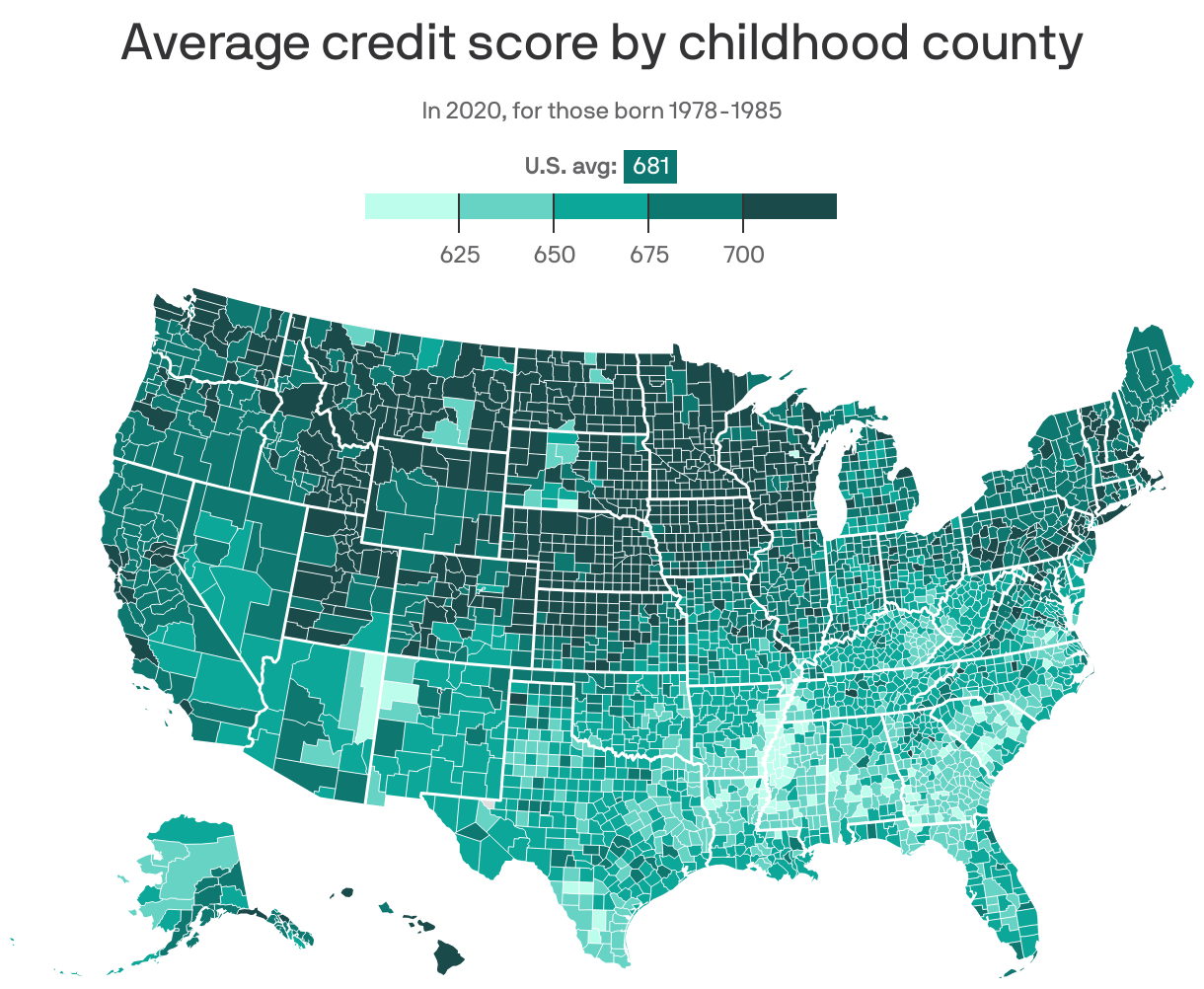
Data: Opportunity Atlas; Map: Alex Fitzpatrick/Axios
People who grew up in parts of the Upper Midwest and the Northeast tend to have relatively high credit scores in early middle-age, newly released data shows, while those from the South tend to have lower scores.
Why it matters: Credit scores can determine people's access to loans, housing, better interest rates and more — despite their flaws and biases.
April's "Liberation Day" was about President Trump trying to impose a new global trade system. Thursday's tariff orders were effectively a reset to create a somewhat more practical regime.
Why it matters: Trump scrapped most of the highest levies, and the erroneous formula behind them. In the process, he settled on a framework that most major partners seem willing to grudgingly accept.
President Trump on Thursday confirmed imports from most countries will face a tariff rate of 10%, while raising levies on Canada to 35% and lowering rates on many other countries.
Why it matters: The baseline rate is unchanged from the global duties Trump first set in April, and will come as a relief given his recent hints it could double.
President Trump's tariffs order for countries yet to strike a trade deal with the U.S. went into effect just after midnight on Friday, though most levies aren't due to start until Aug. 7.
Why it matters: While countries like Mexico struck trade deal extensions ahead of Trump's deadline, others face steep tariffs. The president increased Some Canadian goods imported to the U.S. on Thursday to 35%, effective 12:01am Friday ET.