Here's the average credit score for people who grew up in your area

Add Axios as your preferred source to
see more of our stories on Google.
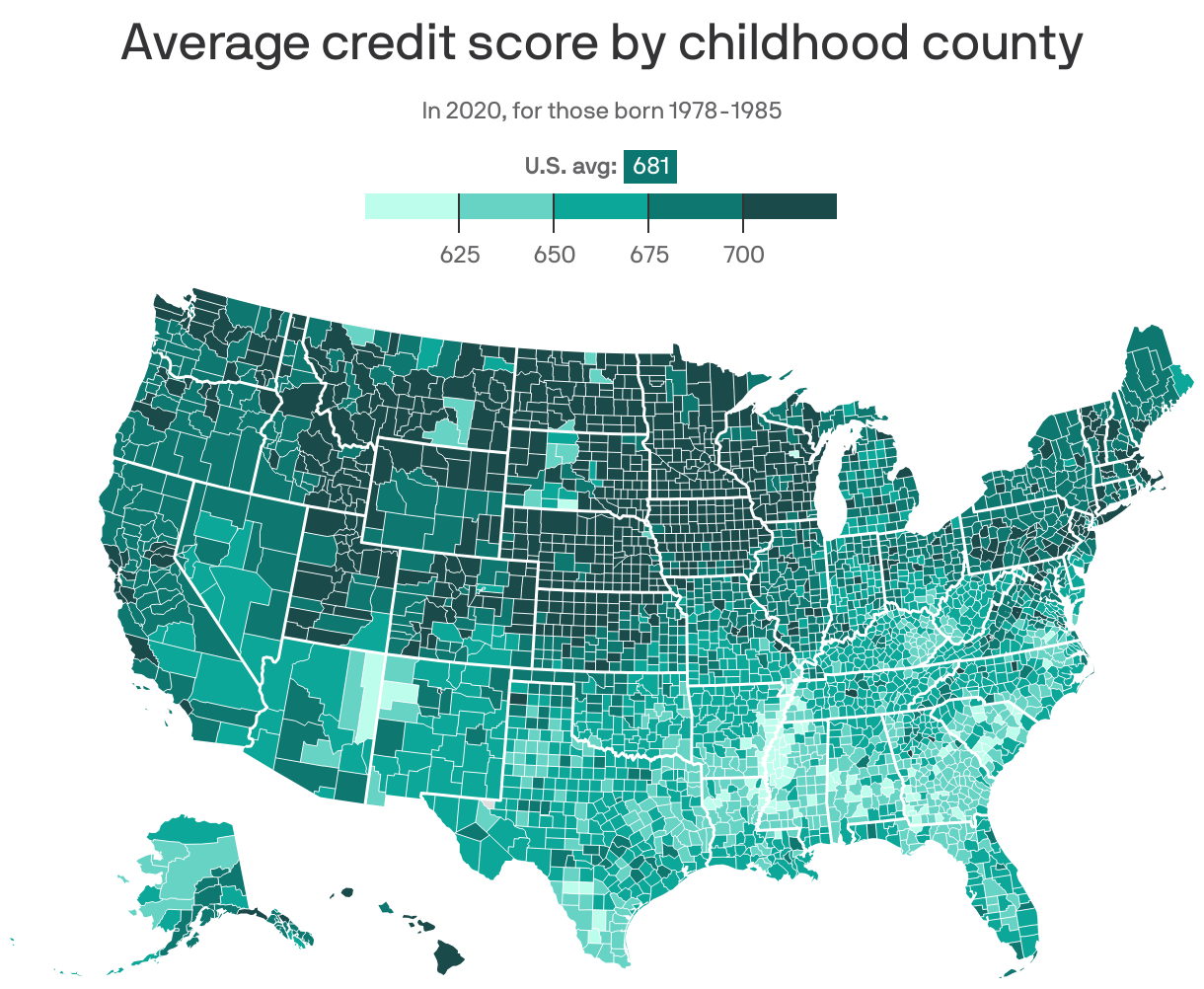
People who grew up in parts of the Upper Midwest and the Northeast tend to have relatively high credit scores in early middle-age, newly released data shows, while those from the South tend to have lower scores.
Why it matters: Credit scores can determine people's access to loans, housing, better interest rates and more — despite their flaws and biases.
Driving the news: The data for the above map comes from The Opportunity Atlas — a joint project from the U.S. Census Bureau and Opportunity Insights at Harvard University — and is based on anonymized info from a major credit bureau.
- The map shows average credit scores in 2020 by childhood county for people born 1978-1985, making them roughly 35-42 at the time of measurement.
- The result: a snapshot of people's credit scores based on where they grew up, not necessarily where they lived when the snapshot was taken.
Zoom in: People in the target age range who grew up in Slope County, North Dakota (757); Emmons County, North Dakota (754) and Sioux County, Iowa (752) had the highest average credit scores as of 2020.
- Those from East Carroll Parish, Louisiana (593); Allendale County, South Carolina (596) and Claiborne County, Mississippi (597) had the lowest.
Between the lines: A related Opportunity Insights study published in July found "significant differences in credit outcomes by race, class, and geography."
- "In particular, Black Americans, individuals from low-income families, and those who grew up in Appalachia or parts of the South are more likely to have lower credit scores and more limited access to credit."
- "These gaps emerge early, persist into adulthood, and remain stable through age 65."
The bottom line: Measurements based on your childhood neighborhood can reveal how the geographic roll of the dice may impact the course of your life, even if you're no longer there.
