Today's EV price might not be tomorrow's EV price — and that's not something car buyers have experienced very often.
The big picture: Price volatility is the new normal — at least when it comes to electric vehicles — as automakers face intensifying competition while responding to commodity costs and other economic factors.
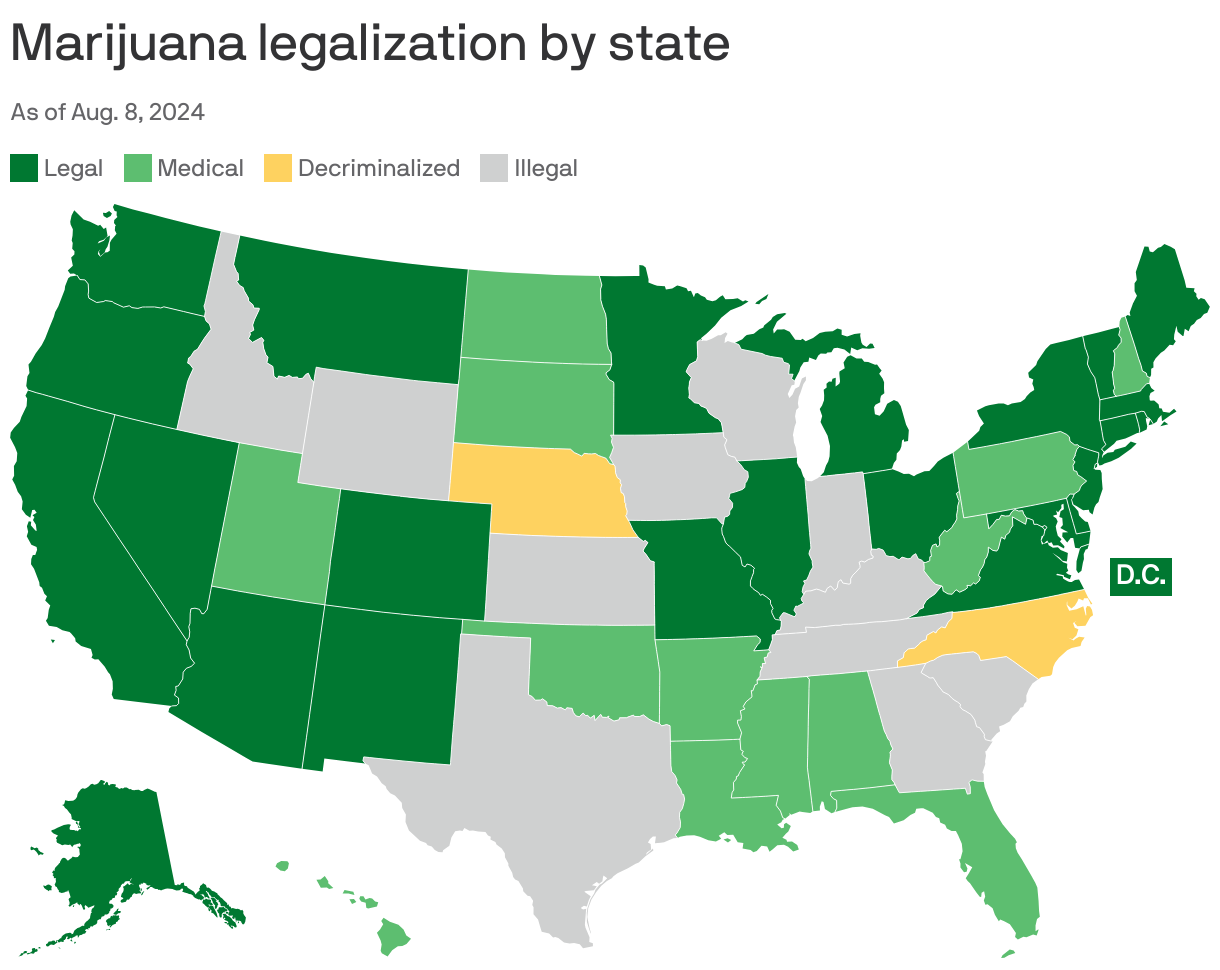
Note: Some states categorized as illegal permit CBD for medical use. Data: DISA; Chart: Axios Visuals
Cannabis aficionados in 20-plus states and Washington, D.C., will be able to buy marijuana legally for Thursday's high-flying informal holiday known as 4/20. Medicinal use is legal in 38 states.
Why it matters: The legalized marijuana market is worth $64 billion, nearly tripling over the last three years as legalization efforts swept the nation, a Coresight Research report found.
U.S. Treasury Secretary Janet Yellen delivered a loud-and-clear message Thursday morning about the relationship between the United States and China: Tensions between the two superpowers are real and not going away, but this shouldn't stand in the way of a constructive economic relationship.
Why it matters: After a few months (and years) of frosty relations between the world's two largest economies, the Biden administration is trying to feel out the possibility of finding areas of limited, pragmatic collaboration.
One big question of the moment is how recent bank failures will impact lending conditions across the country. As anecdotal evidence trickles in, we are getting early answers.
Why it matters: It's difficult to quantify how much credit conditions are tightening (or loosening, for that matter). In that context, the Beige Book — a collection of anecdotes compiled by regional Fed banks, released two weeks before each policy meeting — takes on more importance.
BuzzFeed is shutting down its BuzzFeed News division as part of wider effort to turn the struggling media group around and to squeeze profits from a company that's lost 90% of its value since it listed in 2021.
Why it matters: The move underscores the broader pressure facing the digital media industry and puts a spotlight on a company that failed to move quickly to address ways to boost revenues and manage expenses.
WeWork shares closed below 50 cents on Wednesday, pushing the coworking space operator's market cap down to just $334 million.
The big picture: On Tuesday, WeWork disclosed that it received a noncompliance notice from the New York Stock Exchange because of its flailing stock price.
Home prices continued their downward tumble in March. Median sale prices were 3.3% lower than a year ago — the biggest annual drop since 2012, per Redfin.
What's happening: It's the second month in a row of negative year-over-year prices.
Why it matters: The decline in prices shows that with a bit of luck, and a global scramble for supplies from sources like the U.S. and the United Arab Emirates, Europe has found a way to live without Russian gas.
Companies don't want to talk about their environmental, social and governance goals anymore, experts in ESG and communications tell Axios.
Why it matters: Promoting ESG policies was once an easy layup to score good press — and theoretically move toward bettering society — but now it's a way to court controversy, the ire of politicians, and attention from well-funded anti-ESG groups.
Austin-based DivInc, a startup accelerator that supports young companies founded by women and people of color, announced Thursday that it will focus its next program on blockchain technology.
Why it matters: Cryptocurrency enthusiasts and their venture-capitalist backers — all mostly men — have raised tens of billions of dollars to create web3, the third generation of the internet being built on a foundation of cryptocurrency and blockchain tech. Critics worry about who it's leaving behind.