After nearly 2,500 reports of unruly passengers on flights last year, Congress is considering a new no-fly list.
Driving the news: Senate and House members proposed legislation Wednesday that would allow the Transportation Security Administration to ban people convicted or fined for assaulting or interfering with airline crews.
YouTube is "not really a social media platform," but rather a place to connect with creators, company head Neal Mohan told Axios' Sara Fischer at the What's Next Summit.
Driving the news: "It’s a place where you come to consume all things video … that’s the core use case of what our platform is … as opposed to try and connect with your friends and sharing content with your friends," he said.
Higher interest rates and a loss of confidence in the banking sector have hit commercial real estate especially hard, with both the housing and office sectors poised to feel the chill.
Why it matters: The jury’s still out on how much further the Federal Reserve’s tightening campaign has to go, but the crisis cascading across the banking sector is already constricting lending.
Musical sensation Timbaland’s latest innovation could cause you to rethink what’s real.
What's happening: The rapper-producer said Wednesday at Axios’ What’s Next Summit that he’s considering incorporating fictitious AI influencer Lil Miquela into his next musical endeavor.
Throughout the Trump and Biden years, a common thread in U.S. economic policy has been a focus on bolstering domestic industry, even when it means burning bridges with trading partners and backing away from the era of globalization.
Why it matters: The question of how the United States ought to engage in the global economy is up for grabs right now in a way it hasn't been in a generation, with the Biden administration focusing on domestic investment and disentangling the U.S. economy from China.
The housing sector story of 2022 was one of activity coming to a standstill. The story of this year — at least so far — seems to be one of a rebound.
By the numbers:Pending home sales, where the buyer's offer has been accepted for previously owned homes, ticked up by 0.8% in February, the third consecutive monthly gain. Sales increased in all regions, except the West.
A top U.S. financial regulator continues to hammer into the crypto industry.
Why it matters: The top-line complaint leveled by the Securities and Exchange Commission against Beaxy alleges the platform failed to register as a national securities exchange, and also takes issue with how it operated.
Macy's CEO and Chair Jeff Gennette, whose plan to downsize the company led it to more stable ground, will depart the retail giant next year.
Why it matters: The retailer remains in fierce competition with Amazon, as well as with other nimble digital and physical retailers. In recent years, Macy's pushed aggressively into online retail and smaller stores, despite its outsized brick-and-mortar footprint.
Driving the news: Gennette will retire in February 2024, after four decades at Macy's, where he's been CEO for more than six years.
Tony Spring, executive vice president of Macy's and CEO of the company's Bloomingdale's brand, will succeed Gennette as CEO.
CFO Adrian Mitchell will add the title of chief operating officer.
Macy's stock fell 2.6% in early morning trading.
The big picture: Gennette led the retailer during a crisis for the department store industry.
J.C. Penney, Sears and Neiman Marcus were among the chains to file for bankruptcy protection during his tenure at Macy's.
Gennette launched a transformation called Polaris, designed to close about 125 underperforming locations, or about one-fifth of its locations, within three years beginning in early 2020.
What they're saying: "Thanks to Mr. Gennette, Macy’s isn’t dead or even circling the drain," GlobalData retail analyst Neil Saunders wrote Wednesday. "However, it is still on a perilous glide path with weak long-term prospects. It is the job of the new CEO to change this trajectory and not to simply stick to the current course."
United Airlines is investing $15 million in a carbon capture startup developing technology that may eventually be used to capture and compress CO2 for use in producing sustainable aviation fuel (SAF), the company announced Wednesday.
The startup, Svante, plans to use the funds to manufacture carbon capture filters in Vancouver, Canada, at commercial scale.
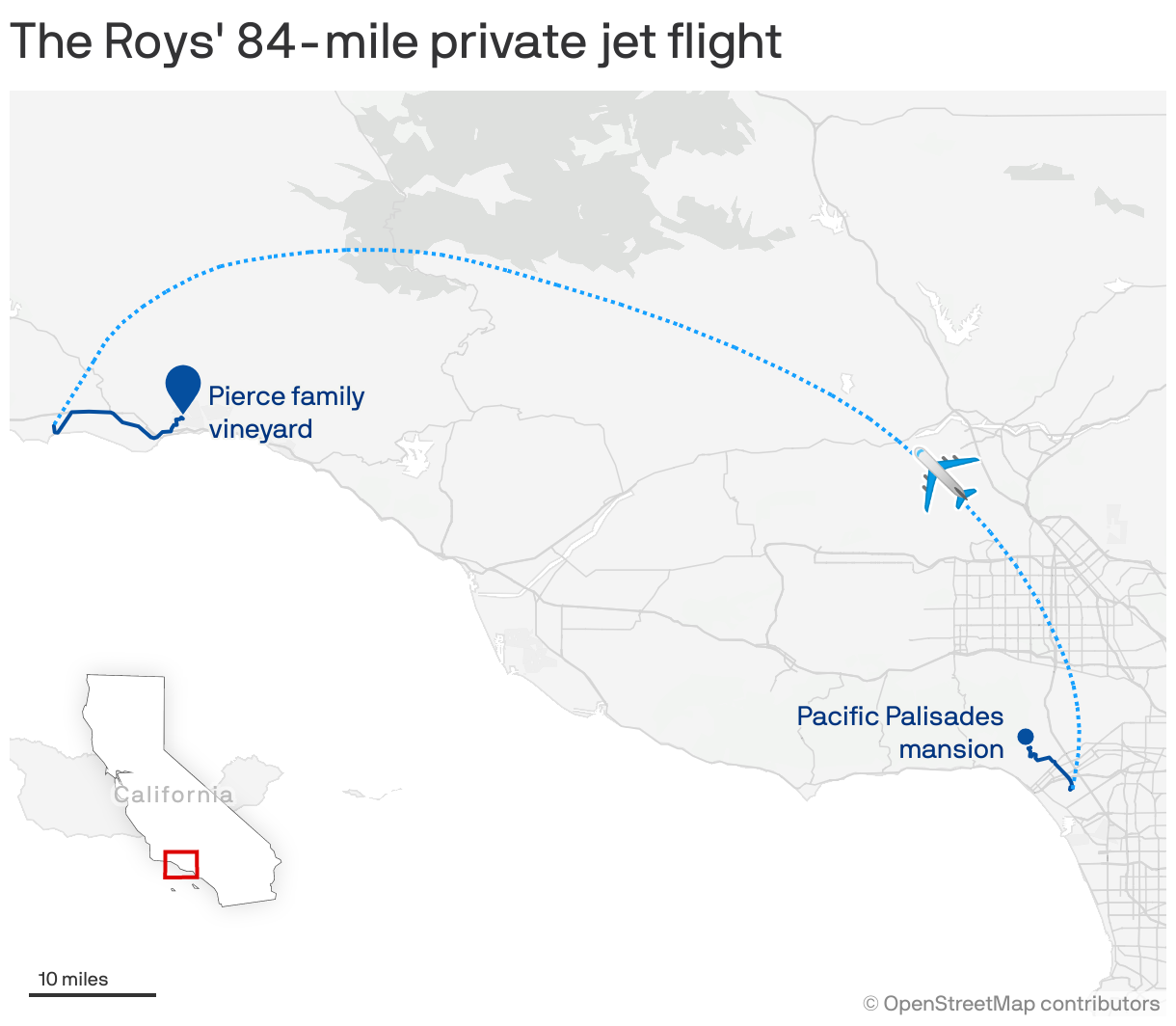
California is famous for its celebrities, its traffic — and the way that the former use private jets to circumvent the latter.
Why it matters: The fictional Roy children, the adult offspring of media baron Logan Roy on the HBO series "Succession," are no exception. In the first episode of the current season, theytake a private jet to fly from Santa Monica to Santa Barbara — a distance of just 84 miles.
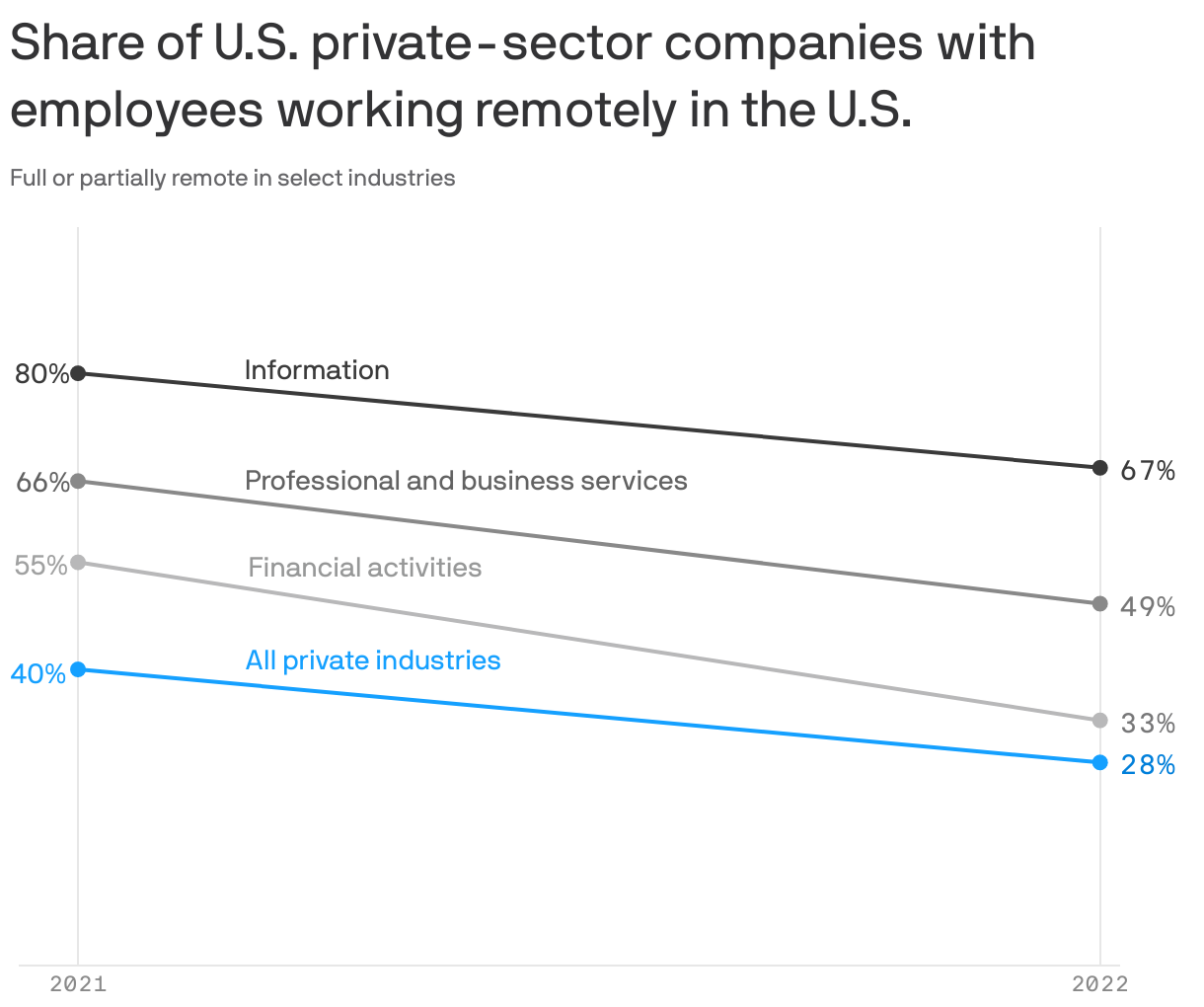
Millions fewer Americans worked remotely last year, according to a new survey from the Bureau of Labor Statistics.
Why it matters: The data show the work world returning to a new normal, where there is some working from home — more than in the pre-COVID era — but less than at the height of the Zoom and sweatpants moment.
Office vacancies — plus the still simmering banking crisis — have us considering what a potential bust in the $6 trillion U.S. office property market might mean.
Why it matters: A deep downturn in property values is more than a problem for oligarchs, feuding billionaire clans and oil-rich foreign wealth funds.
Administrative barriers are holding up social safety net funds like SNAP and WIC from reaching Americans in need as expiring benefits threaten to send them over a nationwide "hunger cliff."
The big picture: Burdensome applications and fragmented eligibility systems are adding to the mounting financial pressures of vanishing pandemic-era benefits low-income Americans are now facing.
The first commercially available human-shaped robots designed for warehouse work were unveiled last week by a company called Agility Robotics, for delivery in 2025.
Details: Digit, which is built to work alongside humans, can lift and move plastic bins in a warehouse or distribution center.


















/2023/03/28/1680029500465.gif?w=3840)