The Biden administration is taking steps to combat racism in home appraisals — an issue viewed as a significant factor in the wealth gap between white people and Americans of color.
Why it matters: Homeownership is essential to wealth accumulation for many Americans, but disparities in home appraisals often mean that people of color are starting at a disadvantage. Below market home appraisals can hinder access to home loans, limit refinancing options and depress selling prices.
Google on Wednesday said it inked a multi-year deal with Spotify that allows Spotify users to pay for their subscriptions using an alternate billing system that isn't Google's, so long as users still have the option to use Google's system.
Why it matters: The Spotify deal is the first partnership in a bigger Google pilot program with other developers. The pilot program marks an important milestone for app developers that have long argued app store fees are too high, and as a result, anti-competitive.
Politico has tapped Dafna Linzer as the new executive editor, replacing former top editor Carrie Budoff Brown, who left for a senior role at NBC News in January, editor-in-chief Matthew Kaminski announced Wednesday.
Why it matters: Linzer, formerly the managing editor of politics for NBC News & MSNBC, will report to Kaminski.
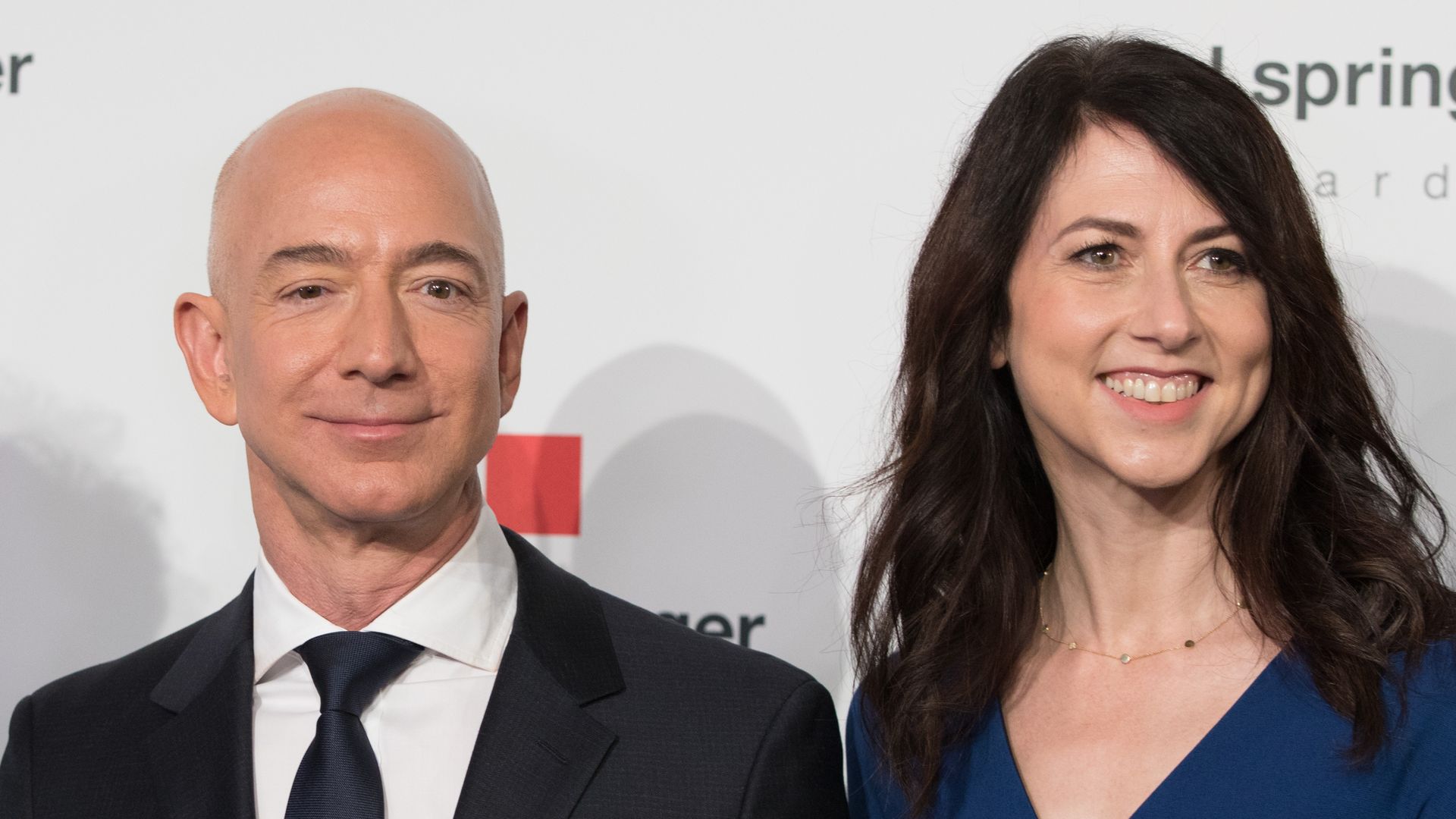
Philanthropist MacKenzie Scott announced in a Medium post Wednesday that she has donated nearly $3.9 billion to 465 different organizations over the last nine months.
Why it matters: The announcement continues Scott's ability to upend philanthropic norms by giving away billions of dollars to organizations, as she also did in both 2020 and 2021.
U.K.-based satellite broadband provider OneWeb announced this week it will partner with SpaceX, one of its competitors, to continue placing its satellites in orbit after the company's launch partnership with Russia collapsed.
Why it matters: The new partnership shows how SpaceX continues to undermine the Russian space agency's grip on rocket launches. It also highlights how Russia is becomingincreasingly isolated from its Western space partners because of its invasion of Ukraine.
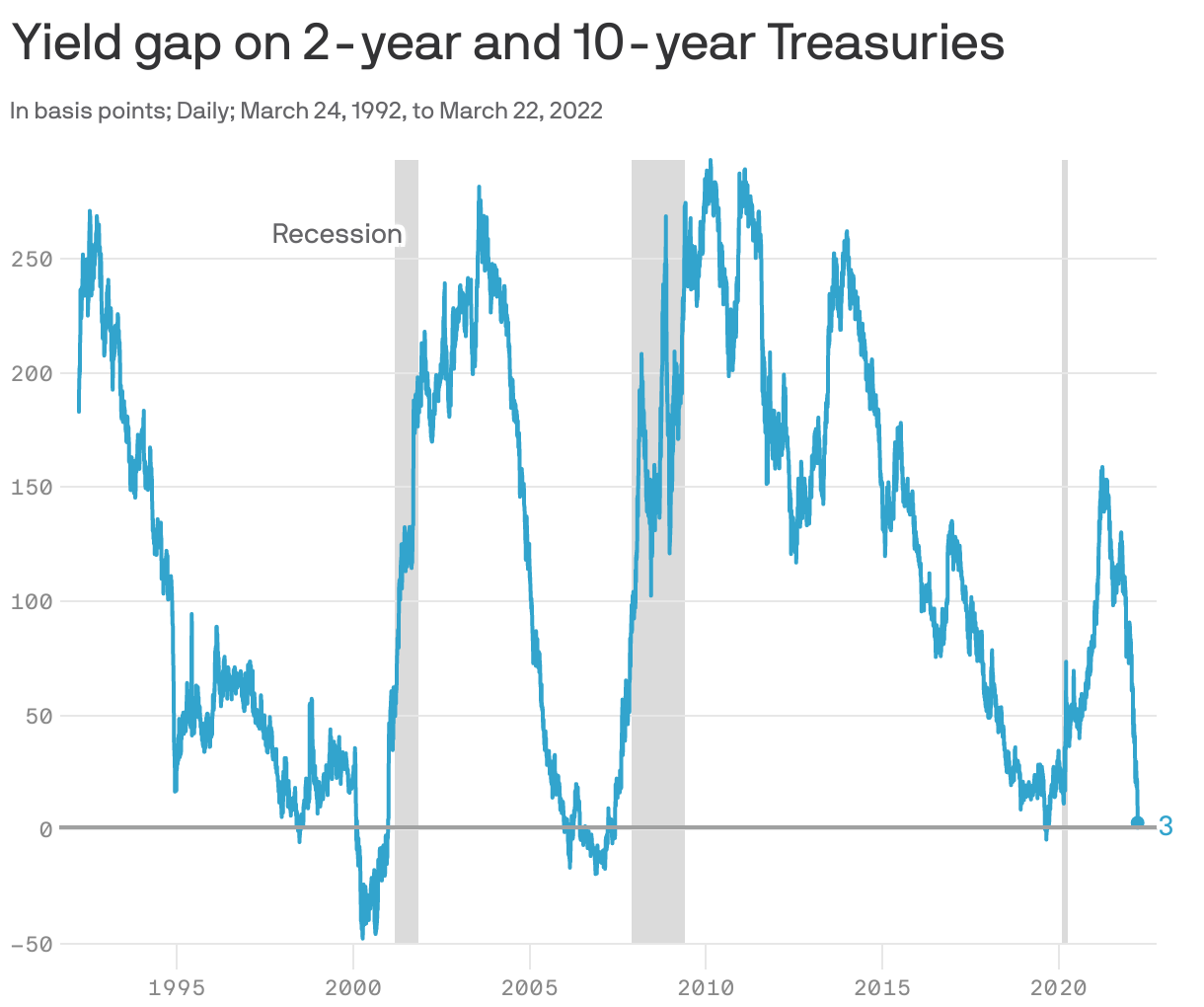
One of the best-known recession indicators is flashing warning signs on the economy. Yields on longer-term U.S. government bonds are in danger of slipping below yields on short-term bonds, a relatively rare occurrence known as an "inversion."
Why it matters: Inverted yield curves can reflect a rising risk of economic recession. Analysts and investors closely watch for this early warning sign.
Russia appears to be making good on the interest payments it owes on tens of billions in dollar-denominated bonds — it paid some last week, and initiated another one that was due on Monday.
The big question is why Russia's paying. The main consequence of default — that you can’t borrow in the market anymore — is basically moot since sanctions have all but removed Russia from international financial markets already.
Despite pleading from politicians and bosses, offices around the country are still pretty empty, according to data released this week by security firm Kastle.
Driving the news: Kastle measures occupancy by looking at foot traffic into offices, pulling data from security swipe cards and keyfobs.
We heard from more than 100 What's Next readers in response to our question: What do you think of the proposal — which passed the Senate this month — to make daylight saving time permanent, starting in 2023?
Your responses fell into four categories, and one was the clear winner:
By far, the largest number of people who responded said they'd like to stop changing the clocks back and forth — but they'd prefer to keep them permanently set on standard time, not daylight saving time.
The second-largest number of responses came from people who said, "No to permanent daylight saving time."
Nearly the same number of respondents — though just slightly fewer — said they'd vote "yes" to permanent daylight saving time.
A fourth category of reader said, in essence: "Pick one or the other and stick with it."
A handful of readers suggested splitting the difference and changing the clocks back and forth half an hour once or twice a year.
What you're saying:
"Standard time should be permanent. Let’s fall back now and stay there." — Mike Head
"Let’s make daylight savings permanent and get rid of this annoying and anachronistic clock change twice a year!" — Alex Kemp
"Permanent daylight savings time was tried during the Nixon administration. It sounded like a great idea, but in the end, was a miserable flop. The simple reason was that parents voiced concerns about their children standing more and more in the dark waiting for the school bus." — Jon F. Gasper
"I live in Texas. The sun doesn't come up until 8 a.m. now. Kids are going to school in the dark now. Permanent DST would be particularly horrible in the winter months for us. I understand the East coast has the opposite problem." — Myrna Grigsby
"Current surveys are missing the point. The vast majority of people want to stop changing our clocks twice a year. Some may prefer Daylight Savings Time and some may prefer Standard Time depending on whether they prefer more sun in the morning or evening. But the majority agrees that we should stop changing our clocks." — Jonathan Coon
"If you think about it, there are only two days a year people bitch about it and they get over it within a week or so. If a switch is made to permanent DST, people will be complaining about it for two months and still have nothing to look forward to in the spring." — Chuck Goonan
"I would prefer that we were on Standard time all year long. However, if Congress goes with permanent daylight savings, that is better than changing twice each year." — David Lias
"NO! NO! NO! NO! NO! NO! NO! Don’t mess with Mother Nature and the natural order! How presumptuous of us. We should adapt to the rhythms of nature and physics, not the reverse." — Dave Stoller
"As a kid, I loved Daylight Savings because it meant spring was around the corner, and another sign that my beloved Phillies would be in first place (until they actually started playing real games). As an adult I grew weary of it. My first choice would be to stick with Standard Time." — Mark Israel
The U.S. battery cell developer Kore Power has acquired Vermont-based storage developer Northern Reliability.
Why it matters: The U.S. is among the world's top battery producers, with 59 GWh of commissioned production capacity in 2020 vs. China's 568 GWh, according to the U.S. Department of Energy.
National Weather Service meteorologists can now predict minute-by-minute weather conditions for individual arrival and departure routes at the nation's 30 busiest airports — which should translate to fewer delays for travelers.
Why it matters: Better weather data synced with actual flight routes will help air traffic controllers as they direct planes to dodge potentially dangerous storms.
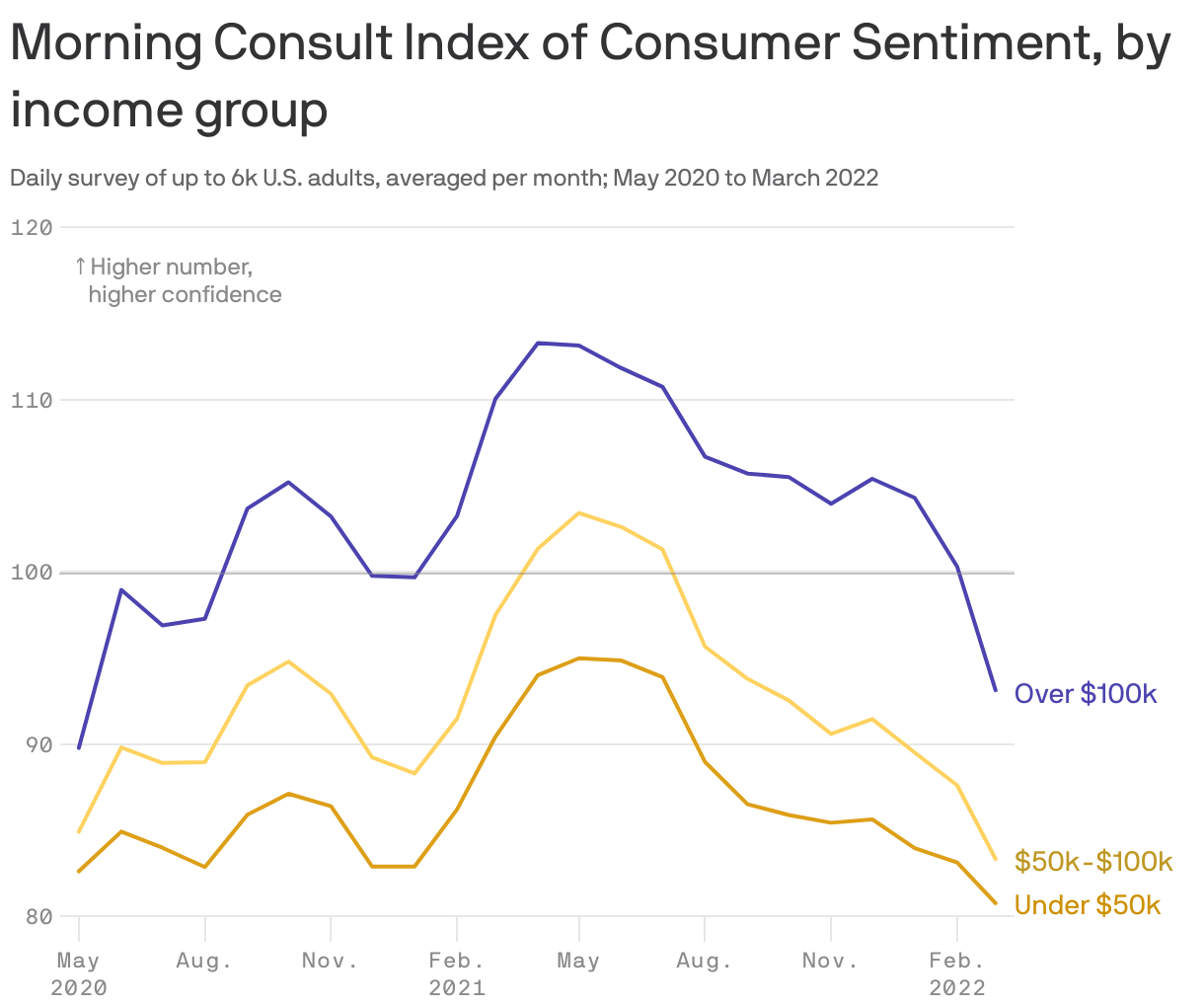
Even though they're still flush with cash from the booming market, wealthier people are increasingly worried about the economy, especially inflation.
What's happening: In March, consumer confidence dropped 7.2% for those earning more than $100,000 — a much larger dip than for those earning less than $50,000, according to a measure of consumer sentiment released today as part of the Morning Consult/Axios Inequality Index.
Russian President Vladimir Putin plans to attend this year's G20 summit in Bali, Indonesia, Russia's ambassador in Jakarta said Wednesday, per Reuters.
Driving the news: White House National security adviser Jake Sullivan told reporters on Tuesday that the U.S. would consult with allies about whether Russia should remain a member of the Group of 20 major economies after the invasion of Ukraine.
Minority-owned small and medium sized businesses were more likely to close than the U.S. average, according to Meta's latest Global State of Small Business Report.
Why it matters: The new research, released on Wednesday, adds to the evidence that the pandemic has disproportionately harmed minorities.
Starbucks baristas at a store in Seattle voted unanimously on Tuesday to unionize, per the National Labor Relations Board.
Why it matters: The vote in the city where Starbucks originated is particularly significant as Howard Schultz prepares to return, as an interim CEO, to the company he helped make a global coffee giant, per the Seattle Times, which notes workers at over 100 stores are seeking to unionize.
By the numbers: The average American read 20 minutes a day in 2020, according to the Bureau of Labor Statistics' American Time Use Survey. That's up 21% from 2019, and the most since the early 2000s.





/2022/03/23/1648042143826.gif?w=3840)




/2022/03/23/1648043348618.gif?w=3840)