Monday provided two major reasons for optimism about the global pandemic recovery.
Driving the news: Real-world data from Israel found that the Pfizer-BioNTech vaccine was at least 97% effective in preventing symptomatic COVID-19 cases, and President Biden signed a $1.9 trillion stimulus bill that the Organization for Economic Co-operation and Development (OECD) projects will add a full percentage point to global economic growth this year.
It may be too soon to tell whether the SPAC party is over — but the forecast for the parade calls for rain.
Why it matters: The phenomenon that has swept Wall Street is now a pop culture buzzword — attracting your favorite celebrities, former politicos, Reddit traders and long-time investors — and drawing increasing scrutiny.
The isolating and emotionally crippling shift back to work after having a baby during the global pandemic threatens to drive a cohort of new moms out of the workforce.
Why it matters:1 in 4 women are thinking of downshifting their careers or leaving the workforce altogether, according to data from McKinsey and Lean In, and experts say the risk is higher for mothers trying to return to work without the support systems and child care options they may have had pre-pandemic.
President Biden signed the $1.9 trillion American Rescue Plan Act in the Oval Office on Thursday, one day earlier than originally scheduled.
The latest: White House press secretary Jen Psaki said at a briefing shortly after the signing that Americans with direct deposit set up can expect to see relief payments hitting their bank accounts "as early as this weekend."
When people have more money,they're more generous to others.
Why it matters: The stimulus hasn't just seen the government giving money to the needy. It's helped increase the amount of money in the economy broadly, and that in turn has increased Americans' propensity to help each other out financially.
If you feel that you're being bombarded with fire takes about Clubhouse, NFTs, and SPACs, then that might be a sign you're Extremely Online.
By the numbers: A SurveyMonkey poll for Axios shows that only 4% of 4,284 respondents said that they're heard or read "a lot" about Clubhouse. The equivalent figure for TikTok was 40%.
One sign that the stimulus has partially sidelined America's central bank is the way in which the government is taking over some of the crisis lending functions that until recently were the remit of the Federal Reserve.
How it works: The American Rescue Plan provides $10 billion for the State Small Business Credit Initiative (SSBCI), allowing states to lend 10 times that amount to small businesses.
TinySeed, which runs an accelerator program for very early-stage business software startups that are largely bootstrapped, has raised $25 million for its second fund, the company tells Axios exclusively.
Why it matters: The news comes at the heels of the recent shuttering of Indie.vc, an experiment from O'Reilly AlphaTech Ventures in backing revenue-generating startups not seeing heaps of venture funding.
Coupang, a South Korean e-commerce giant, raised $4.6 billion in its IPO. It priced shares at $35, above its upwardly revised range, for an initial market cap of $60 billion.
Why it matters: It's the largest U.S. IPO for a foreign issuer since Alibaba in 2014. And that tracks, given that Coupang is most often compared to Alibaba and Amazon (albeit with a smaller target market).
Thomas H. Lee Partners has agreed to double the size of an assistance fund for former workers of Art Van, a Michigan-based furniture and mattress retailer it bought in 2017 but which went bankrupt less than three years later.
Why it matters: It shows how the Toys R Us settlement set something of a precedent. And if we get one more, it will be an official trend.
Speaking of the pandemic, the drop in oil-and-gas industry jobs last year was distributed unevenly worldwide, per new analysis from the consultancy Rystad Energy.
The big picture: The chart above shows jobs losses in oil-and-gas production and midstream industry jobs, which involve storage, transport and other aspects.
The electric vehicle startup Canoo, which went public in late 2020, is the latest company to gamble on consumer interest in battery-powered pickup trucks.
Driving the news: The Los Angeles-based company hopes to begin delivering them as early as 2023, with preorders opening in Q2 of this year.
Facebook said Thursday it‘s significantly expanding the number of options for creators to get paid directly by fans.
Why it matters: These investments will "help strengthen the relationship between creators and their fans," said Yoav Arnstein, director for Facebook app monetization. The company hopes that this will ultimately increase engagement across Facebook and its family of apps, like Instagram, Messenger and WhatsApp.
CEOs of some of the largest companies in the U.S. reported confidence at one of the highest levels on record, according a new survey from the Business Roundtable.
Why it matters: The survey is the latest evidence of the K-shaped recovery, which has seen large companies and wealthy people reporting strong confidence and positive outcomes while small companies and those with little or no wealth face increasing struggles.
The Dow Jones Industrial Average rose to a record high on Wednesday, closing above 32,000 for the first time and seeming to cement a changing of the guard for U.S. equities.
What's happening: So far in 2021, the Dow's mix of financial, health care and retail companies has outperformed the tech heavy Nasdaq, thanks in large part to a rise in U.S. interest rates.
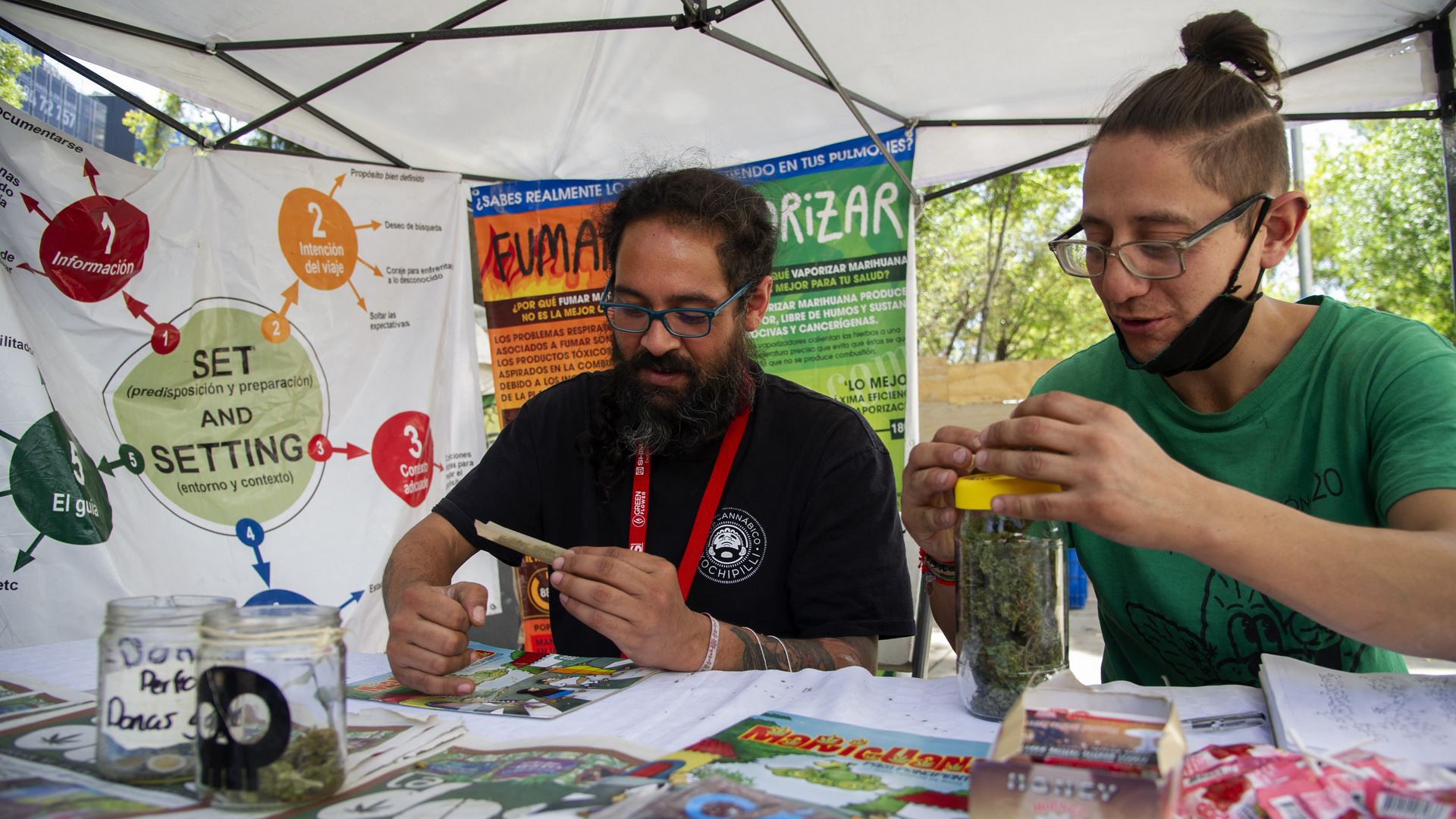
Lawmakers in Mexico's lower house passed a bill Wednesday to legalize recreational marijuana.
Why it matters: The action sets it up for approval in the Senate before it's sent to President Andrés Manuel López Obrador, who has signaled support for the measure.








/2021/03/11/1615483439695.gif?w=3840)