Monday's technology stories

"Troubling and problematic": Gov. Moore rips Trump's Nvidia actions on "The Axios Show"



Axios Future of Defense Summit: What leaders say is needed to supercharge U.S. military readiness
WASHINGTON — U.S. lawmakers, defense leaders and technology innovators face growing pressure to strengthen military readiness as global threats intensify and emerging technologies reshape modern warfare.
Why it matters: Maintaining a military advantage is increasingly complex for the U.S. amid cyberthreats, rising tensions in the Arctic and rapidly evolving battlefield technologies, compounded by criticism that U.S. leaders are not doing enough to respond.
- The Nov. 19 event was sponsored by JPMorgan Chase, RTX, TurbineOne, Salesforce and Seekr.
Catch up quick: Here are the top five takeaways.
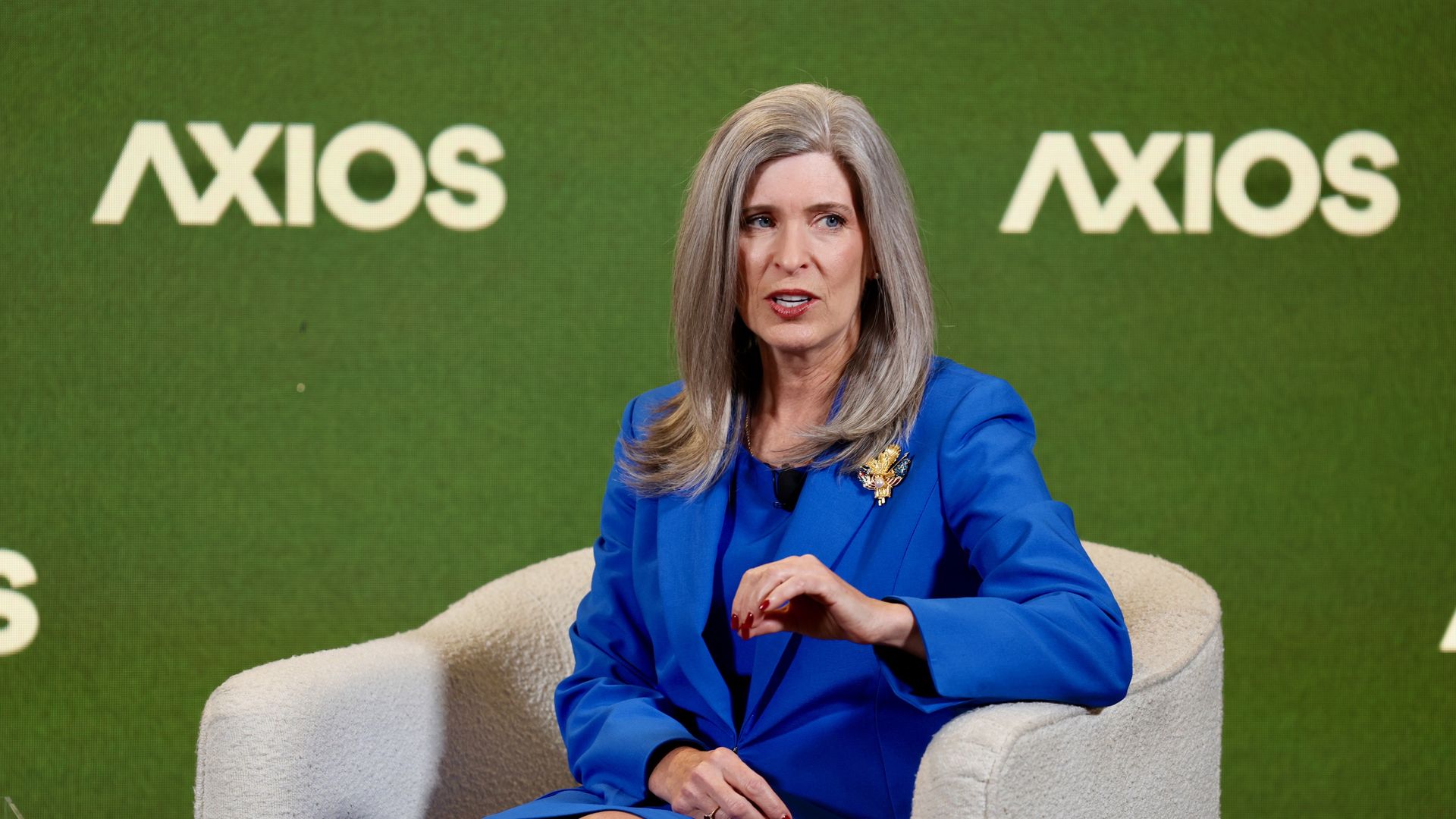
- Sen. Joni Ernst (R-Iowa) criticized the Trump administration for limited congressional briefings on the war with Iran, raising questions about the conflict's impact on munitions stockpiles. Ernst also called for boosting defense spending to keep up with growing threats. "There are a number of programs that we need to shift more towards the base budget," Ernst said.
- "We've ceded too much, and we've got to stand up and take it back," Rep. Gregory Meeks (D-N.Y.) said regarding the balance of power between the legislative and executive branches. Meeks said Congress will aim to reassert its oversight of foreign policy after Democrats take control in January and did not rule out bringing Secretary of State Marco Rubio to testify before the House Foreign Affairs Committee.
- The U.S. is playing catch-up in building ships, such as icebreakers, needed to project power in the Arctic, argued Davie Defense CEO Philip Burns-O'Brien. He called the large scale of Russia's presence in the region "quite frightening."
- Sophisticated cyberthreats demand that the U.S. rethink its approach to offensive cyber strategy, said Joe Lin, co-founder and CEO of Twenty. Adversaries are showing "a new way of leveraging cyber in order to both compete with us but also to prepare for war," Lin added.
- Ukraine's defense-tech innovation can offer the U.S. military a lesson in defense readiness, said Steve Bowsher, president and CEO of In-Q-Tel. "I'm a big believer that we aren't studying" the war and Ukraine's use of forward-deployed logistics and strategic manufacturing sufficiently, he said. "We aren't internalizing those lessons enough."
Content from the sponsors' segments:


In a View From the Top conversation, Justin Krauss, Security and Resiliency Initiative lead for defense tech and innovation economy at J.P. Morgan, explained why collaboration between defense tech innovators and larger companies can boost production capacity.
- "They [innovators] do incredible things in advanced manufacturing and developing new munitions … at the same time we need established companies who understand how to scale."
In a sponsored conversation, RTX Ventures president and managing director Daniel Ateya said his firm invests in U.S. defense startups to expand domestic manufacturing.
- "The defense industrial base clearly needs to be rejuvenated and invested … on U.S. soil for national security purposes," Ateya said.
In a sponsored conversation, Seekr vice president of public sector Mark "Whit" Whittington explained why he views AI capabilities as a supplement for human expertise.
- "It's not about replacing an analyst. ... It's about giving them a superpower so they could do so much more of that mission work and keeping our country safe," he said.
In a sponsored conversation, TurbineOne CEO Ian Kalin emphasized the importance of real-world testing of new defense technologies.
- "Get out in the field, put your stuff in an exercise, put it in the hands of a soldier," Kalin said. "If they love it, good things can happen. If they hate it, kick you out, then you probably don't deserve to be there."

Nvidia board shows "lack of backbone" in re-hiring Jensen Huang, governance experts say



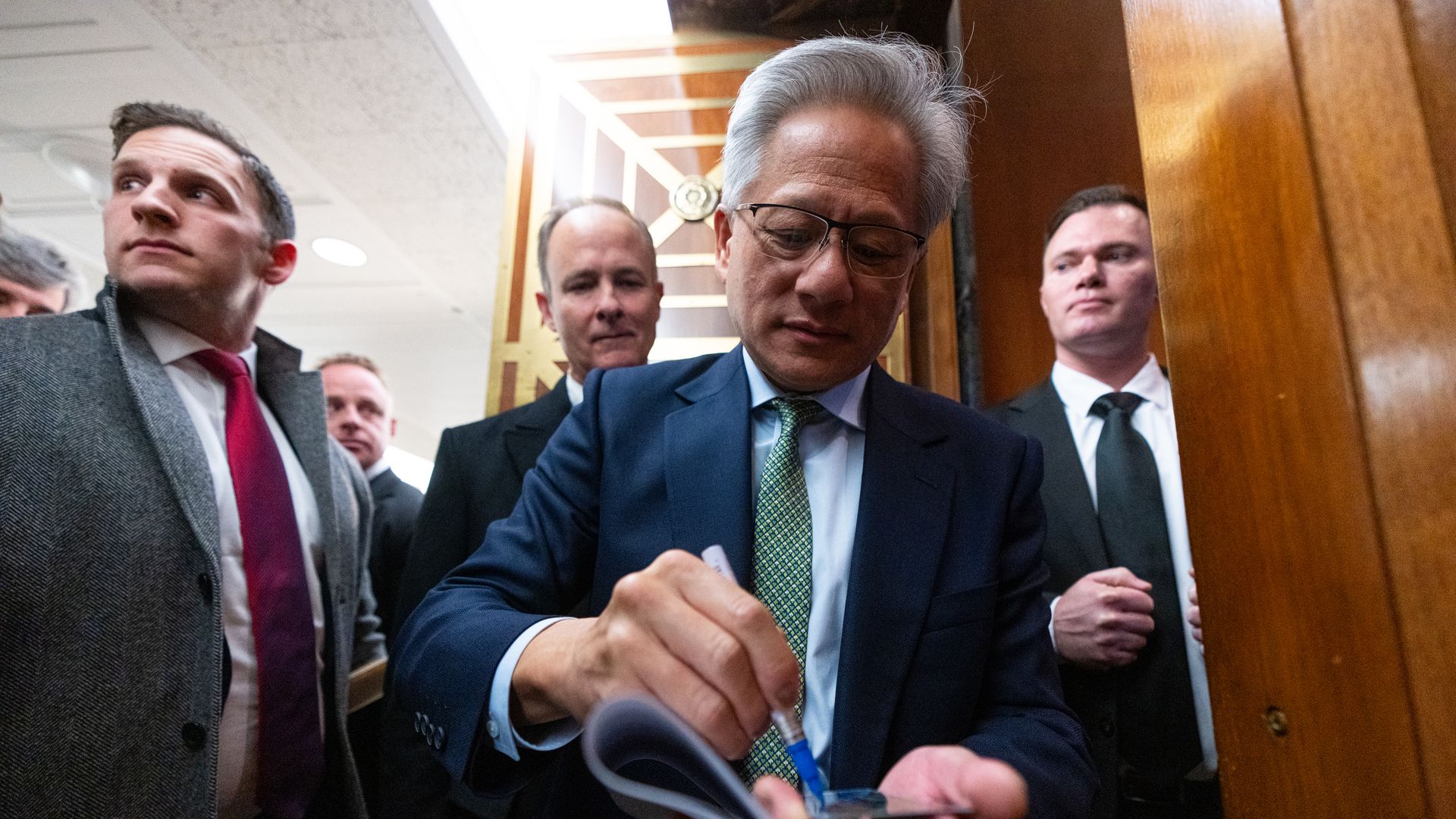
Schumer puts Nvidia, Trump on notice after Huang reinstatement






1m+ missing jobs

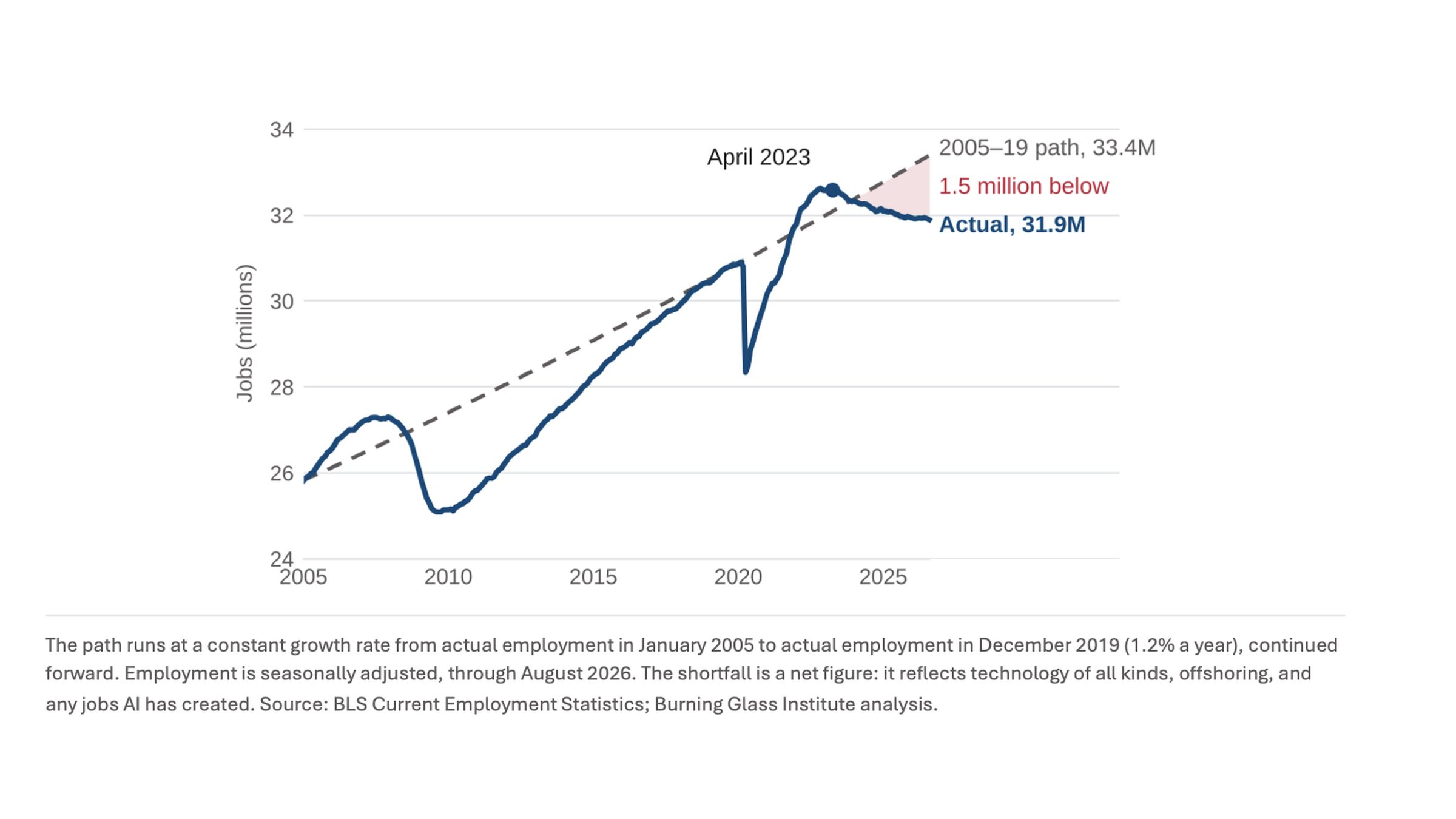
The U.S. economy has 1.5 million fewer white-collar jobs than would be expected based on pre-pandemic growth trends, according to a new report. AI may be to blame.
What they're saying: The technology's labor market effects may be showing up in the form of slower hiring rather than rising unemployment.
- "The missing workers aren't being laid off. They're not being hired in the first place," researchers from The Burning Glass Institute and RAISE US, a group co-founded by former Commerce Secretary Gina Raimondo, wrote.
The big picture: White-collar employment has fallen by about 700,000 since April 2023. The rest of the economy added 4.4 million jobs over the same period.
Reality check: The researchers caution that AI may not fully explain the missing jobs. Higher interest rates and the unwinding of huge pandemic-era hiring may also be contributing to the gap.
The report also warns that young workers could lose opportunities to gain the experience needed to advance as AI dominates routine entry-level tasks.
- In industries with widespread AI use, the share of entry-level job postings was 3% to 8% below its 2021–2026 average in the year ending June 2026, while remaining virtually unchanged across the broader economy.
What to watch: Policymakers are grappling with the possibility of a future in which AI permanently and severely chills demand for workers.
- Gene Sperling, who advised Presidents Clinton, Obama and Biden on economic policy, wrote in a new essay that the priority should be on maintaining full employment — rather than relying on cash payments to compensate workers for lost jobs.
- Sperling calls for using revenue from AI-driven productivity gains to create jobs in areas with unmet needs — including caregiving, education and public services.
- "Tighter job markets give workers options. They are more likely to have multiple offers, demand better wages and conditions," Sperling wrote.





GTCR kicks tires on fintech mega-deal




Axios BFD: Business leaders weigh AI's potential against actual ROI

NEW YORK — AI is driving new investment and changing how companies operate, but business leaders at an Axios BFD roundtable say the quantifiable returns vary.
Why it matters: Organizations that can strategically apply the technology to deliver value that shows up in bank accounts will stand out in a crowded and competitive landscape.
Axios' Madison Mills and George Moriarty moderated the roundtable discussion. The Nov. 19 event was sponsored by KPMG.
5 big takeaways from the conversation:
- AI costs are growing as organizations pay for tokens on top of headcount, Morgan Stanley managing director Todd Castagno said. However, it's "a real jagged frontier," VSP chief data and AI officer JD Hannick said, because the biggest AI users aren't always the best ones.
- Whether AI delivers ROI depends on the industry, Spice Capital founder and general partner Maya Bakhai said. She pointed to revenue cycle management in health care as an example of a sector "that's seen great margin improvement from" the technology.
- Candidly CEO and founder Laurel Taylor said her fintech company uses GitHub, Notion and other tools to measure whether AI influences productivity and operations. She calculates a "40% cost deflection … [and] an increase in revenue production."
- The technology is reshaping infrastructure investment, JLC Infrastructure vice president Riddhish Rege said. AI has sped up sourcing and diligence, he added, and transformed the types of investments getting attention across the industry, including power, internet and cybersecurity.
- "We're still in the very early innings of all this unfolding," said LinkedIn chief economist Liz Wilke, but a "huge tail of economically productive activities" is already at varying stages of AI adoption. "What we don't see is … broad indicators" that companies can blame — or credit — AI for big changes in the job market, she added.
Content from the sponsor's remarks:

In opening remarks, KPMG deputy chair and managing principal Atif Zaim said AI has unprecedented potential, but companies still struggle to measure tangible value.
- "CEOs want to invest; they are investing; they're expecting huge value from it," Zaim said. "A very small portion are reporting actual, really realized value so far from it, and … I don't know how set up enterprises are to actually capture value that's occurring at the margins … [or] shows up in the earning statements."

AI's spending slowdown

The AI trade has entered uncharted territory as stocks limp to the end of an astonishing month.
The big picture: An important new reality for AI emerged in the just concluded third-quarter earnings season that has been overshadowed by the midterm elections, Jensen Huang and the Anthropic IPO.
Zoom in: Wall Street analysts covering the hyperscalers didn't ratchet up forecasts for further capital investment by Amazon, Alphabet, Microsoft, Meta and Oracle — the biggest spenders of the AI data center boom.
- That's a change from recent trends, seen in the chart below, where tech giants regularly announced shocking amounts of planned AI investment as part of quarterly results.
- Those announcements would lead Wall Street analysts to increase their estimates, and the capex line would spike up and to the right.
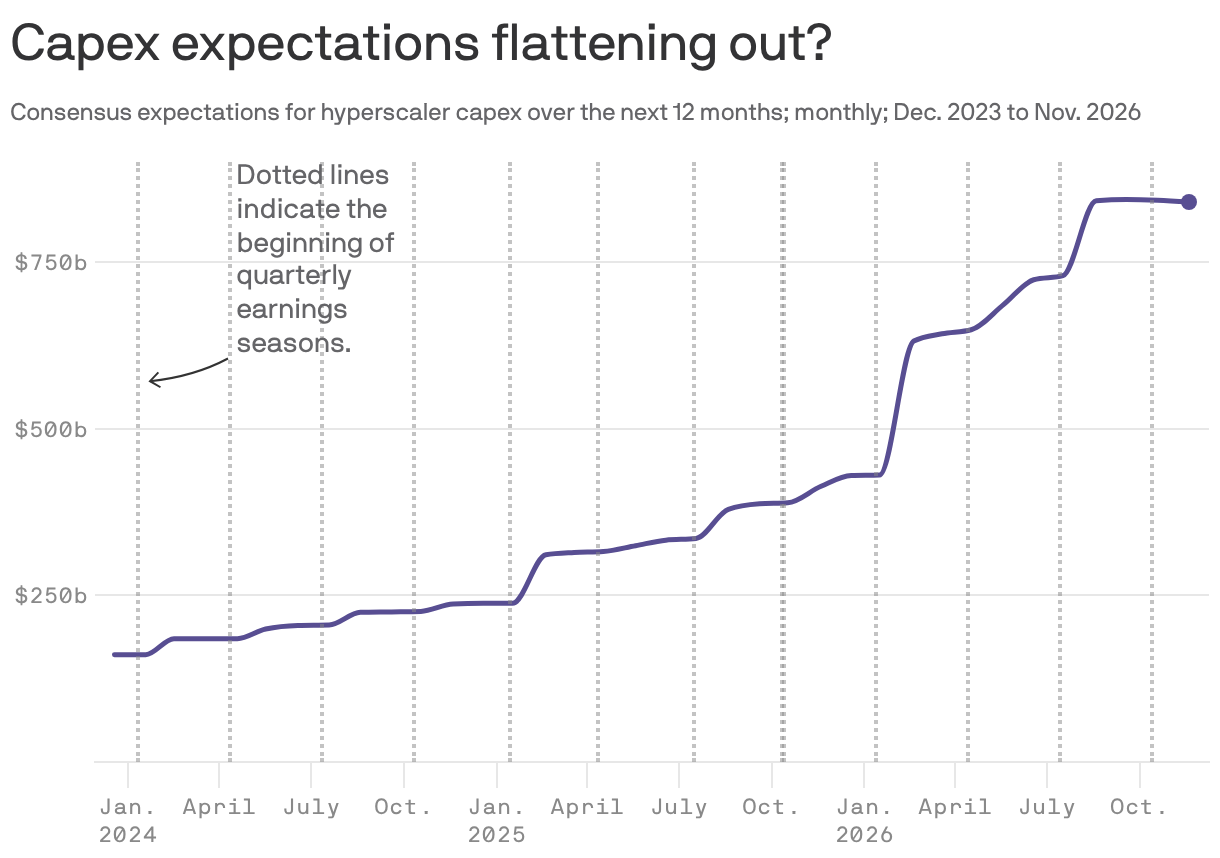
Reality check: This flatlining trend is huge.
- That wave of hyperscaler investment into data centers is also the source of giant profits that other companies — construction and engineering firms, merchant power providers, fiber-optic cable makers and, of course, makers of chips and memory devices — have been raking in from the boom.
- The AI investment gravy train has driven levels of S&P 500 earnings growth and overall corporate profitability to remarkably high levels.
Threat level: Slower capex will curb profits for the "picks-and-shovels" AI stocks that delivered some of the most astonishing gains of the AI boom.
- That's not necessarily a disaster: Analysts are expecting a more-than-respectable 16.4% increase in earnings for the S&P 500 next year.
- But it's clearly a sharp slowdown from earnings-per-share growth of nearly 35% that Wall Street thinks we'll end up with in 2026.
What they're saying: "We think the nature of the market environment is shifting a bit away from this sort of constantly higher capex numbers," David Lefkowitz, head of U.S. equities at UBS Global Wealth Management, told Axios last week, adding "We need to see the monetization at the AI layer, because that's ultimately who's paying for all this capex."
What we're watching: As Lefkowitz says, we're watching for clear, conclusive proof that there's serious money to be made from AI — aside from selling equipment used to build data centers. We haven't seen it yet.
The bottom line: Slowing future earnings expectations, expected Federal Reserve interest rate hikes and the chance of increased AI regulation have the market on edge.