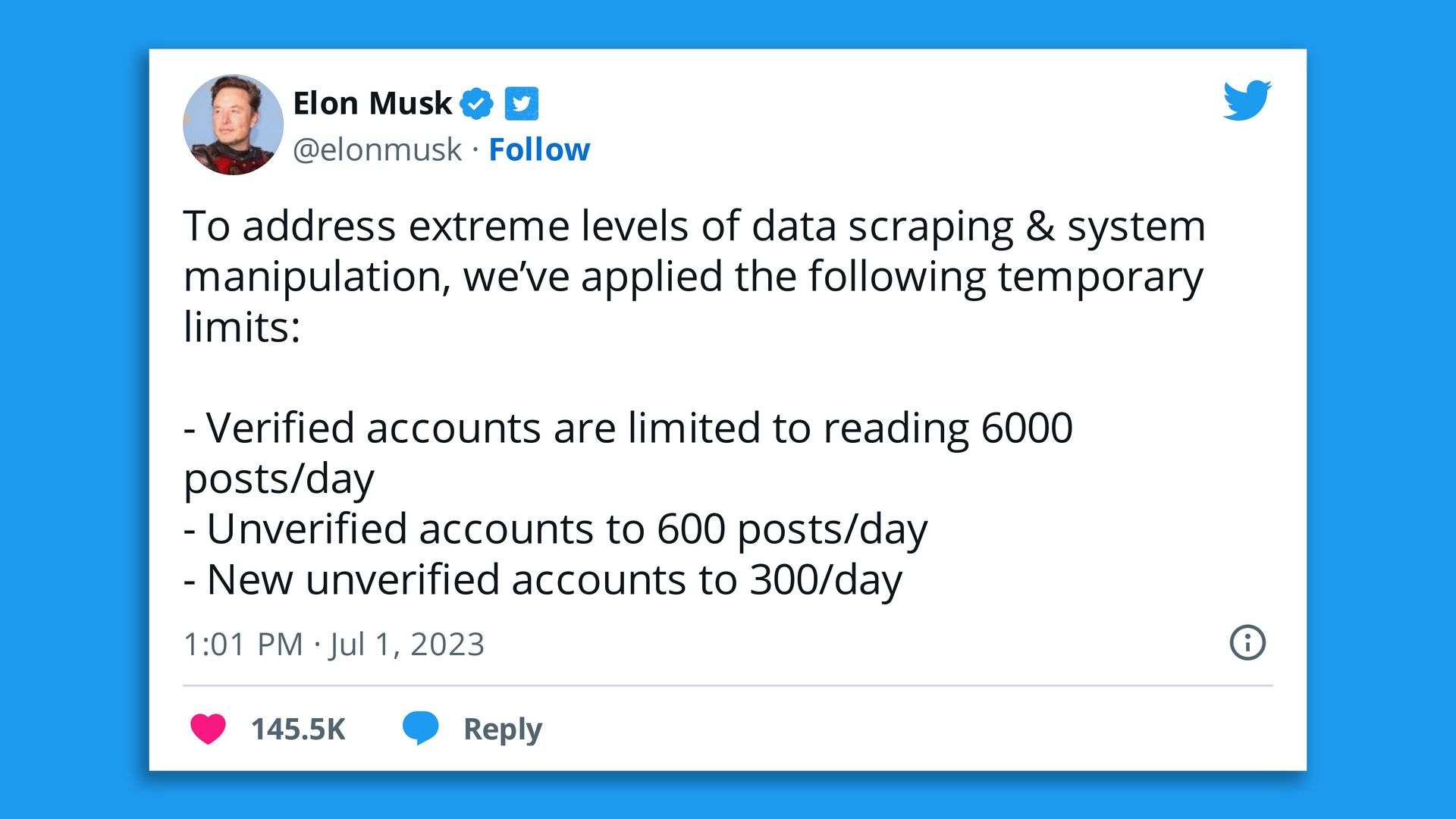
Elon Musk's continued experimentation with Twitter's basic functions introduced new chaos on Saturday when "temporary limits" prevented some users reading from tweets.
Catch up fast: Screenshots shared online show notifications telling users that they had exceeded a "rate limit" and to "wait a few moments" before trying to access more posts.
Imagine this: Democracy is decimated, eaten by locusts of misinformation created by artificial intelligence. Robots didn't simply take our jobs; they conquered our minds. And the wealthiest made money on it all.
Why it matters: Experts at this year's Aspen Ideas Festival saw that scenario not as apocalyptic fiction, but rather a thoroughly possible, maybe even probable future.
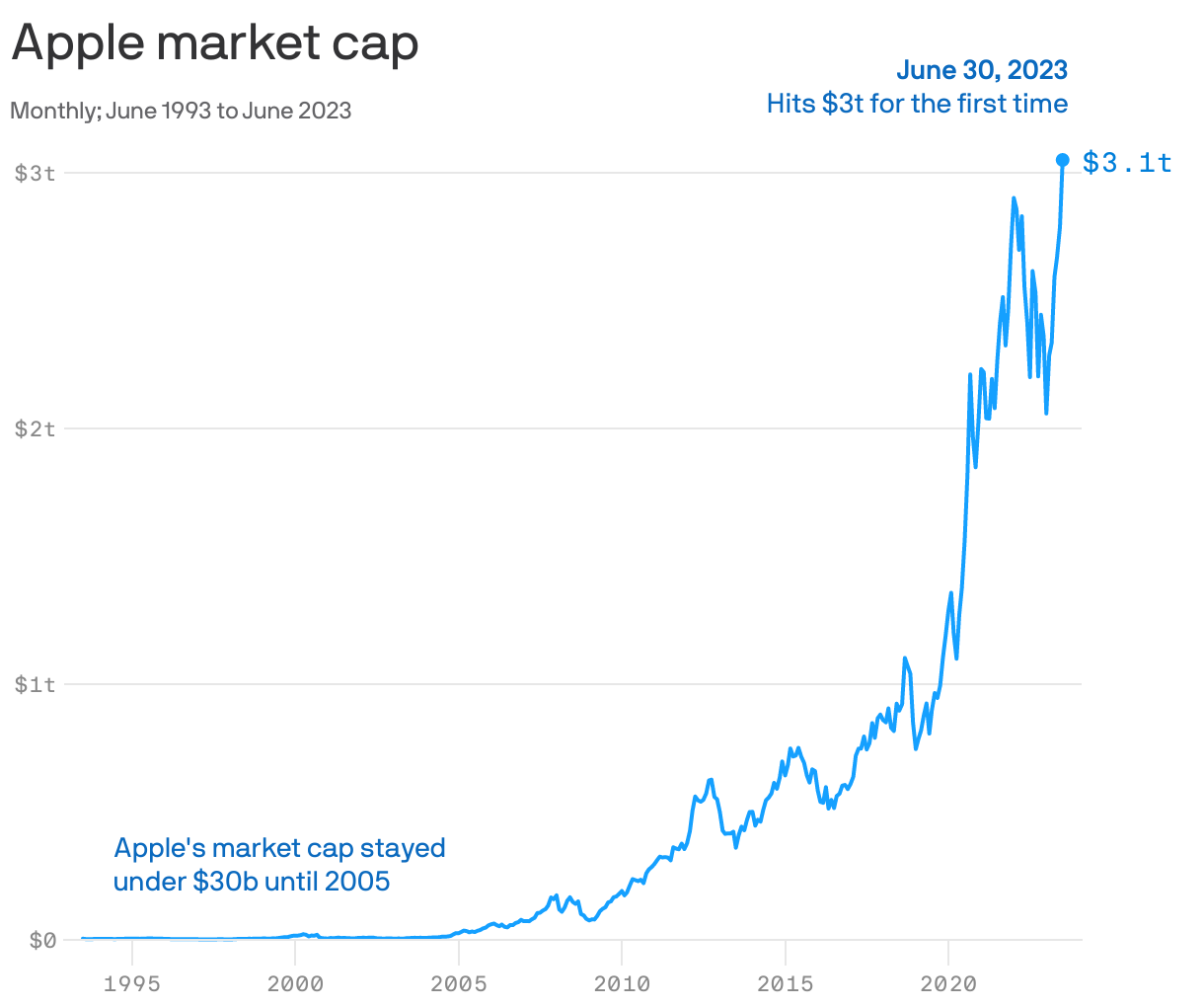
Apple closed the trading day Friday with a $3 trillion market cap — becoming the first company to reach the milestone.
Flashback: The iPhone maker became the first company to reach a $3 trillion market cap in intraday trading in January last year, but it failed to close at that level.
New data on Federal Reserve master account applications could show just how wary the Fed is of letting crypto into its club.
Why it matters: A Fed master account is the holy grail for crypto-touching firms to permit seamless transaction. But those firms argue there's no clear heuristic on who can get one, and who can't.
Data privacy laws in Colorado and Connecticut will go into effect Saturday.
Why it matters: If companies haven't finished their compliance work to abide by the rules, they could face civil penalties of up to $20,000 per violation in some states.
GitHub is betting a yearslong investment in generative AI will fulfill the software security dreams of cybersecurity practitioners and government officials.
Why it matters: Some of the most common network vulnerabilities exploited by malicious hackers result from insecure and outdated coding practices.
Chip giant Taiwan Semiconductor Manufacturing Co. told Axios in a statement Friday that one of its IT hardware suppliers is responding to cybersecurity incident that resulted in some leaked company data.
Driving the news: Late Thursday, the LockBit ransomware gang claimed it had hacked TSMC and demanded a $70 million ransom to keep them from publishing data stolen from the attack.
A tech sector job used to be a dream ticket, but now it may be a fast-track to stress and substance abuse, according to a survey of 500 tech leaders.
Why it matters: High salaries, stock options and office perks at tech companies are starting to take a back seat to job loss fears, long hours and other stresses.
While a federal judge mulls whether to hold up Microsoft's purchase of Activision Blizzard, the five-day hearing has already provided the equivalent of a cheat code for the inner workings of the game industry.
Why it matters: Gaming is a huge business, but many of its financial details are jealously guarded secrets: How much each title costs to produce and how much it makes, as well as the strategy that goes into making a game exclusive to one of the major consoles.
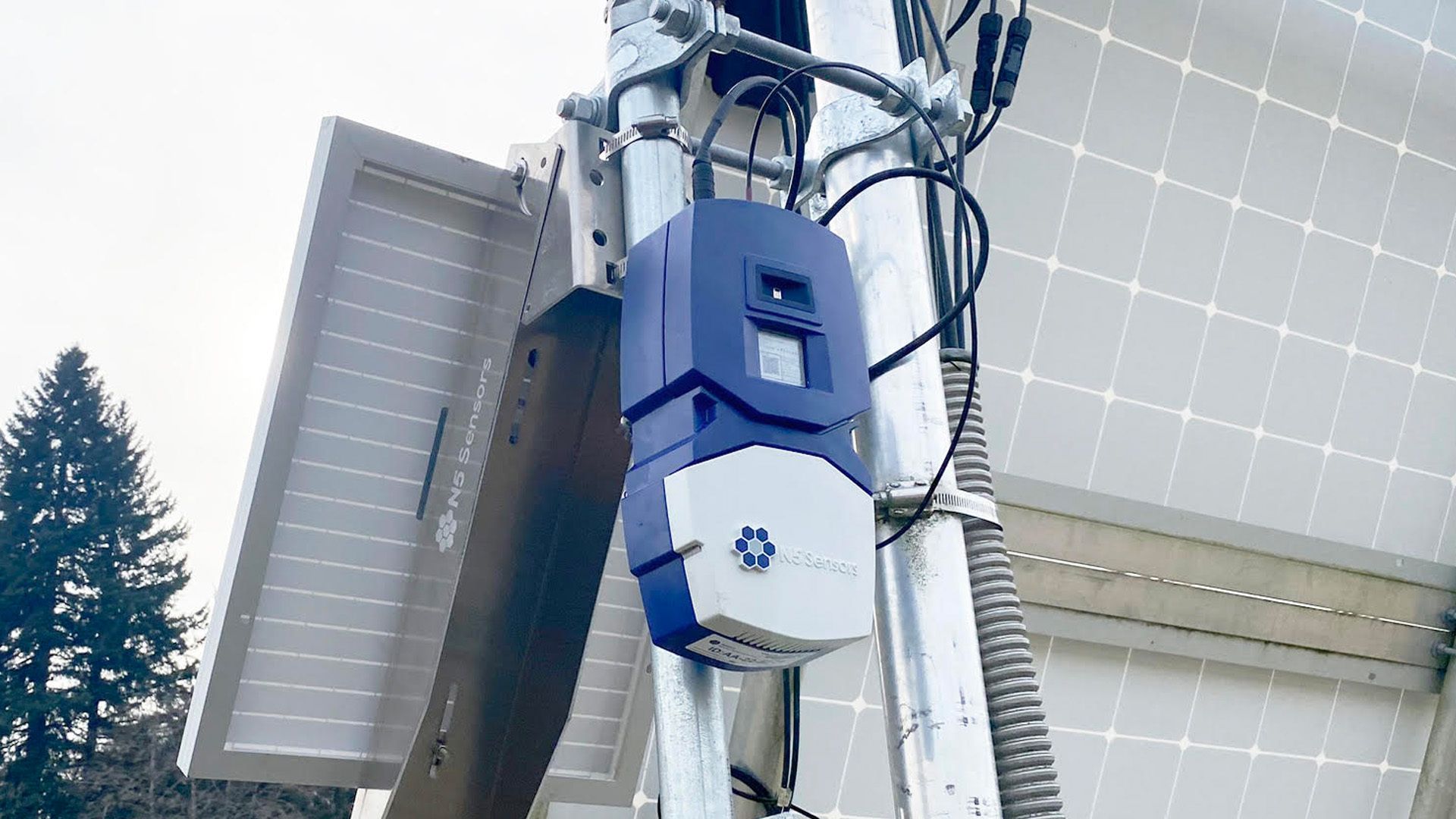
Small, low-cost sensors — about the size of a lunchbox and hung on light poles and elsewhere — are being tested in wildfire-prone communities as a potential new early warning tool.
The sensors "smell" the chemical components of a fire before it ignites, which drones, satellites and other visual surveillance safeguards cannot.
If you want to rent an electric vehicle (EV) in Las Vegas, now you can have one delivered to you remotely, without a driver.
Driving the news: Halo.Car, which has been testing remote delivery of on-demand electric cars in Las Vegas since 2022, says its technology is now robust enough to remove the backup safety driver from its vehicles.







/2023/06/28/1687974863441.gif?w=3840)