AI algorithms employed in everything from hiring to lending to criminal justice have a persistent and often invisible problem with bias.
The big picture: One solution could beaudits that aim to determine whether an algorithm is working as intended, whether it's disproportionately affecting different groups of people and, if there are problems, how they can be fixed.
Tech's leading companies — like the rest of corporate America — responded to the murder of George Floyd by police in 2020 in part by pledging to give big to racial justice groups.
Our analysis of these companies found that, by and large, Big Tech paid up.
Asians make up the majority of Silicon Valley's tech workforce at roughly 57%, according to MarketWatch. Yet they're vastly underrepresented at the leadership level: 27% at Apple, 40% at Google and 25% at Facebook.
The big picture: Many tech leaders like to think the field is "post-race," often pointing to the handful of Asians, mostly East and South Asian men, who occupy prominent executive roles. The reality is far more complicated.
Game developer Chandana "Eka" Ekanayake waited till mid-career to found a startup because he didn't see a path to do it. "I joke about this on Twitter: I wish I had 'white man confidence,'" he says now. "I would have started a company at 25."
Historically, that confidence hasn't been encouraged in the gaming sector. Ekanayake is now one of several entrepreneurs aiming to speed up diversification in a field where progress has been slow.
In the mid-2010s tech's biggest companies started publicly reporting diversity statistics, and the tale these annual numbers tell since then is one of progress — but very slow and very slight.
U.S. Census numbers for 2020 show the U.S. Black population at 12.4% and the Hispanic population at 18.7%. These numbers don't include the growing tally of multi-racial people.
The technology industry is famously determined to change the world — but its efforts to diversify its workforce and remove bias from its products haven't changed nearly enough.
The tech industry likes to cast its failure to include enough people of color and other underrepresented groups as a "pipeline problem" — one that would vanish if only more such people studied tech skills and entered the field.
But there's another reason U.S.tech companies struggle to diversify: work environments that critics say are rife with harassment and discrimination even as companies paint themselves as champions for diversity.
Better sensors, more intelligent AI, and the coming wave of 5G wireless could finally fulfill the promise of the smart city.
Why it matters: How we organize, run and power our cities will be increasingly important in the years ahead, as urbanization expands and the damaging effects of climate change compound.
Roblox now has 1,000 users who have made at least $30,000 annually creating virtual games and experiences on the platform, the company tells Axios.
Why it matters: That figure, which may be inspiring to some and sobering to others, is a mark of how many people are earning a significant wage by creating content for the multibillion-dollar digital platform.
Developing new military technologies, such as artificial intelligence and machine learning, will be necessary to prevent a war with China or other adversaries, Sen. Mark Kelly (D-Ariz.) said at an Axios event Friday.
Why it matters: With the war on terror ramping down and competition with China increasing, Kelly said it's time for the U.S. to adapt its military technology to address threats in the western Pacific, specifically China.
Only 52% of Black tech employees say they trust that their employers value inclusion and diversity, according to a new survey by /dev/color, a non-profit focused on Black technologists.
85% say they'd switch to another employer "that valued me as a Black employee more authentically."
Two of the world's biggest cryptocurrency exchanges laid out their respective big-picture visions for how their ecosystem should be regulated on Thursday. The differences between them are stark.
Why it matters: One of the exchanges, Coinbase, is a big and centralized American company, subject to all U.S. rules and regulations and listed on the Nasdaq. The other, FTX, is a younger, nimbler decentralized exchange of no fixed abode, willing and able to conduct most of its activity outside the reach of U.S. regulators.
Carmakers keep testing the limit of what people will pay for an automobile packed with luxury, high-tech features. Consider the $110,000 Jeep Grand Wagoneer I drove recently.
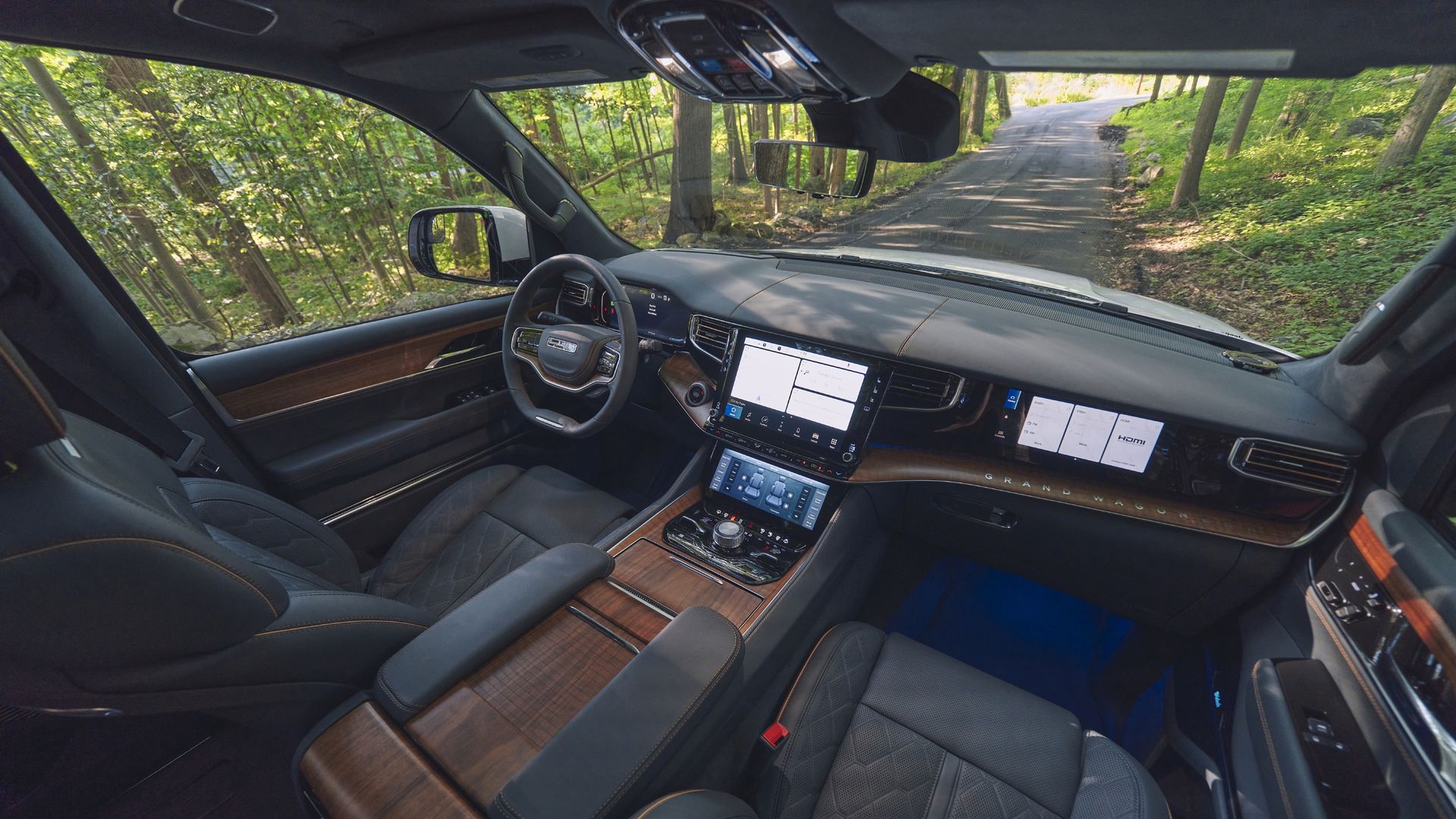
This is the largest, fanciest Jeep ever, with a spectacular interior bathed in dark walnut and supple leather that's outfitted with every tech gizmo you could want.
It's hard to imagine off-roading in this luxury yacht — though it has a 10-inch ground clearance and can ford two feet of water.
But that's not the point: this SUV is about exploring the reaches of American opulence.
The big picture: The Stellantis-owned brand known for its iconic and rugged Jeep Wrangler has already mined the low end of the SUV market with the Cherokee, Compass and Renegade. So now it's pushing the other end of the spectrum, taking on premium full-size SUVs like the Cadillac Escalade and Lincoln Navigator.
Details: The stately, upright Grand Wagoneer is massive and hard to maneuver — though the 360-degree, bird's-eye camera helps — yet it's still surprisingly refined and comfortable on the highway.
It's powered by a 6.4-liter V-8 engine which gets an EPA-rated 13/18 mpg city/highway.
It comes in five trim levels, ranging from about $90,000 to $110,000. (A slightly less grand model — the similarly sized Jeep Wagoneer — starts around $69,000.)
There are screens everywhere — including a 10-inch front passenger screen that has a special privacy filter to prevent distraction for the driver.
Second-row passengers have a 10-inch touchscreen between the captain's chairs, and individual screens mounted on the seatbacks in front of them.
Are we there yet? The Grand Wagoneer and Wagoneer are the first in the industry to come with Amazon Fire TV for Auto, which lets passengers stream content from Amazon Prime, Netflix, Hulu and YouTube, among others.
When you sync the system to an existing Amazon account, you can even pause programming in your home and resume watching in the car.
A fun feature lets kids track the trip's progress, and the time to destination, just as airline passengers can.
There's also a rear-seat monitoring system that lets drivers see passengers seated behind them on a video feed.
There are some surprises too, like an optional cooler in the front center console or a touchpad-controlled safe to stow valuables under the split front armrest.
The bottom line: You have to wonder if it's worth spending $110,000 on a Jeep, but if you've got the money, the Grand Wagoneer won't leave you asking for anything more.
The outcry over Congress' latest proposal to regulate tech companies' algorithms shows how difficult it is for lawmakers and platforms alike to deal with online content moderation.
Why it matters: The new bill is backed by the leadership of a powerful committee with jurisdiction over the issue, giving it more momentum than some previous legislative attempts to revamp online platforms' legal protections.
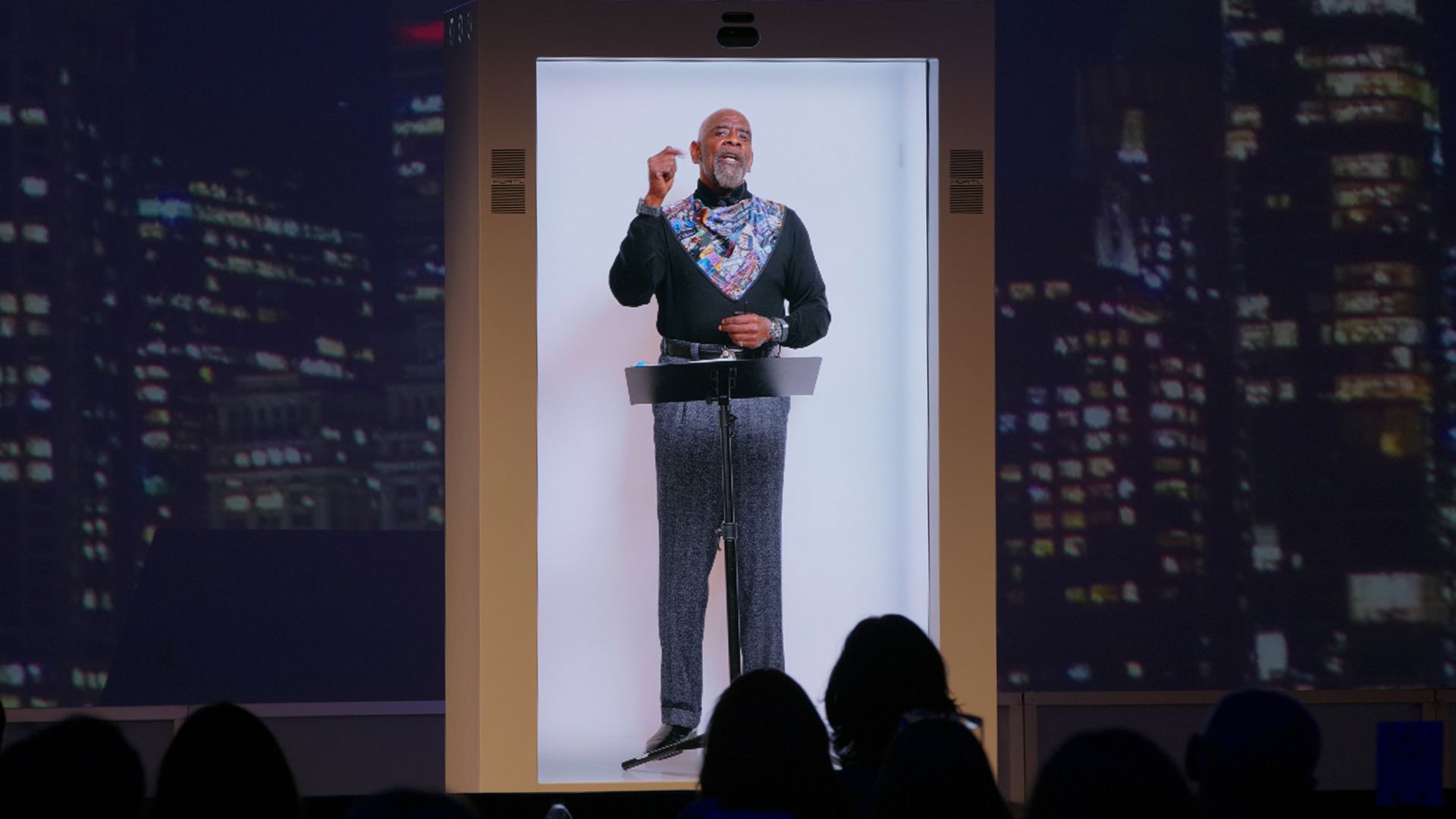
A company called PORTL sells a 7-foot-tall booth into which you can beam a 3-D image of yourself anywhere in the world.
Why it matters: In the age of COVID-19, it's valuable to have a way to project someone realistically from Point A to Point B. The technology, while still a bit expensive and cumbersome, can make anything from classroom learning to celebrity appearances and business meetings more vivid and compelling.