Facebook said Thursday that it stored millions of Instagram passwords without proper security, expanding a disclosure in March that Facebook passwords had been left visible and unprotected inside the company's servers.
Why it matters: Per Axios' Ina Fried: "It’s yet another example of Facebook mishandling customer information. It follows yesterday’s disclosure that the social network had accessed 1.5 million customers contact information without their permission."
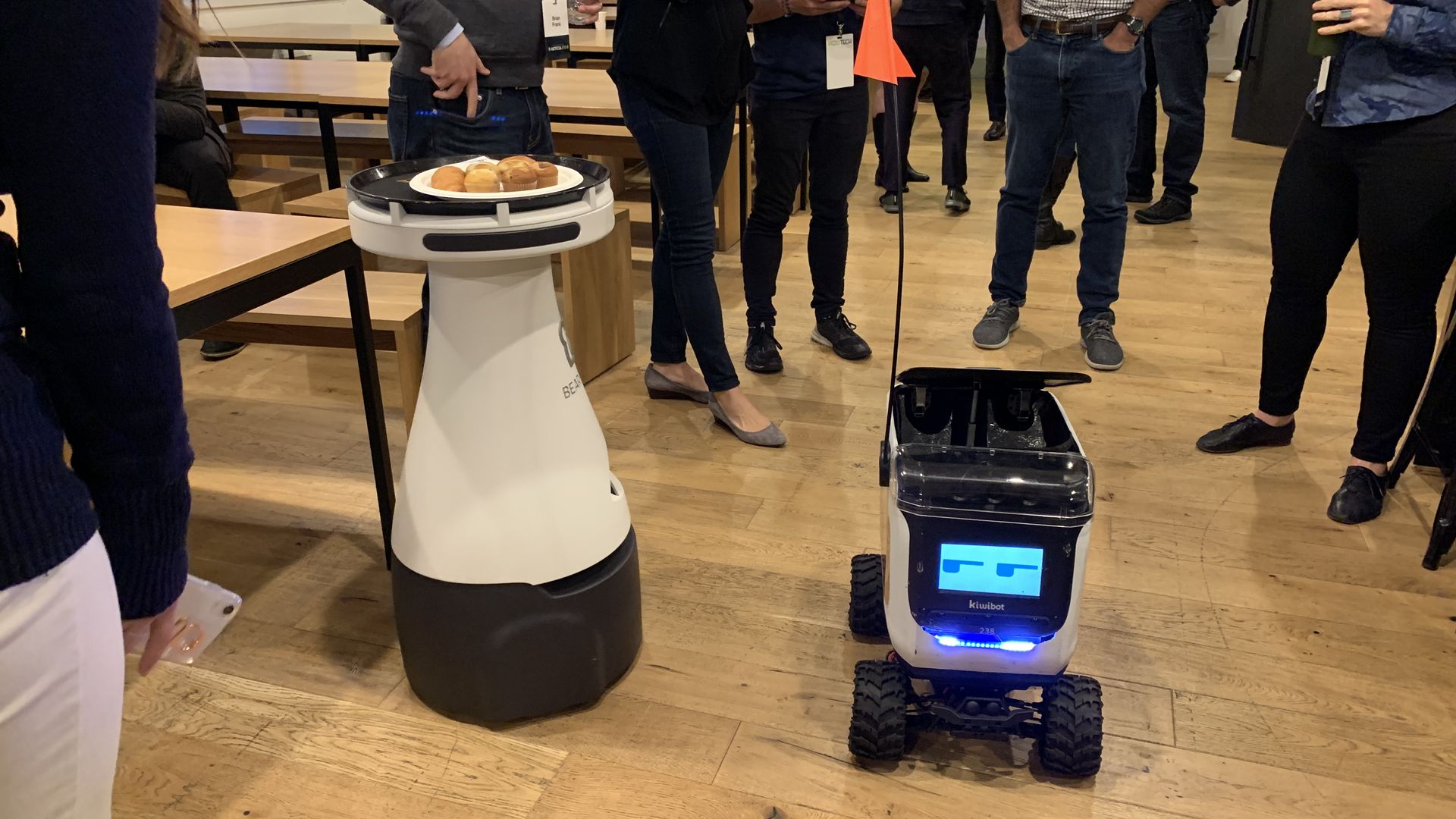
Edging beyond the gimmicky demos of years past, robot startups are mounting a play for the more than $5.7 trillion U.S. food industry, launching their products on farms, in grocery stores and restaurants, and all the way to your front step.
Driving the news: Most bots are still wildly expensive, which has kept them from mass deployment. But they're nudging open the door to the industry, and slowly accustoming people to letting robots take care of their food.
Since May 2016, Facebook collected the contact lists of 1.5 million new users in the account confirmation process, calling the action "unintentional," and now, plans to erase the data, Facebook confirmed.
“Last month we stopped offering email password verification as an option for people verifying their account when signing up for Facebook for the first time. When we looked into the steps people were going through to verify their accounts we found that in some cases people's email contacts were also unintentionally uploaded to Facebook when they created their account. We estimate that up to 1.5 million people's email contacts may have been uploaded. These contacts were not shared with anyone and we're deleting them. We've fixed the underlying issue and are notifying people whose contacts were imported. People can also review and manage the contacts they share with Facebook in their settings.”
Facebook has added 2 new fact-checking partners to help it determine whether content is valid on its platform, according to a spokesperson. Both partners were approved by Poynter's International Fact Checking Network Board, which Facebook has partnered with to approve fact-checkers.
Yes, but: Both of the outlets approved by the Board are considered by some to be partisan: CheckYourFact.com arguably leans right, as it's a for-profit subsidiary owned by The Daily Caller, Inc., although editorially independent. Science Feedback fact-checks news and information primarily based on whether it is rooted in science. Some conservatives disagree with this characterization, arguing climate change is not a settled science.
Amazon will cease its domestic marketplace business in China within the next 90 days, redirecting attention to more profitable overseas ventures, as well as to the sale of goods and cloud services, Reuters reports.
The big picture: Amazon's Chinese marketplace has struggled to defeat homegrown e-commerce rivals like JD.com and Alibaba. Starting in mid-July, customers will no longer be able to buy from third-party Chinese merchants on Amazon. However, they will still be able to buy products from the U.S., U.K., Denmark and Japan on Amazon's global store. And Amazon will continue offering cloud services in China through AWS.
Federal Communications Commission chairman Ajit Pai is recommending, per executive branch agencies, that the FCC deny China Mobile's application to provide telecommunications services in the U.S. due to concerns about national security and law enforcement risks.
Why it matters: It's the first time executive branch agencies have recommended that the FCC deny such an application to interconnect with U.S. communications infrastructure, FCC officials said Wednesday on a call with reporters. The move represents a further escalation in the slow-building conflict between the U.S. and China over telecommunications trade.
New York City is facing a transportation crisis that is triggering new political consensus on old ideas like congestion fees and is helping to move the needle — ever so slightly — toward self-driving cars as part of the solution.
Why it matters: New York's past reluctance to embrace AV testing, for both practical and regulatory reasons, means the city has missed out on the tech buzz and new jobs that the robotaxi boom has brought to smaller cities like San Francisco, Phoenix and Pittsburgh.
Apple's surprise deal with Qualcomm not only resolved one of the biggest legal disputes in the tech industry, but changed the balance of power in the chip industry.
What's happening: Just hours after announcing the settlement — which included a multiyear agreement for Qualcomm to supply chips to Apple — Intel said it was scrapping plans to release a 5G modem chip next year.
If AVs eventually dominate the car industry, automakers could start charging for miles travelled instead of vehicles sold — potentially a much bigger revenue opportunity.
The big picture: Automakers and tech companies are investing in AV technology because it offers, among many things, a new revenue stream if people shift from owning vehicles to buying access to transportation.
New in-depth reports on Facebook portray CEO Mark Zuckerberg as a tough negotiator and shrewd wielder of corporate power — miles from the geeky whiz kid image that kicked off his public life.
Why it matters: Zuckerberg's control of Facebook's voting stock means he controls its destiny, and Facebook controls much of the information diet of the world today.
Parents are relying more than ever on digital babysitters and device-led playtime to entertain their children — and the wide range of content is making it increasingly difficult to monitor what their kids are seeing.
Why it matters: This goes beyond the old challenges of kids watching too much TV. Modern parents struggle to keep up with the immense variety of kids programming across a multitude of apps. Plus, controlling what kids are exposed to on platforms like YouTube can feel like an unwinnable battle with algorithms.








/2019/04/17/1555510135393.gif?w=3840)

/2019/04/16/1555409042356.gif?w=3840)