Thursday's technology stories

Apple says it has eliminated the gender pay gap globally

Apple said Thursday that it has eliminated any gender pay gaps globally and has also continued to increase the number of women and underrepresented minorities in its workforce over the past year. Half of all new hires are from underrepresented groups, according to a newly updated diversity Web site.
The bottom line: White and Asian men still make up the majority of Apple's workforce, but the company has increased its diversity each of the last four years, both across the company and among its technical workers and leadership.

Facebook launches program to promote small businesses
The purpose of the "Community Boost" program is to help provide more people with the digital skills they need to compete in the modern economy.
Why it matters: The investment in small businesses is part of broader push in communities across the board since Mark Zuckerberg released a new mission for the company earlier this year to build a more global community.

Sean Parker unloads on Facebook: “God only knows what it's doing to our children's brains”
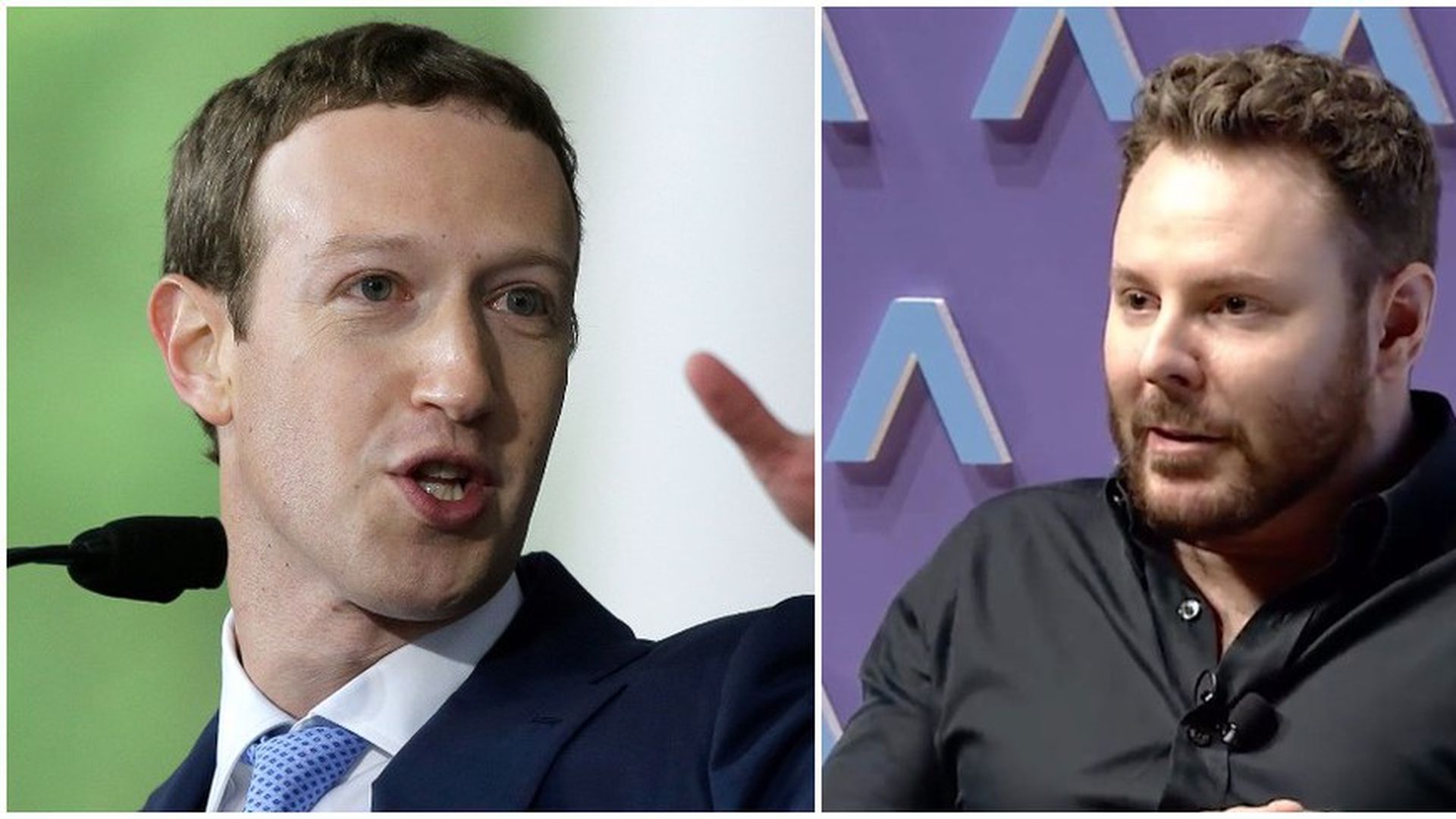
Sean Parker, the founding president of Facebook, gave me a candid insider's look at how social networks purposely hook and potentially hurt our brains.
Be smart: Parker's I-was-there account provides priceless perspective in the rising debate about the power and effects of the social networks, which now have scale and reach unknown in human history. He's worried enough that he's sounding the alarm. Parker, 38, now founder and chair of the Parker Institute for Cancer Immunotherapy, spoke yesterday at an Axios event at the National Constitution Center in Philadelphia, about accelerating cancer innovation. In the green room, Parker mentioned that he has become "something of a conscientious objector" on social media. By the time he left the stage, he jokingly said Mark Zuckerberg will probably block his account after reading this:
"When Facebook was getting going, I had these people who would come up to me and they would say, 'I'm not on social media.' And I would say, 'OK. You know, you will be.' And then they would say, 'No, no, no. I value my real-life interactions. I value the moment. I value presence. I value intimacy.' And I would say, ... 'We'll get you eventually.'""I don't know if I really understood the consequences of what I was saying, because [of] the unintended consequences of a network when it grows to a billion or 2 billion people and ... it literally changes your relationship with society, with each other ... It probably interferes with productivity in weird ways. God only knows what it's doing to our children's brains." "The thought process that went into building these applications, Facebook being the first of them, ... was all about: 'How do we consume as much of your time and conscious attention as possible?'" "And that means that we need to sort of give you a little dopamine hit every once in a while, because someone liked or commented on a photo or a post or whatever. And that's going to get you to contribute more content, and that's going to get you ... more likes and comments." "It's a social-validation feedback loop ... exactly the kind of thing that a hacker like myself would come up with, because you're exploiting a vulnerability in human psychology.""The inventors, creators — it's me, it's Mark [Zuckerberg], it's Kevin Systrom on Instagram, it's all of these people — understood this consciously. And we did it anyway." P.S. Parker, on life science allowing us to "live much longer, more productive lives": "Because I'm a billionaire, I'm going to have access to better health care so ... I'm going to be like 160 and I'm going to be part of this, like, class of immortal overlords. [Laughter] Because, you know the [Warren Buffett] expression about compound interest. ... [G]ive us billionaires an extra hundred years and you'll know what ... wealth disparity looks like."Go deeper: See the video of Parker's comments.
Go deeper: Joe Biden rips Trump's "phony nationalism".
Sign up for Axios newsletters to get our Smart Brevity delivered to your inbox every morning.

Sean Parker: Facebook was designed to exploit human "vulnerability"
Sean Parker, the founder of Napster and former president of Facebook, said the thought process behind building the social media giant was: "How do we consume as much of your time and conscious attention as possible?" Parker was interviewed by Axios' Mike Allen Wednesday:
"That means that we needed to sort of give you a little dopamine hit every once in a while because someone liked or commented on a photo or a post or whatever ... It's a social validation feedback loop ... You're exploiting a vulnerability in human psychology ... [The inventors] understood this, consciously, and we did it anyway."
Sign up for Axios newsletters to get our Smart Brevity delivered to your inbox every morning.

Self-driving shuttle's first day ends with an accident
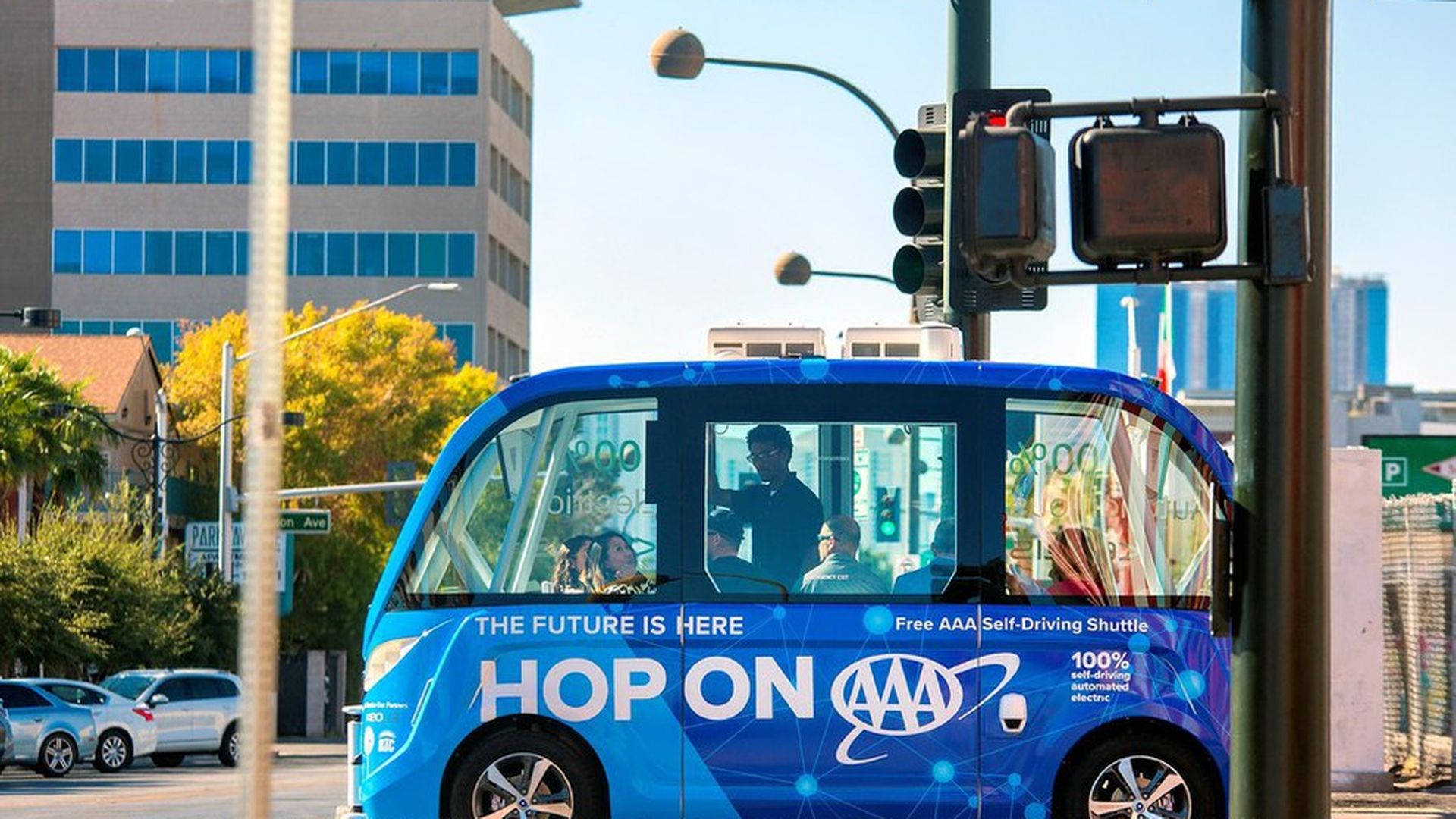
On Wednesday, AAA and transportation company Keolis debuted a 12-month test in Las Vegas for a self-driving shuttle designed by French startup Navya—but the vehicle's first day was cut short when it was hit by a semi-truck. The truck's driver was determined to be at fault, according to the city of Las Vegas, and was cited by local police.
Common thread: This incident is the latest to show that humans tend to make more driving errors than self-driving software. In a recent review of accident data from the California DMV, Axios found a similar pattern. Police said the shuttle "did what it was supposed to do" to avoid a crash and "had the truck had the same sensing equipment... the accident would have been avoided."

Sean Parker: Immunotherapy is our opportunity to disrupt cancer
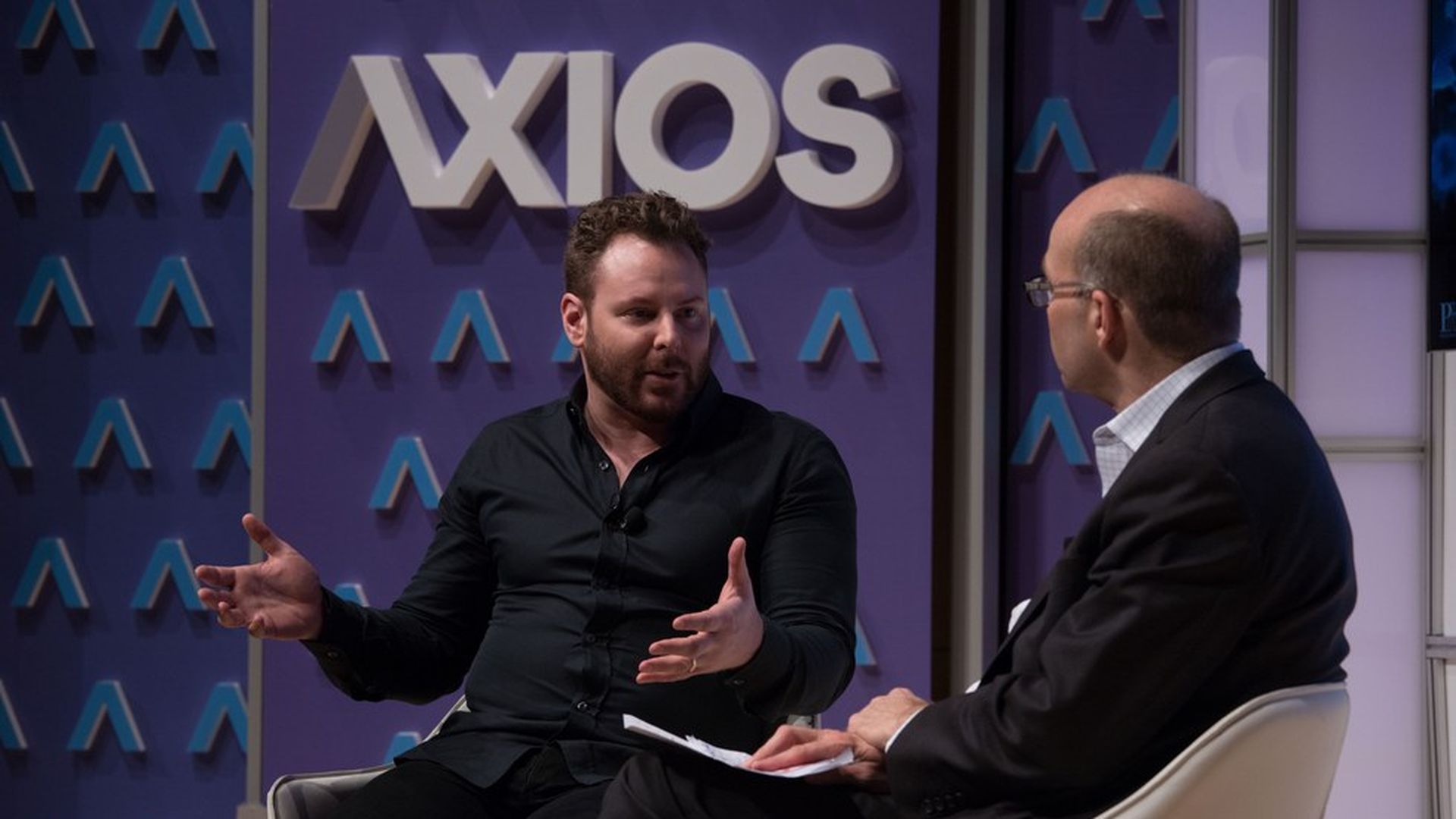
Napster founder and former Facebook president Sean Parker cited immunotherapy as the "opportunity for disruption" in the fight against cancer and the catalyst for his $250 million philanthropic project, the Parker Institute for Cancer Immunotherapy, during an event with Axios' Mike Allen this afternoon.
Parker said that he founded the Parker Institute after realizing that there's a disconnect between cancer research and actually finding concrete cures, saying, "I learned that the field of academic science — or just academic science in general — the values are not necessarily aligned with medicine or in bringing treatments to patients…We also need this sense of urgency."
Pokémon Go creator is working on an augmented reality Harry Potter game

Niantic, the company behindPokémon Go, announced Wednesday it is teaming up with Warner Bros. on a Harry Potter-themed augmented reality.
Details are scant on the new game, Harry Potter: Wizards Unite, though Niantic CEO John Hanks said in a blog post the game will merge virtual gaming with real world location.
Why it matters: Pokémon Go was an instant hit, but it's usage has waned. Adding similar dynamics to another globally popular franchise seems like a no--brainer.

Franken says net neutrality should apply to Google, Facebook and Amazon

Democratic Sen. Al Franken said on Wednesday that the basic idea of net neutrality — that all web traffic and content should be treated the same — should apply not just to the internet service providers whose networks carry that content but also platforms that host it. Here's what he said at an event held by the progressive Open Markets Institute, where he name-checked Facebook, Google and Amazon:
While we fight to preserve the [current net neutrality regulations], we must now begin a thorough examination of big tech's practices in order to secure the freeflow of information on the internet.
Why it matters: It's not clear how net neutrality would be enforced on the largest web platforms. But the idea that ISPs and major web platforms should be treated equally is gaining some traction, as tech companies face broad political pressure.
Go deeper: Franken published this op-ed in The Guardian after speaking at the event.

Former Yahoo CEO: I “sincerely apologize” for breach
Former Yahoo CEO Marissa Meyer, whose 5-year tenure at Yahoo was shaken by online breaches of user data, placing it at the top of the list of largest data breaches ever, told lawmakers Wednesday that she wants to "sincerely apologize to each and every one of our users," per CBS News.
Verizon, which recently acquired most of Yahoo, revealed last month the 2013 breach affected all 3 billion Yahoo user accounts, not just 1 billion as was originally disclosed in December last year.
Aetna working with Apple on health and fitness apps

Aetna plans to give away Apple Watches to more than 500,000 of its members next year and is working with the tech giant to develop a variety of health and fitness apps.
Why it matters: While smartphones are considered a must-have device for most Americans, smartwatches are still seen as luxuries. If Aetna can prove the devices save money on health costs it could dramatically expand demand for such devices and open up the possibility of someone other than consumers footing the bill.

Why Google and Facebook folded on sex-trafficking bill
Silicon Valley folded in a fight over a major anti-trafficking bill after months of mounting pressure from both political parties. The industry forged a compromise with senators that, while better for tech than the original proposal, amounts to the first major legislative defeat for tech giants Google and Facebook.
Why it matters: Online platform companies initially dug in their heals when lawmakers first approached them about the proposal. The fact that they were forced to make a compromise signals a big change for Big Tech, which has enjoyed immense political power in Washington during the past decade but now faces significant new pressures on several fronts.