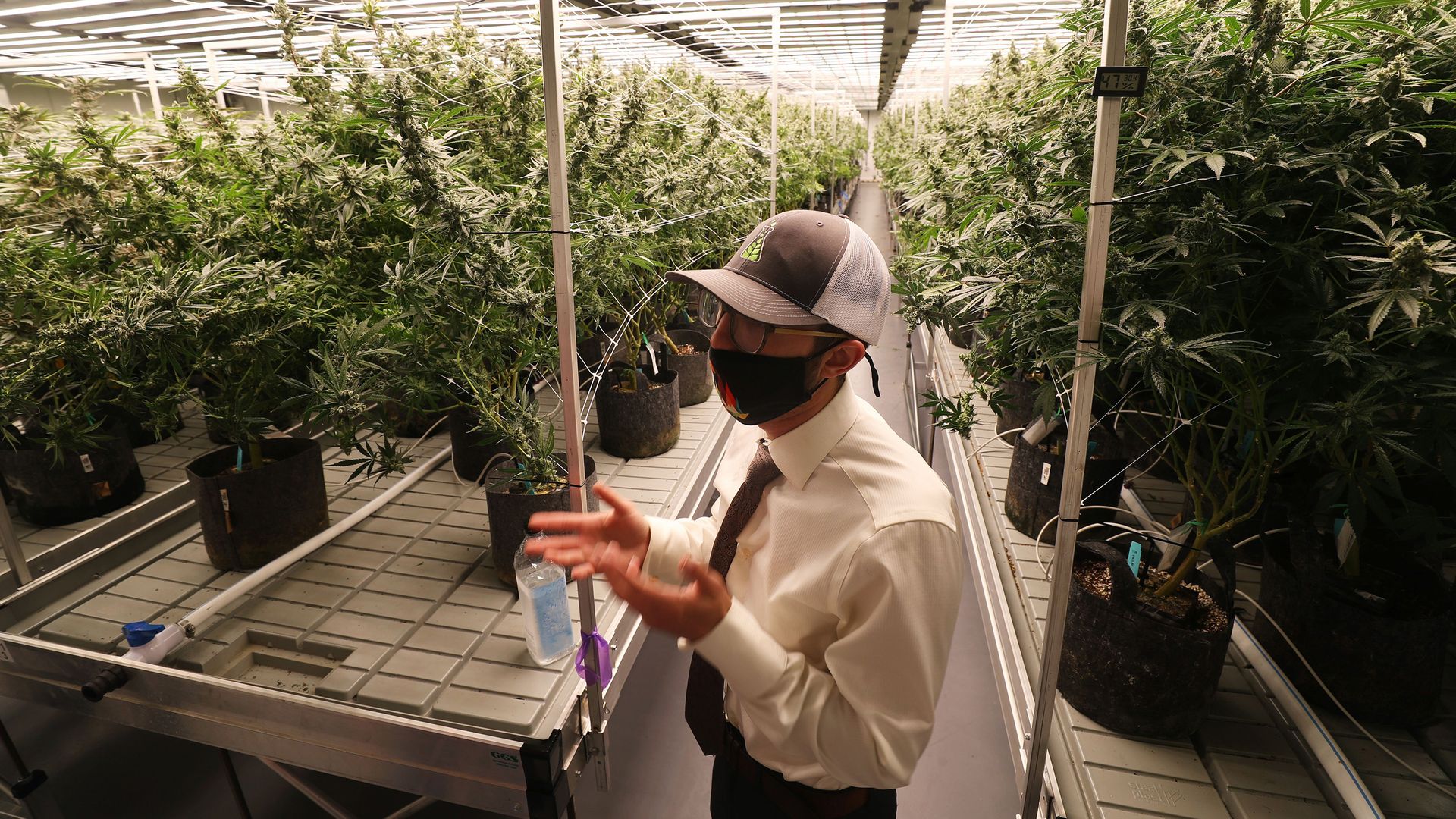
Officials with the Department of Health and Human Services (HHS) recently recommended the Drug Enforcement Administration (DEA) to move marijuana to a lower-risk category under the Controlled Substances Act.
Why it matters: Easing federal restrictions on marijuana could eliminate some of the hurdles facing the country's growing cannabis industry, such as access to banking services, and would potentially allow it to expand, according to Bloomberg, which first reported on HHS's recommendation.
Indeed, the online job search company, is offering transgender employees who want to relocate for care or support a $10,000 benefit to cover expenses, the company confirmed to Axios on Wednesday.
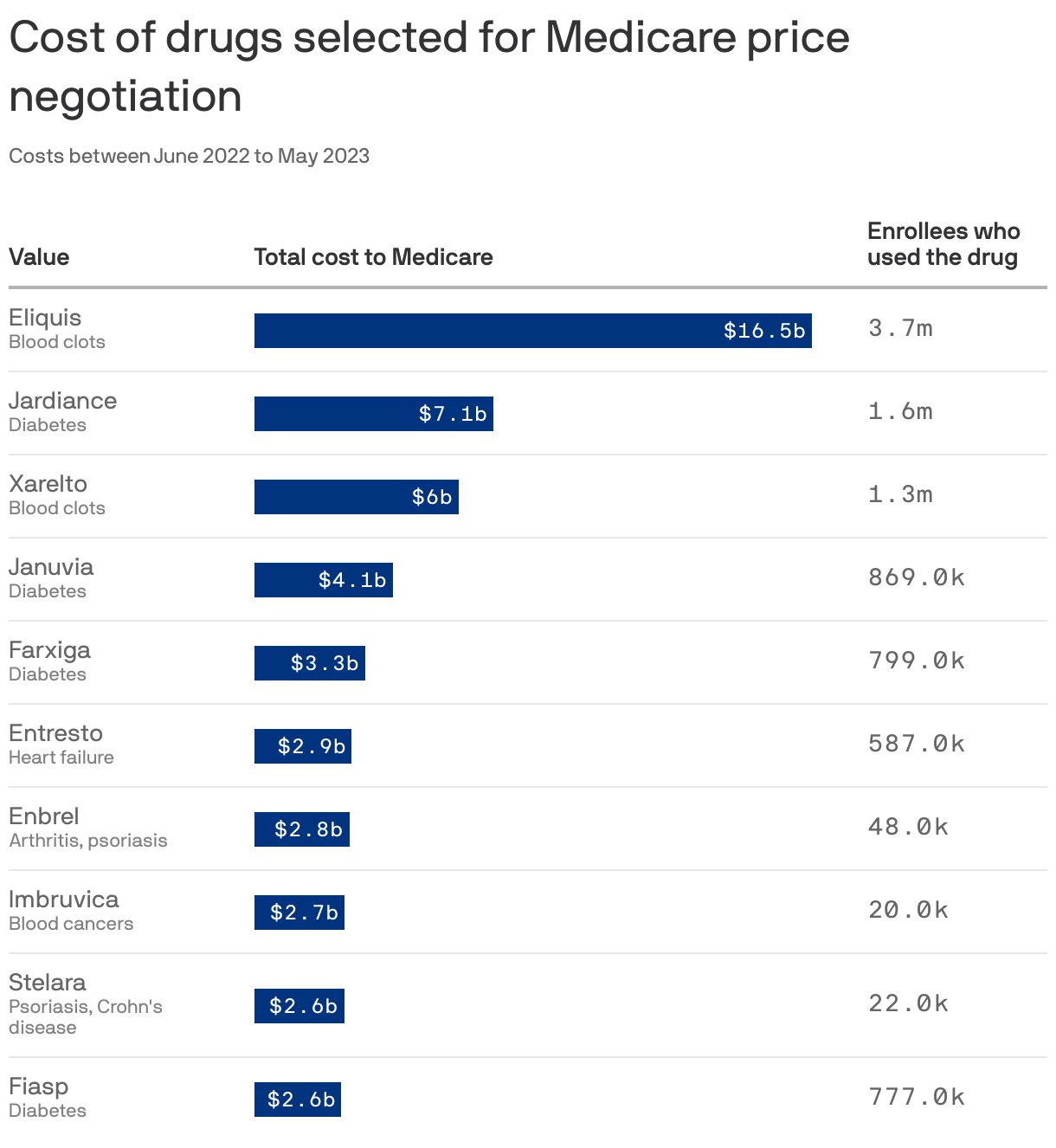
Data: Centers for Medicare and Medicaid Services; Chart: Erin Davis/Axios Visuals
The Biden administration says the 10 medicines selected for the first round of negotiations cost Medicare $50 billion in the last year.
Yes, but: The numbers don't account for discounts from manufacturers, or rebates secured by health insurers and drug benefit managers.
By the numbers: The blood thinner Eliquis, made by Bristol Myers Squibb and taken by 3.7 million Medicare enrollees, cost the federal government more than $16 billion between June 2022 and May 2023.
The first opioid overdose treatment to be sold without a prescription will hit store shelves next month — but at a price some experts worry is too high for widespread use.
Why it matters: The individuals with the greatest need might not be able to afford a co-pay, if health plans even opt to cover over-the-counter Narcan, which will retail for $44.99.
U.S. companies are spending big on employees' health, often with little insight into whether they're paying for quality care.
Why it matters: Whether patients are given and stick with the best documented course of care — such as statins for heart disease — can have everything to do with what doctor they go to.
Electrolyte supplements have become a shockingly big market considering they're supported by limited scientific evidence.
Why it matters: Although influencers and marketers consider electrolyte powders hydration hacks, doctors say that regularly drinking them instead of plain water is a waste of money.
Depending on who you ask, the first-ever Medicare drug negotiations announced yesterday will either mean huge pocketbook relief for seniors or the demise of America's pharmaceutical industry — but the immediate impact will likely be relatively small, experts told Axios.
Why it matters: There are still questions about how the Biden administration will arrive at what it thinks is a fair price for the drugs and how much of the savings from lower prices will ultimately be passed on to seniors.
The blood-thinners Eliquis and Xarelto are among the 10 prescription medicines the Biden administration will seek lower Medicare prices for under a new program allowing the government to negotiate drug prices for America's seniors.
Why it matters: The administration's landmark announcement Tuesday detailed the first-ever set of drugs subject to Medicare price negotiations, a longtime Democratic priority included in last year's Inflation Reduction Act over drug companies' fervent objections.
Uruguay is tackling its staggering suicide rates by offering free antidepressants and establishing youth social and mental health centers as part of a national plan to promote wellbeing.
The big picture: The country's average suicide rate last year was more than double that in all of Latin America. There were 23 suicides per 100,000 people in 2022, up from 20 in 2019. The regional average last year was 9 per 100,000 people.
Danaher, a Washington, D.C.-based life sciences conglomerate, agreed to buy Abcam, a British provider of biological reagents for $5.7 billion in cash (including debt assumption).
Why it matters: Abcam is often called the "Amazon of antibodies," and will allow Danaher to provide its lab equipment customers with a broad range of consumables.
Hospitals' financial performance worsened in July due to a summertime drop in outpatient business and ongoing Medicaid redeterminations in more than 30 states, the consultancy Kaufman Hall said in its latest industry report.
The big picture: While there was some improvement in operating margins compared to last year, bad debt and charity care as a percentage of hospitals' gross operating revenue rose 7% from June to July.
Schools across the country are missing out on millions of dollars from an unlikely federal source — Medicaid — because of longstanding bureaucratic hurdles that the Biden administration is now trying to address.
That's according to an investigation by NPR freelance reporter Shasta Kearns Moore and Axios' Emily Harris (who began the investigation while at NPR).
In the year since the passage of Democrats' drug pricing law, pharmaceutical companies and venture capitalists have shifted their priorities and placed less emphasis on developing synthetic drugs that will be subject to price negotiations faster than biologics.
The big picture: Pharmaceutical interests say it's proof that Democrats' signature health policy achievement is driving investment away from some mainstays of modern medicine.