Investors are scrutinizing the AI trade amid concerns that companies may be throwing money into a bottomless pit.
Why it matters: Not all AI spending is created equal. Investors are drawing a harder line on companies that fail to show how today's AI investments will translate into profits.
Disney on Wednesday said it will move most of its consumer products business from its experiences segment to its entertainment division, bringing its expensive intellectual property closer to lucrative merchandise sales.
Why it matters: The change, which goes into effect this October at the start of Disney's fiscal year, supports the company's efforts to build higher-margin flywheels from its marquee franchises.
Private employment data suggests that the labor market might be tighter than the headline hiring numbers alone suggest, with worker pay accelerating alongside lackluster jobs growth.
Why it matters: Employers are pulling back on hiring as they navigate an uncertain economic outlook, but supply constraints continue to limit the pool of available workers in some industries.
Amazon-owned Zoox is about to start scaling its robotaxi service after federal regulators last week cleared it to charge for rides in its driverless vehicles with no steering wheel or other human controls.
Why it matters: Zoox and Amazon are playing the long game, betting a purpose-built vehicle and a self-sufficient business model can crack a market that's become almost synonymous with Waymo.
Driving the news: The average rate on a 30-year fixed-rate mortgage rose to 6.81% last week, the Mortgage Bankers Association said Wednesday morning, the highest in a year. Mortgage applications fell 2.9%.
Disney on Wednesday announced an agreement to sell its 50% stake in A+E Global Media for $1.2 billion in cash to Hearst, which would gain full ownership when the deal closes next month.
The big picture: Disney keeps cutting its legacy cable cords — mirroring its customers — even if that means losing a profitable business and deep content library.
Traders and bankers are set to see big bonus increases this year, significantly outpacing other sectors in finance, per a new report out Wednesday morning.
Why it matters: A booming stock market, the AI investment surge and a pickup in deal-making are turning 2026 into "the year of the bank," finds the analysis from compensation consulting firm Johnson Associates.
You can chalk it up to the resilience of the U.S. economy, the firm's president Alan Johnson tells Axios.
Who cares about war, oil prices, interest rates or an AI bubble? Investors apparently do not — for now at least — sending stocks back to record highs.
Why it matters: High stock prices are critical to keeping funds flowing to the AI buildout.
A significant erosion of investors' confidence in stocks would be a big risk to the AI flywheel of financial flows, capital expenditures and industrial activity driving the U.S. economy.
The Trump administration's rosy promises of a new "golden age" with 6% economic growth have fizzled on the realities of slower-than-anticipated growth and souring consumer sentiment.
Why it matters: President Trump's roller coaster economy has risen with consumer spending and AI investment but also tumbled on tariff uncertainty, stubborn inflation and his Iran war, muddling the economic picture.
Top Pentagon officials are already pitching reconciliation 4.0 to Senate Republicans behind closed doors, underscoring the need for a massive boost in military funds, Axios has learned.
Why it matters: Thune hasn't embraced reconciliation 3.0. The White House is already looking beyond it.
Polymarket is making a bigger push into live sports, partnering with the ATP Tour — the global governing body of men's professional tennis — to pair official tennis match streams with real-time prediction markets data.
Why it matters: This deal is different from Polymarket's other sports partnerships because it goes beyond branding and official data into live media rights and product integration.
SpaceX exceeded revenue expectations and reduced its losses in its initial quarter as a publicly traded company, delivering sharp increases in all three of its divisions: space, connectivity and AI.
The company's stock was down more than 8% in after-hours trading. During the trading day, the shares ended up 9.4%, at $125.33, as investors anticipated the earnings report.
Why it matters: SpaceX has been under the microscope — with shares falling below their IPO price of $135 — as investors look for Elon Musk to deliver AI advancements.
The U.S. labor market remained on a solid trajectory in June, as employers cut back on the number of job postings but increased their rate of hiring.
Driving the news: That's the upshot of the Job Openings and Labor Turnover Survey issued Tuesday morning, which affirms a basic resilience in the job market also evident across a range of indicators.
Key sectors of the economy that spent years squeezed by high interest rates are gaining momentum.
Why it matters: For years, manufacturing and construction were among the clearest signs that the Federal Reserve's tightening campaign — reversed only somewhat at the end of last year — was weighing on the economy.
Now, manufacturing and construction are early sources of job growth, helped by an AI investment boom that has so far been unconstrained by still-high borrowing costs.
Bending Spoons on Tuesday said it has agreed to acquire Airtable, a San Francisco-based relational database company, for $1.29 billion in cash.
The implied equity value is $2.25 billion, including Airtable's cash and cash equivalents.
Why it matters: This is one of the first major SaaSpocalypse sales, and an absolute crater for many of Airtable's venture capital investors, despite the unicorn-level sale price.
Less information from the Federal Reserve would likely make the markets more volatile and market pricing more "error-prone," Goldman Sachs chief economist Jan Hatzius wrote in a note Monday.
Why it matters: Markets won't stop trying to predict the Fed's actions in the face of less information — investors will likely make the same guesses, only with less evidence and a greater chance of getting it wrong, he argued, echoing the concerns of several other analysts and economists.
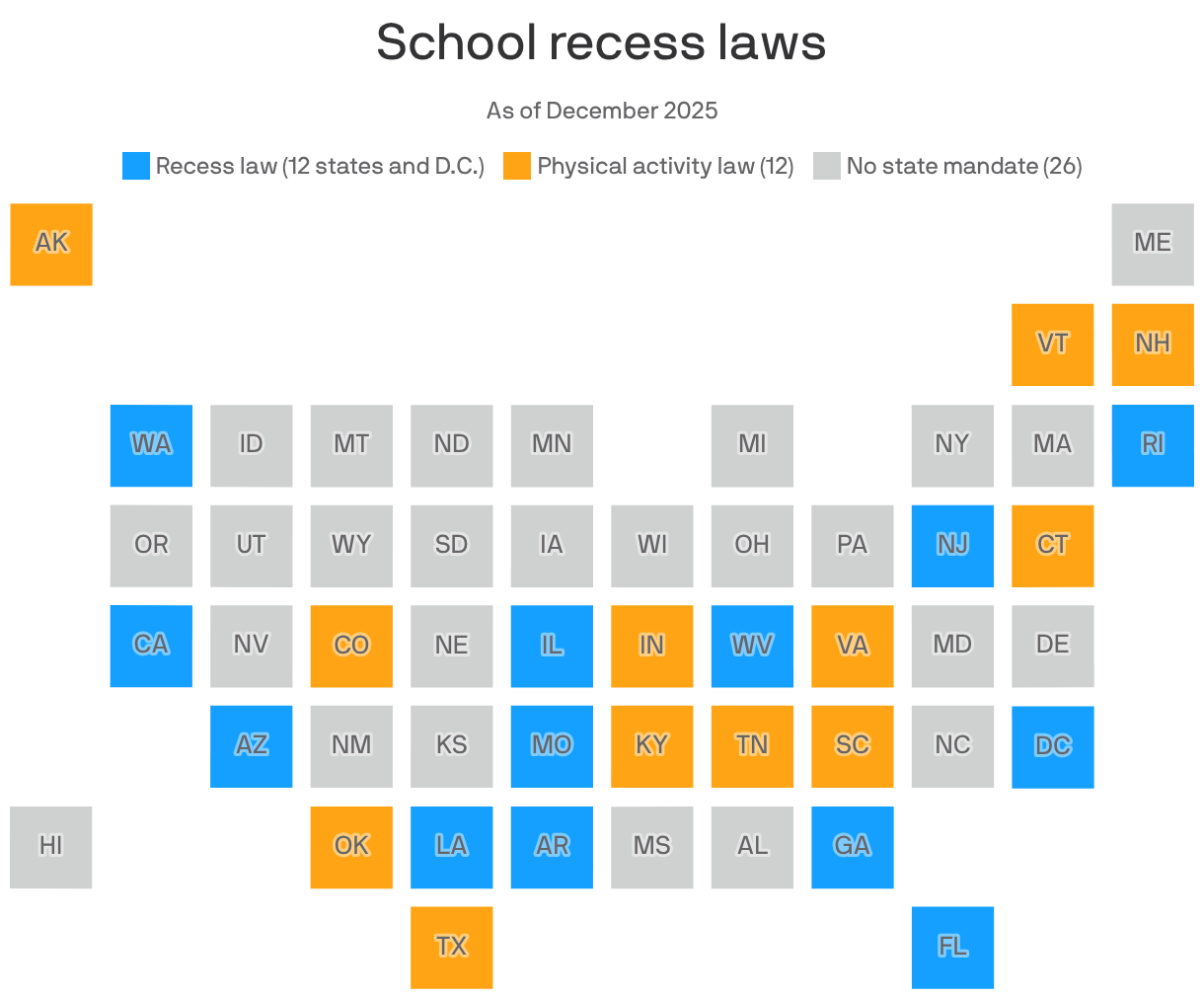
Data: Johns Hopkins Bloomberg School of Public Health research via Bloomberg American Health Initiative; Map: Sami Sparber/Axios
After decades of diminishing recess time, half of U.S. states now require it or other physical activity by law.
Why it matters: Yes, recess is literally child's play. But researchers, pediatricians and parents say it's crucial for young students' physical and mental health.