SpaceX is testing market gravity

Add Axios as your preferred source to
see more of our stories on Google.
Illustration: Aïda Amer/Axios. Stock: Getty Images
Elon Musk's galactic AI rocket-social media company faces two big tests this week: reporting its first financials as a public company and potentially coping with a flood of unlocked stock.
Why it matters: Investors aren't exactly eager to scoop up shares. Judging by the SpaceX stock price, Musk's power to drive investor excitement is already fading.
- The company's stock market debut is increasingly looking like a cautionary tale for the two other mega-cap IPOs coming down the pipeline, Anthropic and OpenAI.
By the numbers: Since SpaceX's IPO on June 12 at $135 a share, its shares have fallen nearly 20% — closing at $108.37 on Friday.
- The company lost $772.8 billion in market cap between June and July — a record.


Zoom out: A supply and demand situation is playing out here. SpaceX made a very small percentage of its stock available to investors when it went public, less than 5%. That means there was high demand for only a wee bit of stock. And even then, the pop faded.
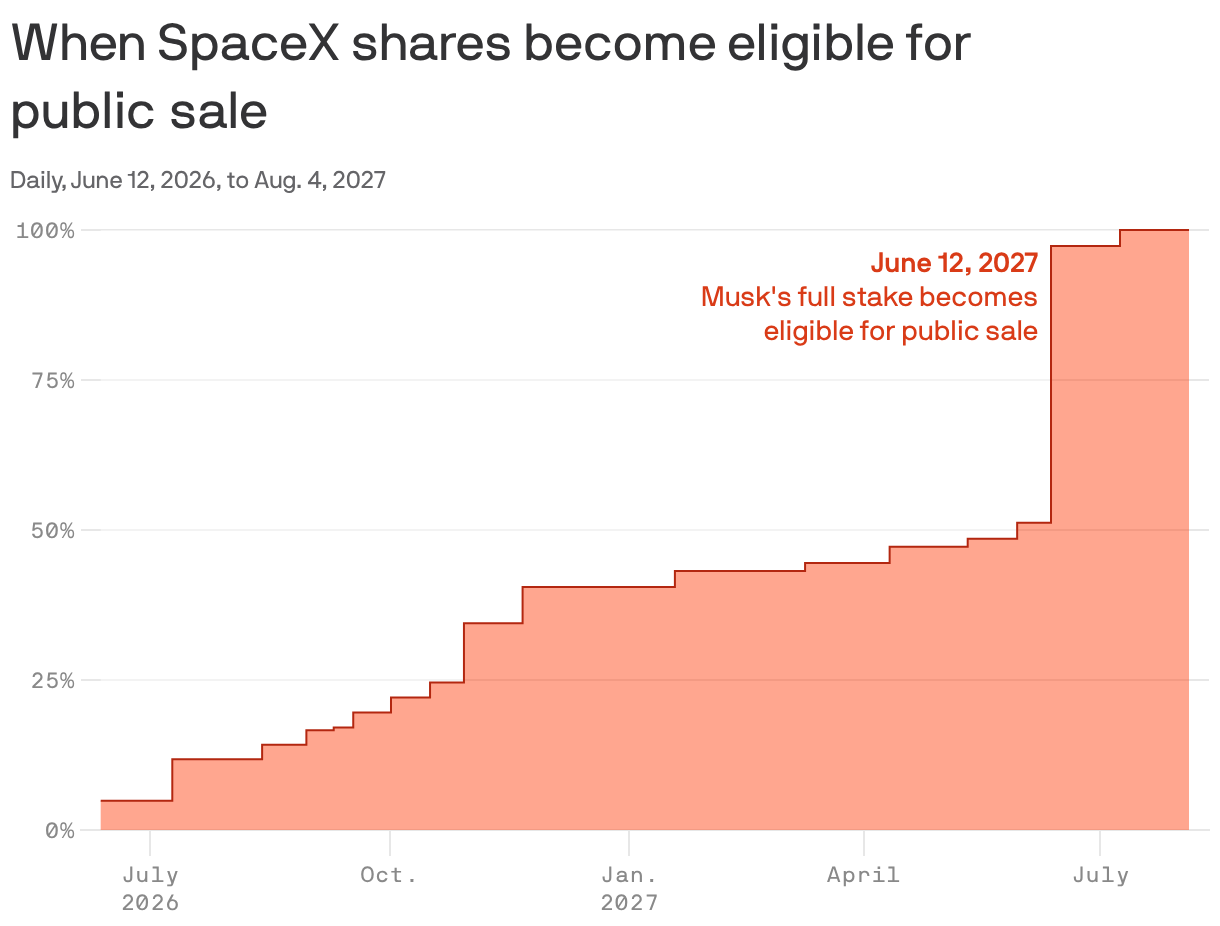
Where it stands: Now, more supply is on tap. On Thursday, two days after the earnings report, SpaceX employees and some early investors will be able to sell 911.5 million shares — 12% of the total, and more than the 640 million currently on the market.
Follow the money: A lot of those folks need to sell, says venture capitalist Paul Kedrosky. They've pledged their stock to buy homes, "private islands, cars, whatever," he says.
- That puts downward pressure on the price.
- In anticipation of this, short sellers are piling in — betting the share price will go down, Bloomberg reported Friday
What they're saying: "When lockups expire, that does put downward pressure on stock prices," says Jay Ritter, the University of Florida economist known as Mr. IPO.
- And the SpaceX unlock is unusually large because of the initial tiny float. "It's quite possible there will be a little bit of a further dip in the share prices."
Yes, but: Not all the unlocked shares will wind up on the market, he says.
- And, perhaps counterintuitively, all those short sellers will be effectively supporting the share price when the lockups do expire later this week.
- Eventually they do have to buy back stock to cover their positions, and some of them might do so in the wake of the unlock.
The intrigue: The SpaceX IPO may well have been the moment the market began to turn on the AI trade, Kedrosky and others have said.
- Investors looking to buy SpaceX at share prices that analysts are increasingly seeing as overvalued also sold other assets — particularly those that had seen the most gains this year, like chip stocks.
- Since the IPO in June, those stocks saw sharp drops in value. (So steep in fact that they contributed to the near blow-up of hedge fund Situational Awareness.)
Between the lines: "You can expect the exact same phenomenon happening two more times," Kedrosky says, if and when Anthropic and OpenAI IPO with similarly small floats.
Flashback: Remember the dot-com bubble and how it burst at the turn of the last century? Widely cited research from that era attributed some of that collapse to the expiration of lockup agreements putting more stock onto the market.
What to watch: More shares unlock through the year. By next June nearly 50% of SpaceX's shares will float on the public markets, and the rest will be in Musk's hands.
