School recess is back in play

Add Axios as your preferred source to
see more of our stories on Google.
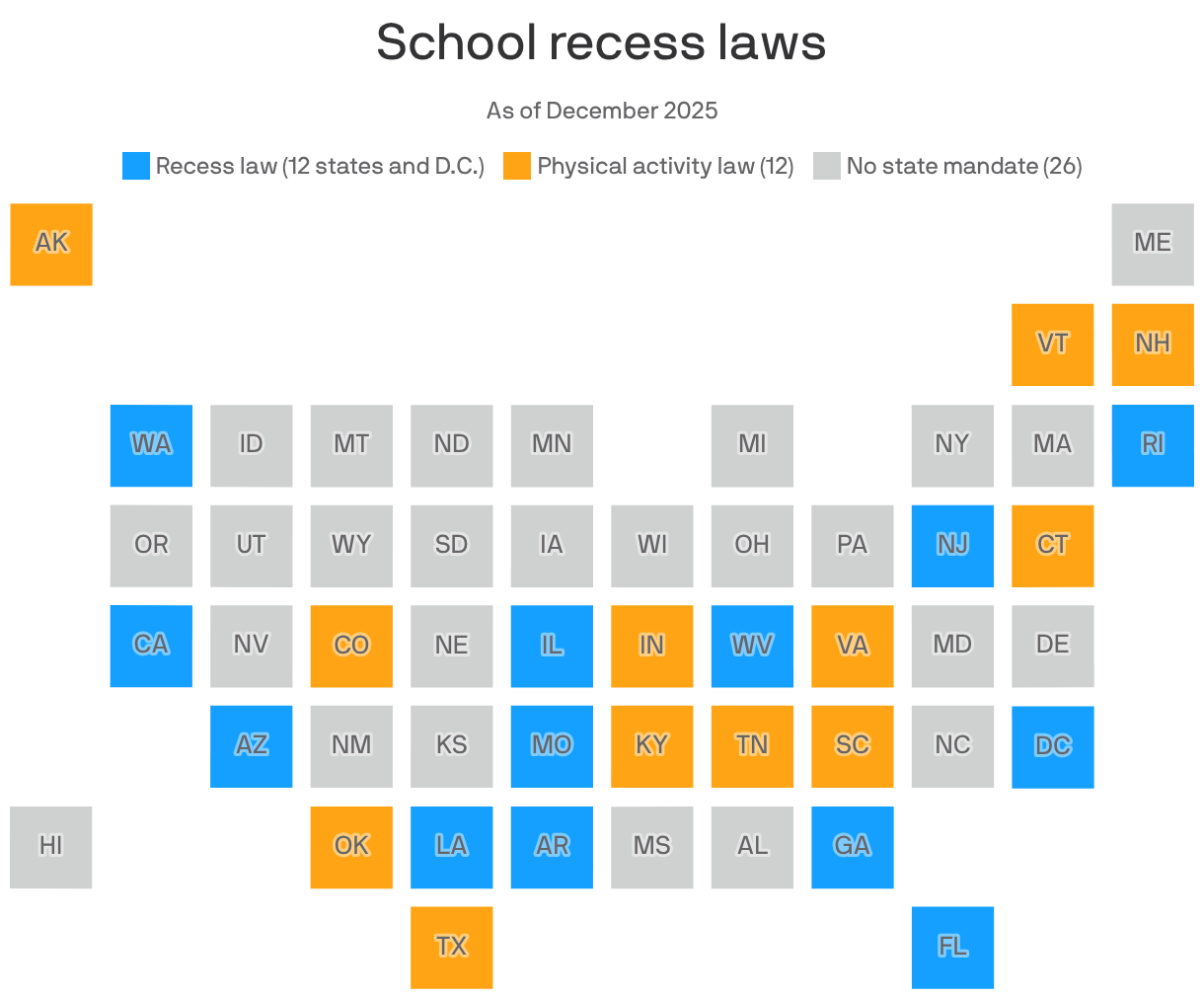
After decades of diminishing recess time, half of U.S. states now require it or other physical activity by law.
Why it matters: Yes, recess is literally child's play. But researchers, pediatricians and parents say it's crucial for young students' physical and mental health.
By the numbers: As of December, school recess was mandated in 12 states and D.C., and laws requiring physical activity existed in 12 states, according to Johns Hopkins research.
- Most recently, Oklahoma's law mandating 40 minutes of daily recess became effective in July.
Between the lines: "Physical activity" laws are broader than "recess" ones.
- They can include after-school sports and gym class. And, separately, nearly every state has PE legislation.
- But physical activity and phys ed laws don't necessarily require free play, which advocates say is a daily necessity for kids.
The big picture: Unstructured play doesn't just teach social skills, but research connects it to increased classroom motivation and behavior, better school attendance, and less stress for students.
- And more physical activity could help academic performance.
What they're saying: "Recess gives you a better feeling about school. Recess refreshes you. Recess helps you feel a little bit less cynical about what's going on," says psychologist Peter Gray, author of the forthcoming book "Restoring Childhood."
- "Anyone who's ever spent even a day with a kid can recognize that if you kept them sitting all day, they'd go insane, they'd drive everybody else insane," says Hannah Thompson, a physical activity epidemiologist with the University of California, Berkeley's Nutrition Policy Institute. "Everybody needs recess."
- Although schools don't tend to fight the idea of recess itself, Thompson says it can be a challenge for administrators to carve out more time for it and ensure it's not withheld as punishment.
Catch up quick: From 2001 to 2019, weekly recess time in U.S. schools dropped by 60 minutes, education consulting company EAB found.
- One oft-cited factor for the decline: The signing of "No Child Left Behind" in 2002, which led to more time focused on reading, math and school testing — and less on recess.
The latest: We're in an upswing when it comes to recess advocacy and legislation, Thompson tells Axios. And the cause has attracted widespread support.
- In June, conservative policy group The Heritage Foundation hosted an event about the importance of recess.
- In May, the American Academy of Pediatrics updated its policy statement on the "crucial role of recess" to recommend it for not just elementary but middle school and high schools for at least 20 minutes.
- And last year Say Yes to Recess, a parent-led advocacy group, became a national nonprofit, with chapters across the country.
Yes, but: There's no federal tracking system ensuring that recess laws spark change.
- Thompson's team is monitoring California's 2024 recess law by scraping school websites for bell schedules before and after its passage.
The bottom line: "More recess" isn't just a student council campaign promise — it's increasingly seen as essential to the school day.
