General Motors, the largest U.S. automaker, is seeking to become more of an energy company, turning electric vehicles into grid assets and batteries into fuel for AI data centers.
Why it matters: The moves are another sign of how automakers are investing in opportunities far beyond transportation, leveraging battery technology as EV growth has cooled.
Another sharp selloff hit tech stocks Tuesday, with some AI-related shares posting double-digit losses shortly after noon ET.
Why it matters:Tech shares have been the engine of a stock market rally that has driven the S&P 500 up more than 75% over the last three years through last week.
President Trump said the U.S. military has determined that Iran shot down the U.S. helicopter that crashed on Monday in the Strait of Hormuz and pledged a military response.
Why it matters: The incident took place amid U.S.-Iranian negotiations and just a day after Trump brokered a renewed ceasefire between Iran and Israel. It could ignite a fresh round of escalation.
The Social Security trust fund is on track to run out of money in late 2032, its trustees said in a new report Tuesday, three months sooner than projected last year.
Why it matters: If Congress doesn't act to address the long-anticipated shortfall, millions of Americans would receive a 22% reduction in retirement benefits.
Traditional financial firms are rapidly embracing crypto, marking a turning point for an industry that once viewed digital assets as a threat.
Why it matters: A long-running rivalry between Wall Street and crypto is disappearing, with financial institutions racing to meet growing demand for digital assets from retail and institutional investors.
The market for many typesof white-collar professional workers is bad. The overall U.S. job market is pretty healthy. There is less of a contradiction here than it might seem.
The big picture: These are gloomy times for many office workers — their employers shedding payroll, their livelihoods threatened by AI. But the jobs seemingly under the greatest threat right now amount to a small share of overall employment.
It's a foregone conclusion that SpaceX will raise at least $75 billion in its record-wrecking IPO, with pricing set for Thursday and first trades for Friday.
Artificial intelligence will fuel job creation on main streets across America, Small Business Administration administrator Kelly Loeffler predicted Tuesday at Axios' AM Live in Washington, D.C.
President Trump's comment that he doesn't "care" about midterms has been misinterpreted,National Republican Congressional Committee chairman Rep. Richard Hudson said Tuesday at Axios AM Live.
Why it matters: The president's war in Iran has jacked up prices, and there is growing concern that his unfulfilled promise to address cost-of-living issues could cost Republicans the Senate and the House.
Bank of America's top U.S. stock market analyst called out a number of red flags she has seen emerge from the recent market run-up.
Why it matters: It's rare that analysts employed by Wall Street come close to suggesting that investors "sell." (After all, Wall Street is in the business of distributing stocks and bonds to the public. That sales job will likely be tougher if analysts at Wall Street banks are warning that prices for those securities are going to fall.)
Driving the news: Bank of America's head of U.S. equity and quantitative strategy, Savita Subramanian, published a note late Friday entitled "Too many red flags. Take profits." She wrote:
"Our bear market signposts — the triggers that typically precede an S&P 500 peak — suggest additional caution may be warranted. Today, 70% of our signposts are triggered, in line with the average observed in prior market peaks."
These "signposts" are market condition metrics. They include unusually high expectations for long-term earnings growth, very easy credit conditions and extreme dispersion between the performance of stocks with high and low price-to-equity ratios, to name a few.
What they're saying: "Dispersion has been most pronounced within Tech, where the spread between the best/worst performing quintiles' median stock is a whopping +120 [percentage points], the highest since Feb. 2000, which reached +130 [percentage points] ahead of the market peak of March 24, 2000," she wrote.
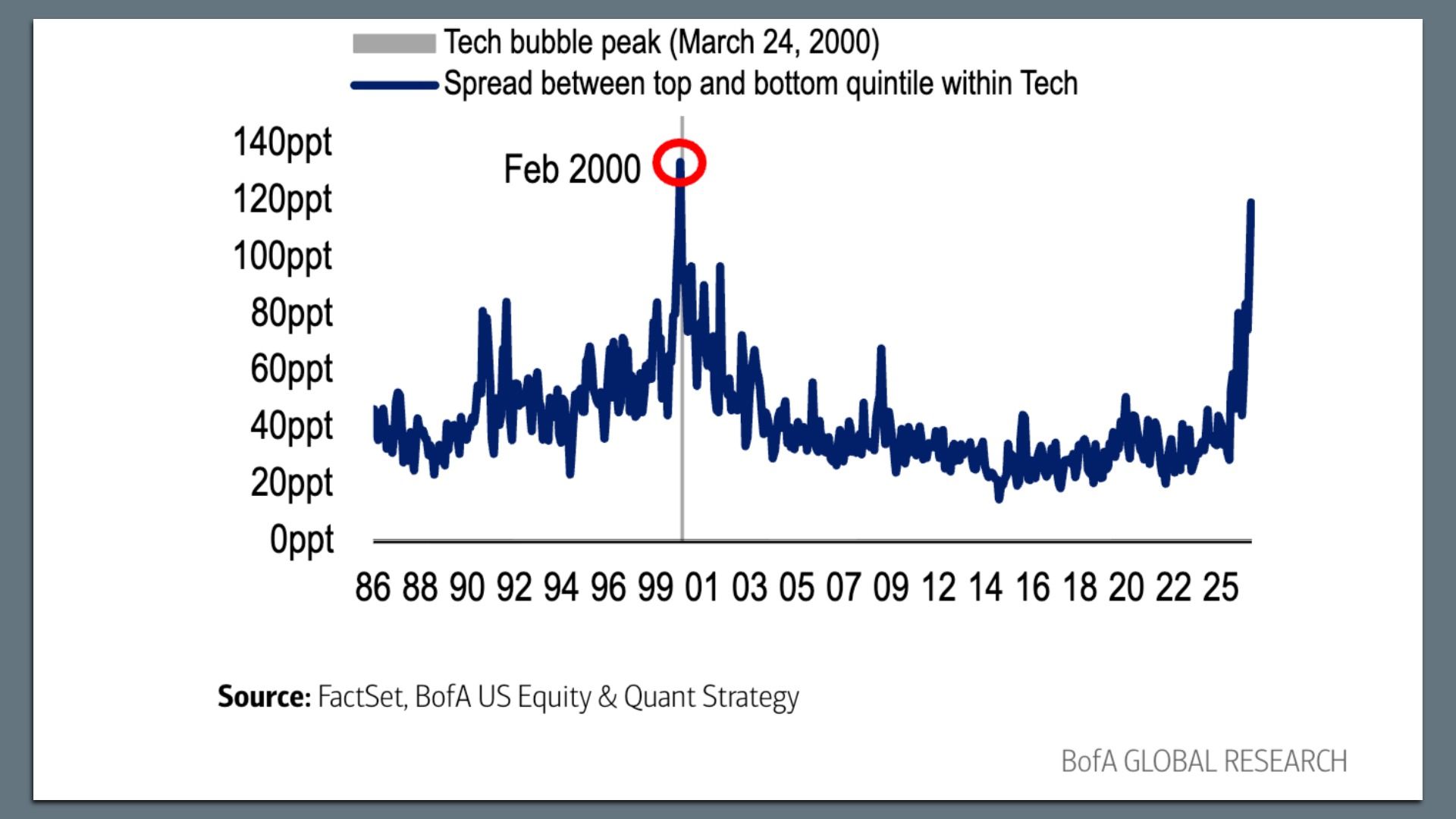
Image: Bank of America Global Research
Yes, but: This is just one analyst's view. After Friday's market jolt — in which the Nasdaq 100 tumbled 4.8% and the SOX semiconductor index dove 10.3% — plenty on Wall Street had more reassuring things to say.
Morgan Stanley's chief U.S. equity analyst, Mike Wilson, wrote that "in our view, a correction was inevitable and ultimately healthy if this bull market is going to extend into year-end, which remains our baseline."

Add birth control to the list of things an iPhone can do: The introduction of Apple's smartphone in 2007 helped lower U.S. fertility rates, especially among teens and young adults, a new paper concludes.
Why it matters: Researchers and policymakers have been scrambling to pinpoint why exactly birth rates are falling in the U.S. and around the world.
Smartphones and the rise of social media are hardly the sole factor — birth control access and economic concerns like child care and housing costs are also debated — but the paper offers some intriguing evidence that helps explain the overall trend.