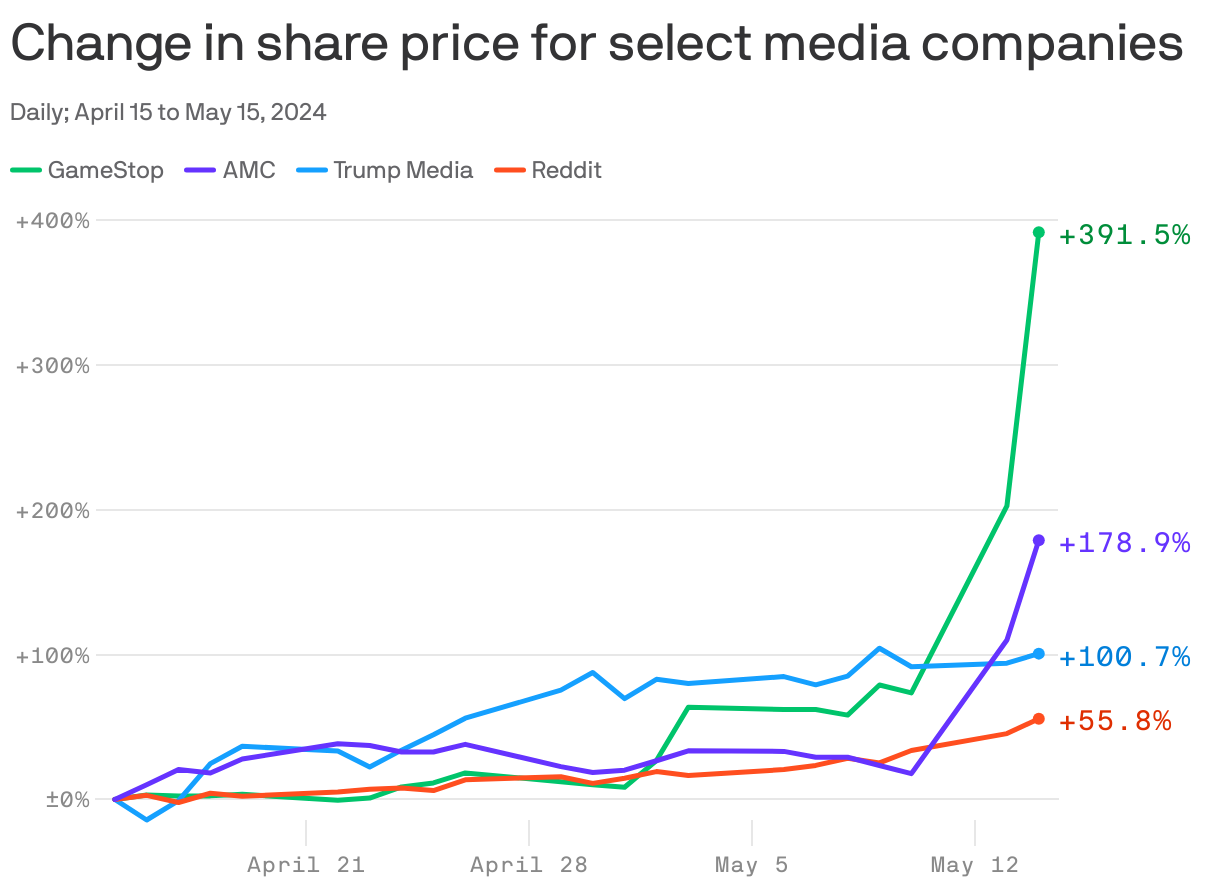
The meme stock resurgence continued through a second day.
The intrigue: One beneficiary, AMC Entertainment, said it had reaped about $250 million from a previously announced equity offering completed yesterday. (Most of that will go toward paying down debt.)
The company sold 72.5 million shares for an average of $3.45 in a sale it launched March 28.
A new roller coaster billed as "the World's Tallest & Fastest Triple-Launch Strata Coaster" has been temporarily shut down a week after it opened at an amusement park in Ohio.
State of play: Cedar Point said on Facebook that it is indefinitely closing Top Thrill 2 to complete "a mechanical modification to the ride's vehicles."
The ride includes two 420-foot-high crests and a top speed of 120 mph.
Zoom in: "Early speculation has centered on a 'shimmy' or vibration that occurred on the trains during early runs of the ride," Cleveland.com reported.
💭 Nathan's thought bubble: This will not help convince me to make my roller coaster debut.
Krispy Kreme is teaming up with the Queen of Country on its first-ever celebrity doughnut line.
The big picture: The Dolly Southern Sweets Doughnut Collection launched Tuesday includes four Dolly Parton-inspired limited-time doughnuts sold at Krispy Kreme shops and select grocery stores.
It was 2021. People were bored and stuck at home. Stimulus checks piled up. Interest rates were zero. And a series of unhinged rallies drove meme stocks to prices far above any plausible fundamental value.
The big picture: The stance of monetary policy is radically different now, yet meme stocks are having a new moment, along with speculative crypto assets and other hallmarks of that bubbly environment three years ago.
Alexey Pertsev, the Russian national arrested in the Netherlands for developing cryptocurrency privacy application Tornado Cash, has been sentenced to 64 months in prison.
Why it matters: The judgment is likely to make other software developers reluctant to work on privacy-preserving technology in the future.
Why it matters: The ability to generate thousands of new meme tokens at very low cost, in the hopes that one of them really grabs the public, has been the killer use case on the Solana blockchain this year.
A few months ago, we wrote that the blockchain industry was throwing down in a battle over open-source AI versus closed.
Why it matters: It's a fight between people who want free expression and those who want safe expression.
The latest: Erik Voorhees, founder of the ShapeShift exchange, and a cypherpunk from way back, has launched a consumer app for AI built on the open-source Nous AI.
The app, called Venice, says it doesn't store your questions.
The inference computers responding to requests don't know who is sending them.
It also doesn't censor answers.
What they're saying: Voorhees wrote a detailed essay about the new app connecting the separation of church and state to the separation of the state and artificial intelligence.
"Every person who has used the leading AI apps has observed the weird, creepy, paternalistic censorship, and it's getting worse. Are you interacting with AI, or with a multi-billion dollar bias simulator?" he writes.
An op-ed Friday in Blockworks called it foolish for anyone to throw their vote away for crypto, and it kicked off a big conversation on social media.
Two industry scions, Nic Carter (investor) and Erik Voorhees (entrepreneur from way back, (see his latest in 3️⃣)) weighed in thoughtfully on how partisan the technology is (h/t Fortune).
Flashback: Whatever it is, its proponents are spending mega money on this election.
An increasing share of Americans fell behind on their credit card payments at the beginning of the year, according to data out Tuesday.
Why it matters: Rising credit card troubles are a sign that some consumers are feeling more financial stress — a worrying indicator for an economy that's been powered by strong consumer spending.
President Biden is set to announce massive new tariff increases on $18 billion worth of Chinese imports — including a 100% tax on electric vehicles.
Why it matters: The administration wants to keep cheap Chinese EVs out of the U.S. market and prevent domestic automakers (and workers)from getting crushed by the competition.