The stock price of Teva Pharmaceutical Industries shot up more than 7% in after-hours trading Wednesday after Warren Buffet's firm, Berkshire Hathaway, revealed it spent $358 million to buy 19 million shares in the drug company, representing 2% of Teva's outstanding shares.
Between the lines: Existing Teva investors are cheering Buffett's entrance, but the drug company still faces several problems. Teva is losing a ton of money, undertook massive job cuts, has $32.5 billion of debt, and recently found out its best-selling multiple sclerosis drug, Copaxone, will face a second generic competitor sooner than expected.
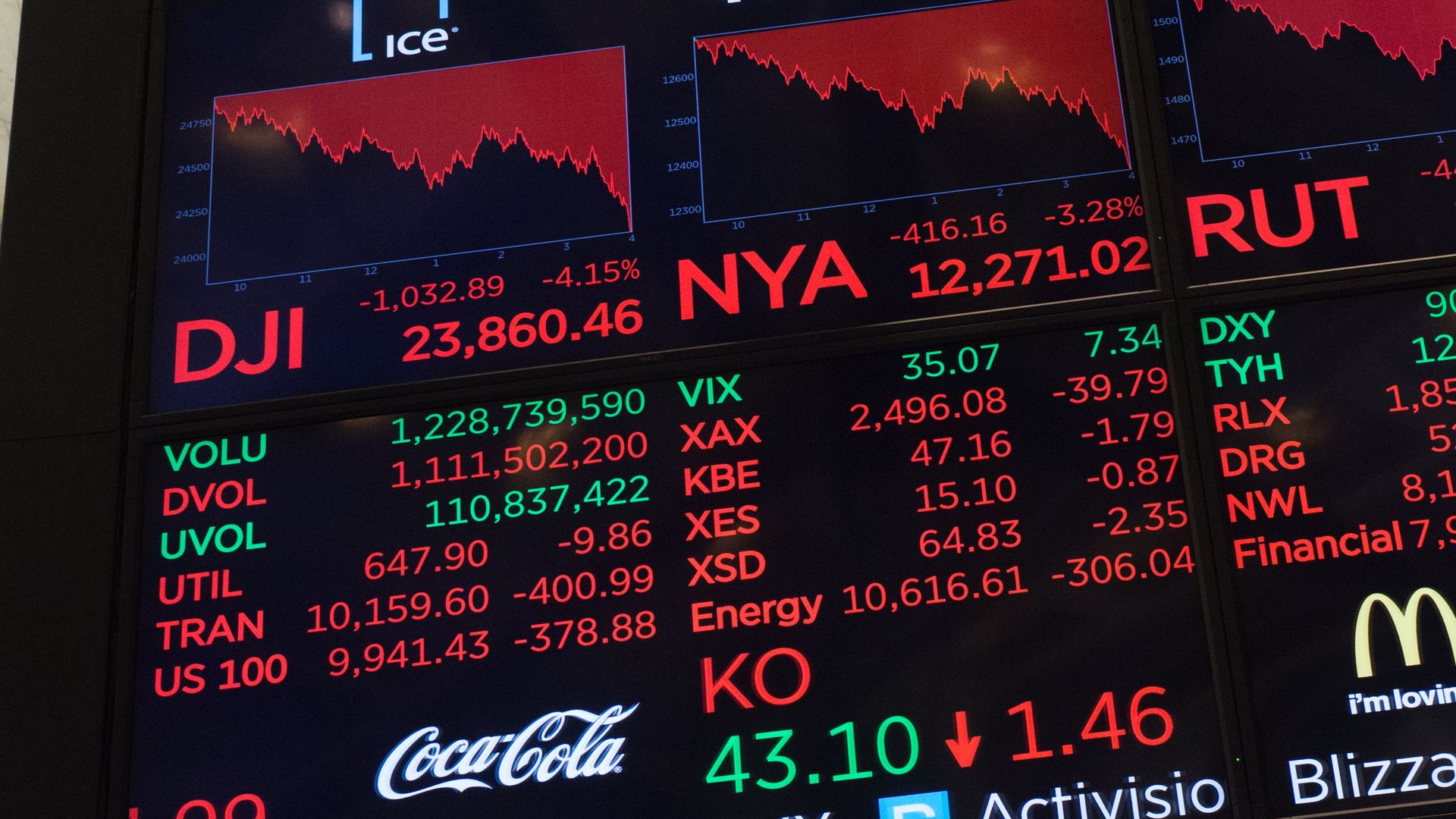
The Dow opened down by triple digits today following the release of the much-anticipated Consumer Price Index report, which showed prices rose 1.7% from a year ago against analyst forecasts of 1.5%. It finished the day up 253 points, or about 1%.
Why it matters: Coupled with last week's news of increased wage growth—which caused all three major U.S. stock indexes to finish the five-day trading period down 5%, per CNBC—investors fear inflation will cause the Federal Reserve to hike up interest rates.
Amy Goldstein's Janesville is this year's Hillbilly Elegy — the go-to volume for understanding what is really going on in the hearts of the U.S. midsection. The book chronicles six years in a Wisconsin town where the demise of its central actor — a General Motors plant — pushes many of its long-middle class residents into poverty.
Quick take: In a survey that Goldstein commissioned, she found that, contrary to the popular consensus, reskilling is not necessarily the answer for reemploying people thrown out of work.
Nicole Carroll will become editor in chief of USA TODAY effective March 2018. She replaces Joanne Lipman, who stepped down in December to focus on an upcoming book.
U.S. consumer price inflation climbed more than expected in January, which will likely heighten concerns that the economy is overheating, according to a Labor Department report released Wednesday.
Why it matters: The report has taken on higher significance after strong wage growth roiled the stock market, resulting in one of the most volatile trading months in years. The numbers may also add to investor fears that the Federal Reserve will raise interest rates at a faster pace than anticipated.
A new study of income inequality could be bad news for those expecting the GOP's tax cut to trickle down to the middle class. The report by the Brookings Institution found that some places saw shrinking gaps between the top and bottom of the income scale between 2014 and 2016 — but in other places, the gaps grew much larger.
Why this matters: This shows gains on one end of the income scale don't necessarily translate into gains at the other end, at least in the short term. It also suggests that different places have different economies, meaning one-size-fits-all national policy solutions aren't likely to be universally successful.
Amazon's move to provide shipping services to its business customers extends a trend at the e-commerce giant of subsidizing its operations by converting a cost center to a revenue source. For the first time, it puts Amazon in direct competition with key logistics providers FedEx, UPS and the U.S. Postal Service.
Why it Matters: Amazon has a history of disrupting incumbents’ billion-dollar categories (think: Amazon Web Services). Expect Delivery-as-a-Service (DAAS) to enter the e-commerce lexicon and shipping expenses to reduce their drain on the company’s earnings.
The Dow finished up 39 points Tuesday, recovering from an early loss of as much as 180 points. The Bureau of Labor Statistics will release its Consumer Price Index report tomorrow, which could give investors clarity into how much of a threat inflation really is, per CNBC.
The backdrop: February has proven to be one of the most volatile months for the stock market in years, pummeled by investor fears about inflation and higher interest rates. As Barron's pointed out over the weekend, "trading is expected to be choppier, and investors more nervous than they have been for two years." [Go deeper: Global markets could have "a much bigger shakeout coming"].
Why it matters: Consumption habits are being shaped by web platforms with expert engineering that are designed to maintain consumer attention and eyeballs. Less sophisticated consumer experiences, like slow websites or crappy apps, are being abandoned or intentionally avoided by consumers.
A new Interactive Advertising Bureau study finds that companies like Warby Parker, Blue Apron and Casper are not just fads, but are growing in response to an “enduring shift" in the way the consumer economy operates towards personalized, custom brands.
Why it matters: Americans are shifting consumption habits to brands centered on direct-to-consumer relationships. These distributors have nimble supply chains and are flexible enough to serve consumer needs in real-time.
Business executives across the globe—typically a chorus of free traders—favor barriers that would protect and foster technological advances in their own country, according to a new survey.
Quick take: The result, in a GE survey of 2,090 executives in 20 major economies, diverges from seven decades of broad business support for liberalized trade, which mainstream economists believe has powered rising prosperity and shrinking poverty.
John Oliver is getting ready to launch his fifth season of “Last Week Tonight” on HBO, a show that combines comedy with well-researched takes on the biggest news stories.
Why he matters: His show’s deep-dive segments on topics like corporate consolidation, net neutrality, the Sinclair-Tribune merger, the decline of local newspapers, vaccines and the Flint water crisis have triggered large public responses and even a few remarks from policymakers — although he says he's pretty sure President Trump doesn't watch the show. He answered reporters' questions in New York on Monday.
Snapchat is launching Snap Maps on the web to make its public and often hyper-localized content available outside of the Snapchat app. The public stories that you can view on the website (map.snapchat.com) can also be embedded directly into news organizations’ websites.
Why it matters: Consumers tend to trust news from local sources over national news sources, according to Pew Research Center and Morning Consult/Politico. Platforms like Snapchat are taking advantage this by using their unique ability to quickly crowdsource news, strengthening their positions in the news ecosystem.