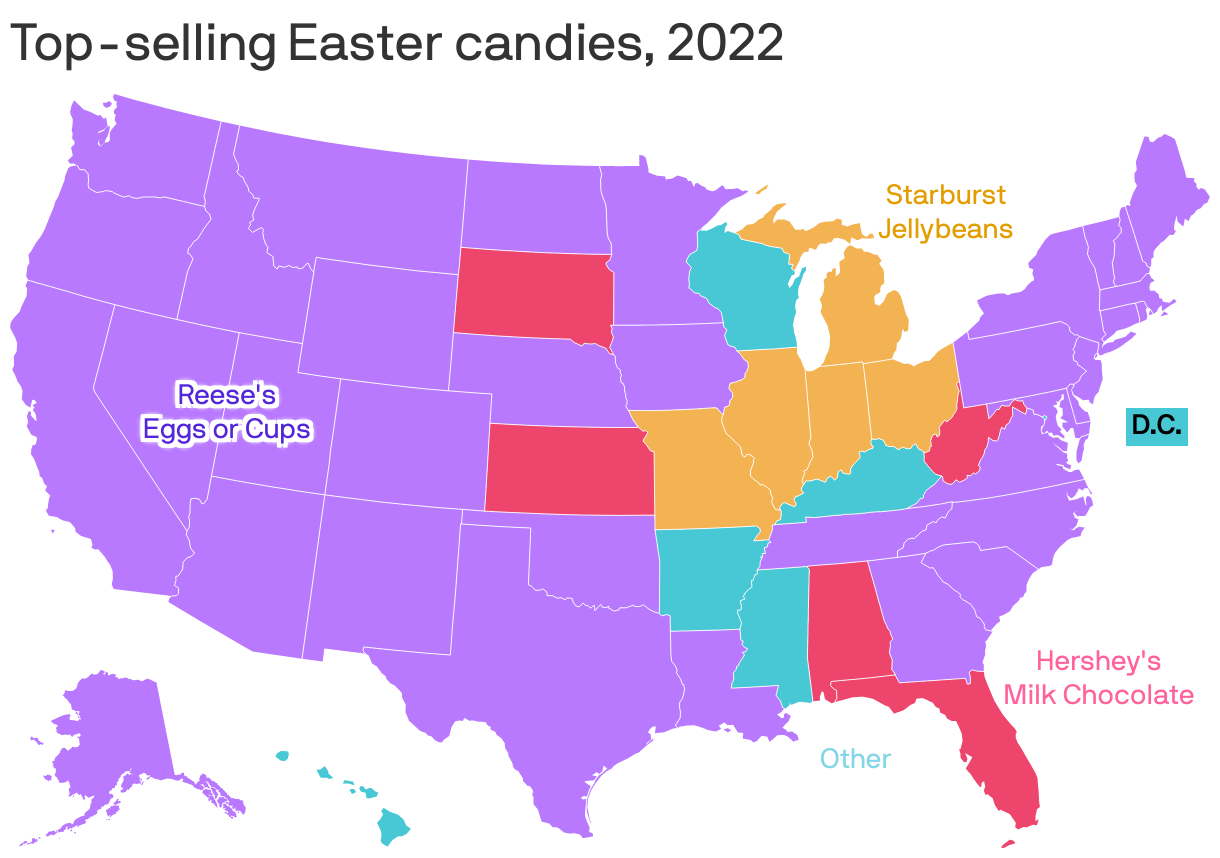
Reproduced from Instacart; Note: “Top-selling” candies are those with sales that grew more than 50% April 4-17, 2022 compared to the two weeks before; Map: Axios Visuals
Chocolate is king for Easter and America’s favorite candy is Reese’s Peanut Butter Eggs, according to data from Instacart.
Driving the news: The Reese’s eggs were the top-selling seasonal candy on Instacart last year in 29 states with Reese’s cups, Starburst Easter Jellybeans, and Hershey’s Milk Chocolate tied with five states each.
The 2008 financial crisis was caused, in part, by mortgage lenders taking on too much risk. Now, the pendulum has swung so far in the opposite direction that the private sector has all but ceased taking on mortgage risk any more.
Why it matters: Private-sector risk aversion has prevented millions of Americans from buying houses. It is also driving banks out of the mortgage game. That might be OK, if the nonbanks weren't disappearing too, and unlikely to return any time soon.
Americans continue to get hooked on pickleball and now two of the nation’s largest chains — Walmart and Subway — want in on the action.
State of play: Pickleball, which is a combination of tennis, badminton and ping-pong, was the fastest-growing sport in America for the third year in a row, according to a report from the Sports & Fitness Industry Association.
Why it matters: Credit Suisse's final years and hours were uniquely Swiss — which means that the way the bank was resolved is unlikely to provide much of a guide for investors looking at too-big-to-fail banks elsewhere.
As more people turn to fertility treatments to build their families, online invitation company Evite has launched a new "Parenthood Journey” category with invitations for IVF, egg freezing, and “rainbow" baby showers.
Why it matters: Approximately one in six people worldwide experience infertility at some stage in their lives, according to a new report from the World Health Organization and more companies are acknowledging the different paths people take to becoming a parent.
Investors drove Johnson & Johnson's stock up earlier this week after the company announced a proposed settlement with people accusing its talc-based baby powder of causing cancer — but it's far from a done deal yet.
Why it matters: Tens of thousands of alleged victims and families — whose claims mostly involved ovarian cancer — are hoping for compensation for their suffering.
Millennial homeowners outnumbered millennial renters for the first time last year, despite creeping interest rates and a tight real estate market.
Driving the news: Nearly 52% of the first generation to grow up in the Internet age — people born from 1981 to 1996 — were homeowners in 2022, making the largest ownership gains of any generation in the last five years, according to a new RentCafe report.
Abundant jobs. More people working. Inflationary pressure fading. That represents the dream scenario for the U.S. labor market.
It is also the picture painted by the March jobs numbers out Friday morning.
Why it matters: If America's labor market were to remain healthy while coming into a less inflationary balance, it would look an awful lot like what we see in March's payrolls data.
When newsletter platform Substack last month launched a crowdfunding campaign, its writers and fans responded with more than $7.5 million in demand at a $585 million pre-money valuation.
What none of those new investors knew, however, were Substack's recent financials. They still don't. And won't.
Carbonwave, a Boston-based startup that "upcycles" Sargassum seaweed into biomaterials, raised $5 million in venture capital funding led by an affiliate of Natixis Investment Managers.
Why it matters: The largest-ever blob of Sargassum seaweed — brown, oily and often pungent — is currently floating toward Florida's west coast, with its outer edges already washing up on local beaches.
The U.S. labor market continues to add jobs at a strong pace: Payrolls rose by 236,000 in March, while the unemployment rate ticked down to 3.5%, the lowest level in over a half-century, the Labor Department said on Friday.
Why it matters: Employers still have plenty of demand for workers, despite aggressive efforts from the Federal Reserve to cool off the economy.
Americans, men especially, are working fewer hours now than they did before the pandemic, according to a new paper presented at Brookings last week.
Why it matters: The research suggests that the decline in hours has something to do with a shift in attitudes toward work over the past few years, with more people reevaluating their work-life balance in favor of the life part.
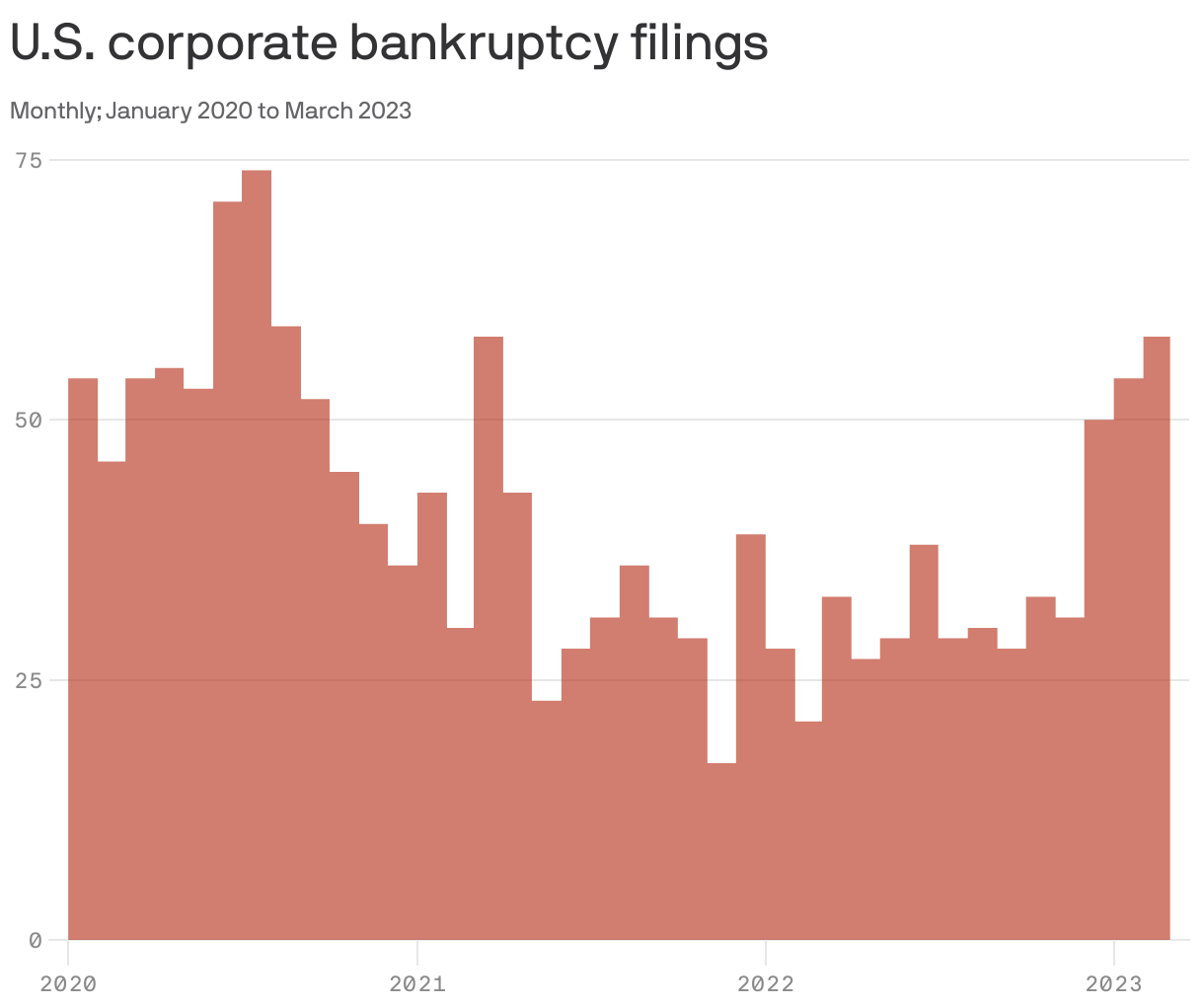
Note: Data includes companies with public debt and assets or liabilities of at least $2 million, or private companies with assets or liabilities of at least $10 million. Data: S&P Global Market Intelligence; Chart: Alice Feng/Axios
Bankruptcy filings by U.S. companies are finally starting to tick up convincingly.
Why it matters: It’s the fated result of the Fed’s rate-hike campaign. When money gets more expensive and lenders get pickier, the number of companies cut off from rescue capital soon rises.
The financial market slump has big implications for state finances in California and New York.
The big picture: The ugly market for stocks and bonds — well into its second year — has pushed down both banker bonuses and new tech stock IPOs, key drivers of tax revenue for the giant coastal states.