Beginning Monday, startups can raise up to $5 million every year from ordinary people who can get a proportionate slice of the company in return.
Why it matters: The changes take effect amid a retail investing mad dash, kicked into high gear by the pandemic and the extra money in (some) people's pockets.
Just 8.8 million people tuned into the Grammy Awards on CBS this year, a new all-time low for the music awards show, according to near-final Nielsen ratings.
Why it matters: In a sign of how much the pandemic has sped up ratings declines for award shows, the Grammy's ratings were still the highest for any major award show in the past year.
The universe of companies able to be purchased by SPACs is increasing, as rollups become more prevalent.
Between the lines: SPACs typically focus on a single target company, like DraftKings or Virgin Galactic. Several new SPACs, however, are looking to merge two or more private companies, and then take public an entity with larger scale.
Why it matters: The self-driving car industry is consolidating as access to capital becomes more difficult and the timeline for autonomous vehicles stretches further into the future. Only a handful of leaders in the trillion-dollar market are likely to remain.
Fidelity acquired a minority stake in Moonfare, a German platform for investing in private equity funds.
Why it matters: This reflects amplified institutional and high-net-worth access to alternative investment opportunities, beyond the "unicorn" exposure Fidelity already provides via some of its mutual funds.
Digital payments giant Stripe yesterday announced $600 million in new funding at a $95 billion valuation, making it the most highly valued U.S. "unicorn."
Why it matters: When I began doing this job years ago, big outlier numbers were king. Like when the late J.P. Morgan Partners sought to raise $5 billion from outside investors for a global fund, or when the late Amp'd Mobile raised over $260 million in VC funding during its first year of existence.
A year of pandemic living drove U.S. consumers to spend an additional $183 billion online, according to a new study from Adobe released Monday. That's roughly the amount they spent during e-commerce's peak November-December holiday shopping season last year.
The big picture: Adobe is predicting 2021's total e-commerce sales to land between $850 billion and $930 billion, with the figure topping a trillion for the first time in 2022. That's compared to $813 billion in 2020, which was a big leap up from $573 billion in 2019, the last pre-pandemic calendar year.
The above cliff is what happened to electric vehicle startup Lordstown Motors stock Friday after short-seller Hindenburg Research issued a report saying the truck company had "misled investors on both its demand and production capabilities."
The big picture: The report hits Lordstown for, among other things, promoting nonbinding "pre-orders" that turn out to be from customers that generally don't operate fleets and "often do not have the means to make the purchases."
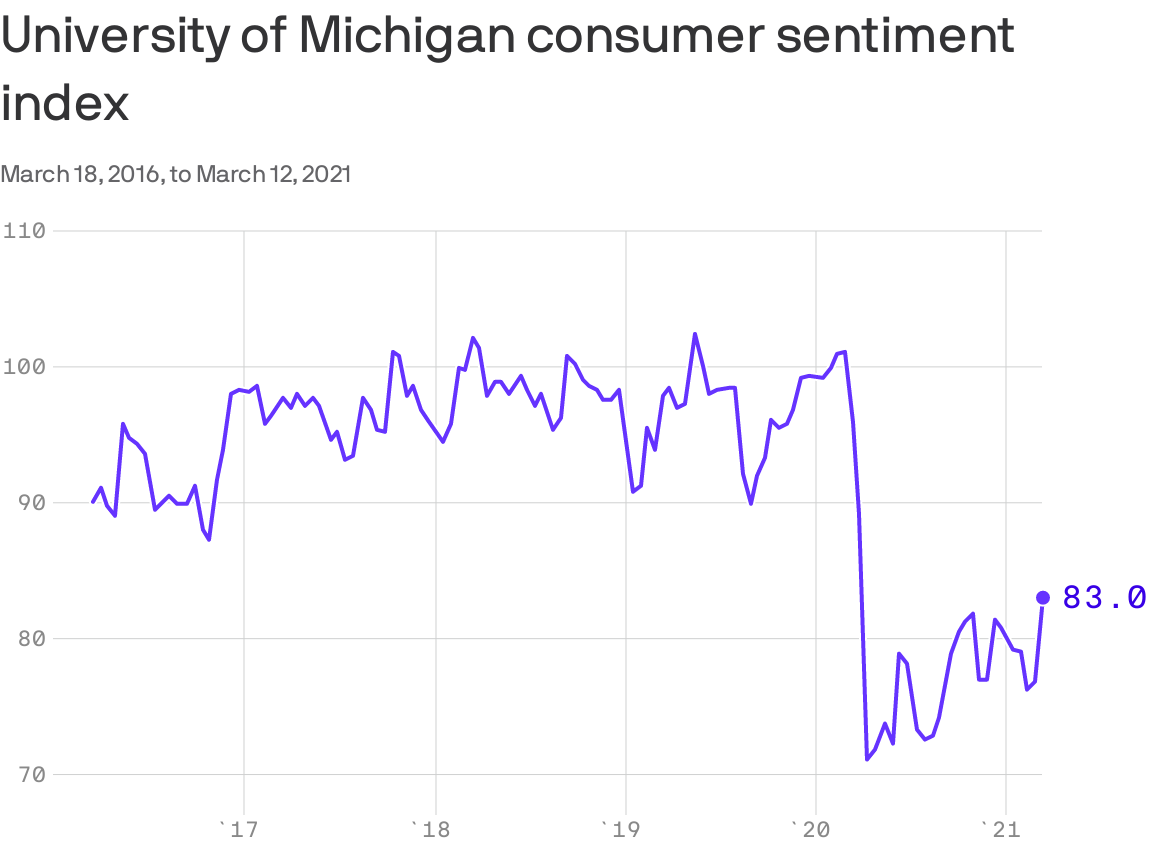
The good news about the economy that asset managers and economists have been crowing about for months is finally starting to make its way into consumer sentiment and confidence measures, as evidenced by the latest survey from the University of Michigan.
By the numbers: Michigan's consumer sentiment index in March hit the highest level since March 2020, jumping to 83.0 from 76.8 in February.
Americans are locking away greater shares of their money — especially big businesses and the wealthy — a trend that has increased thanks to the coronavirus pandemic and is likely to stick around for some time.
Why it matters: The U.S. economy is built on our propensity to spend and the past decade's environment of stubbornly low interest rates, low growth and economic inequality all could be exacerbated in the future as the country leans further into the savings trend.
Disney+ last week surpassed 100 million subscribers, meaning its audience is already half the size of Netflix's just 16 months after launch.
Between the lines: Roughly 30% of those 100 million subscribers (28 million) are from Disney+ Hotstar, an India-based streaming service known for its live cricket coverage.
Myanmar's ruling junta imposed martial law on townships in the country's most populous city Sunday following the deadliest day since the Feb 1 coup, per Reuters.
Driving the news: At least 38 civilians were killed in live ammunition Sunday, said the Assistance Association for Political Prisoners, an independent monitoring group, in a statement. A police officer was also killed.