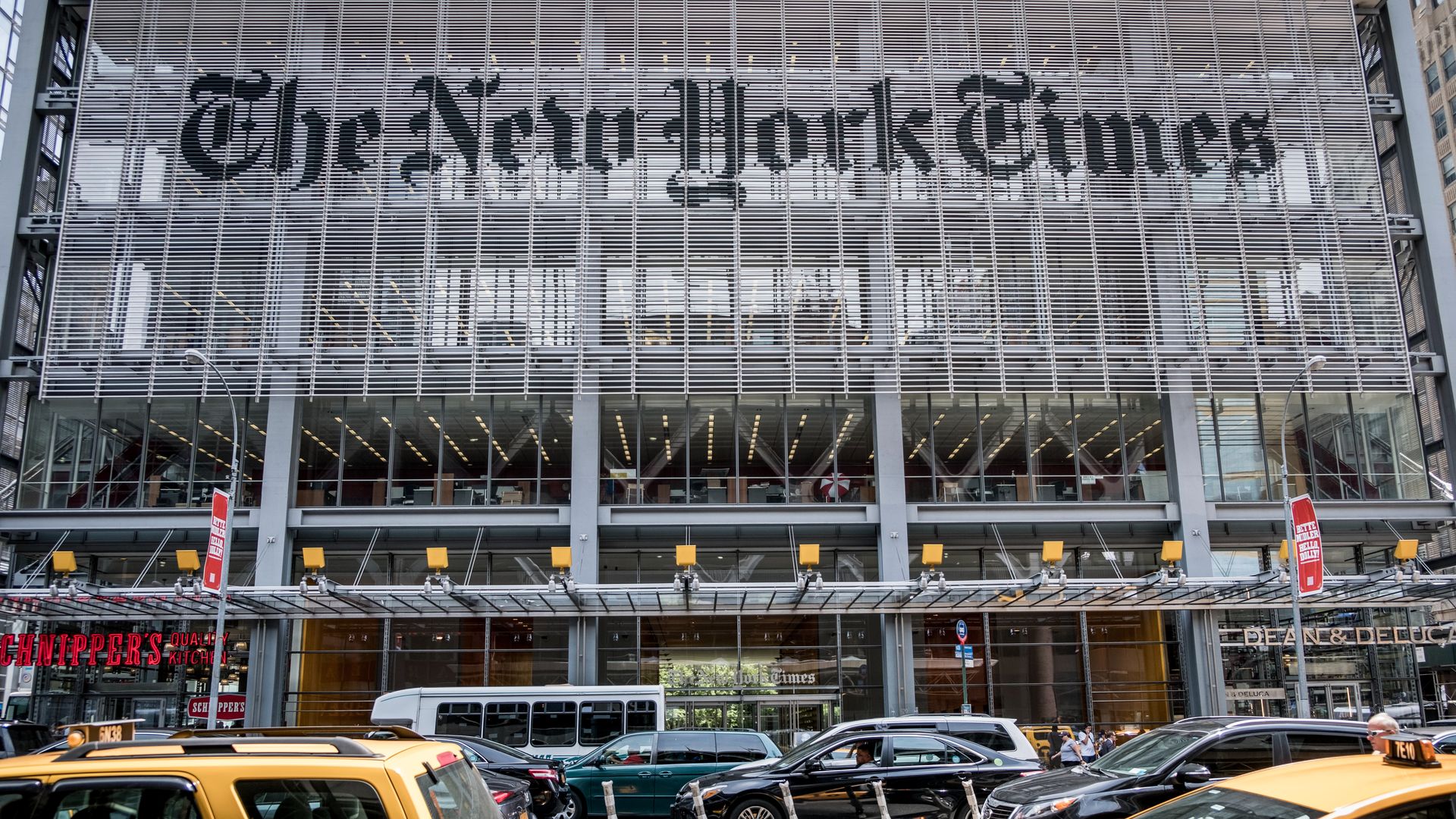
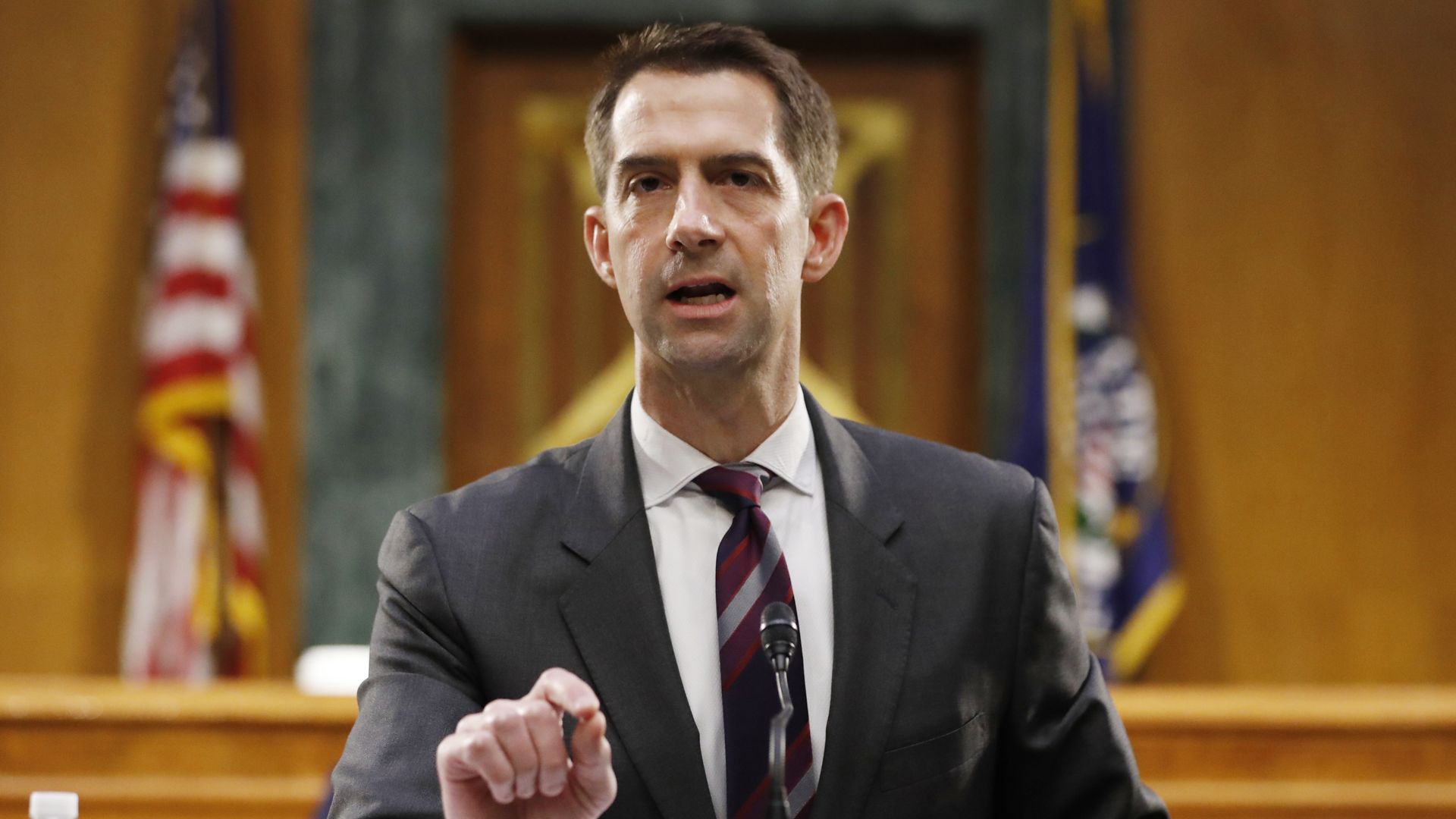
A New York Times spokesperson said in a statement Thursday that the paper will be changing its editorial board processes after a Wednesday op-ed by Sen. Tom Cotton (R-Ark.), which called for President Trump to "send in the troops" in order to quell violent protests, failed to meet its standards.
Why it matters: The shift comes after Times employees began a coordinated movement on social media on Wednesday and Thursday that argued that publishing the op-ed put black staff in danger. Cotton wrote that Trump should invoke the Insurrection Act in order to deploy the U.S. military against rioters that have overwhelmed police forces in cities across the country.
Bloomberg's Tracy Alloway noted Tuesday, the country saw "mass social unrest, continued culture wars, the prospect of martial law, a curfew in the world's biggest financial center, and the looting of a retail icon. So naturally, futures are up."
Between the lines: She didn't even mention that the number of new coronavirus cases worldwide is now rising at a record rate of more than 100,000 per day.
The U.S. is about to embark upon the most momentous social experiment in living memory: What happens when you take laissez-faire economic principles and apply them to public health?
Why it matters: When millions of people make their own individual risk/reward calculations, the result is superior to top-down decision-making by the government. That's the central tenet of capitalism — but you'd be hard-pressed to find any epidemiologists making the same argument.
ZoomInfo, a Vancouver, Wash.-based SaaS platform for sales, marketing, and recruiting data, raised $935 million in its IPO. The company priced 44.5 million shares at $21, above its original $16-$18 price range, for an initial market cap of around $8 billion.
Why it matters: It's the year's largest tech IPO, and is likely to get some trading boost from confusion with videoconferencing company Zoom Communications.
The U.S. Senate finally did its job last night, providing greater flexibility to the millions of small businesses that received loans via the Paycheck Protection Program. It now heads to President Trump, who is expected to sign the bill into law.
Why it matters: This should both help save small businesses and protect payrolls, without costing extra taxpayer dollars.
Oil companies in the battered shale patch are starting to bring back some production as prices climb, but a new report underscores how the pandemic is taking a heavy financial toll despite signs of revival.
Driving the news: Fourteen North American producers have filed for bankruptcy thus far during the second quarter, per a tally from the law firm Haynes and Boone, which closely tracks the sector's finances.
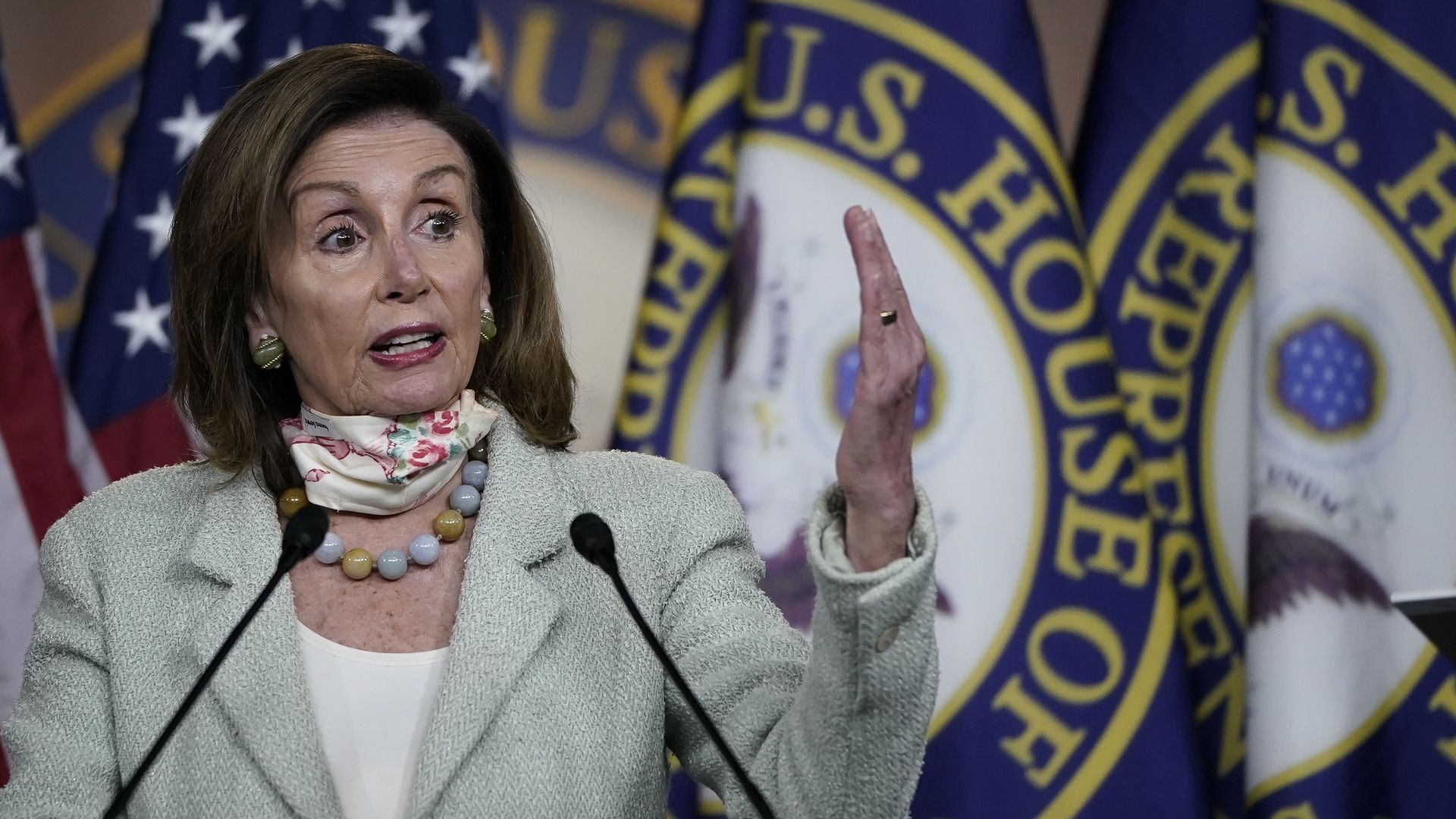
House Democrats unveiled a five-year, roughly $500 billion transportation proposal Wednesday aimed at bolstering mass transit and creating carbon-cutting initiatives.
Why it matters: The bill arrives as mass transit agencies are struggling with a collapse in ridership from the coronavirus pandemic, and facing a tough future as social distancing will require reduced capacity and virus-wary riders may stay away in favor of cars.
"Germany is doubling incentives offered to buyers of battery-powered cars as part of a 130 billion-euros ($146 billion) economic recovery package for the period through the end of next year — but the government refused pleas for the program to include internal-combustion cars," Automotive News reports.
Why it matters: It fills in some of the blanks in the wider — and very open — question of how much governments will seek to use stimulus packages to bolster low-carbon technology as they support domestic industries.
Another 1.9 million people filed for unemployment last week, the Department of Labor said on Thursday.
The big picture: The coronavirus pandemic is still putting a historic strain on the labor market, though the pace of unemployment applications continues to slow.
In addition to largely ignoring economic data, the stock market's rally is defying cratering earnings per share estimates.
By the numbers: During the first five months of 2020 the bottom-up earnings per share estimate for S&P 500 companies — an aggregation of the median 2020 EPS estimates for all the companies in the index from FactSet — has fallen by 28% (to $128.03 from $177.82).
Risk assets have jumped over the past week and continued their rally on Wednesday, with the S&P 500 gaining for a fourth straight day and posting its highest close since March 4, while the Nasdaq ended the day just 1.4% below its all-time high.
What it means: If it hadn't been evident before, Wednesday's market action made clear that the bulls are back in charge.
Close to 6 million jobs are at risk of being lost in coming months as a second wave of coronavirus-induced layoffs is headed for the U.S., according to a new report from Bloomberg Economics.
What's happening: The job cuts are expected to include higher-paid supervisors in sectors where frontline workers have been hit first, such as restaurants and hotels. It also includes the knock-on effects to connected industries such as professional services, finance and real estate.
ISM's stronger-than-expected reading of U.S. services sector data grabbed headlines, but IHS Markit's index told a different story.
Flashback: In December, similar divergence popped up in the two indexes' manufacturing reports, but with ISM's data showing much weaker numbers — the worst manufacturing report in a decade.
Ivanka Trump, delivering a virtual commencement address to WSU Tech in Wichita, Kansas, on Saturday, will say: "You are a wartime graduate."
"Our entire society is engaged in a national endeavor to defeat the virus, protect our fellow citizens, and open up America again to rebuild our economy," the presidential adviser says in prepared remarks. "Amidst the uncertainty, your training ... has prepared you for exactly this moment."
Gilead's intravenous coronavirus drug remdesivir could fetch $6.7 billion in revenue in 2021 with a 19% profit margin, assuming the company prices each treatment at $5,000, according to new forecasts from Geoffrey Porges, a highly read pharmaceutical analyst at Wall Street firm SVB Leerink.
Why it matters: That kind of price tag would make remdesivir a blockbuster, but it's far from being a blockbuster treatment.
Social media companies are finally beginning to take action on posts from world leaders that violate their policies, after years of letting them mostly say whatever they wanted unfiltered to millions of people.
Why it matters: Government officials are among the users most likely to abuse the wide reach and minimal regulation of tech platforms. Mounting pressure to stop harmful content from spreading amid the coronavirus pandemic, racial protests and a looming U.S. election has spurred some companies to finally do something about it.
Walmart is taking guns and ammunition off sales floors in some U.S. stores amid widespread protests over the death of George Floyd, per CNN.
The big picture: Most protests have been peaceful, but stores including Walmart have been targeted by looters during outbreaks of unrest, Business Insider notes. The retailer took the action out of "an abundance of caution," a spokesperson told Newsweek. "Those items are available for purchase, but are being stored in a secure room." Walmart announced last September it was halting the sale of ammunition for handguns and assault-style weapons.
New York Times employees on Wednesday posted en masse on social media saying that the editorial board's decision to run an op-ed by Sen. Tom Cotton (R-Ark.) calling to "Send In the Troops," put black Times' staff members in danger.
What he's saying: Cotton wrote that the U.S. military should be sent to cities across the country to address protests following the death of George Floyd, saying, "One thing above all else will restore order to our streets: an overwhelming show of force to disperse, detain and ultimately deter lawbreakers."
The Senate unanimously passed a bill on Wednesday to loosen some of the rules that small businesses must follow when applying for Paycheck Protection Program loans.
By the numbers: Businesses now have 24 weeks to use loans obtained through the program, instead of eight weeks. Only 60% of a PPP loan now has to be used for payroll, instead of 75% — a requirement that "tens of thousands of borrowers" weren't expected to meet, per a recent inspector general report.