A trio of Silicon Valley venture capitalists focused on enterprise tech are forming a new early-stage investment firm, Axios has learned.
The big picture: In a time of slowed fundraising and firms reconfiguring their teams, it's no surprise to see some established investors choose to start a fresh endeavor.
The federal government is overhauling parts of its hiring process to remove educational and years-of-experience requirements for a subset of tech and cybersecurity roles, the White House announced Monday.
Why it matters: The U.S. government's arcane hiring practices have made it difficult for federal offices to compete with the fast-moving, higher-paying Silicon Valley job market.
Databases storing approximately 550 gigabytes of secret data from a government artificial intelligence contractor were exposed on the internet until the end of last month, according to a report released Tuesday.
Why it matters: Plenty of attention has been given to protecting confidential information from entering AI models, but the new research suggests more focus needs to be given to how AI models' training data itself is stored.
The number of ransomware attacks on health care organizations continued to rise last year — prompting heightened attention from Capitol Hill this week.
As the looming electricity demand from artificial intelligence datacenters has lawmakers and grid operators scrambling for solutions, Bitcoin miners point to a partial solution: powering down when a utility needs them to.
Why it matters: AI is projected to be one of the most transformative technologies in decades, but only if it can access torrents of new electrical power.
Eight prominent U.S. newspapers owned by investment giant Alden Global Capital are suing OpenAI and Microsoft for copyright infringement, in a complaint filed Tuesday in the Southern District of New York.
Why it matters: On top of a similar case filed by the New York Times against both companies, the new suits add heft to publishers' claims.
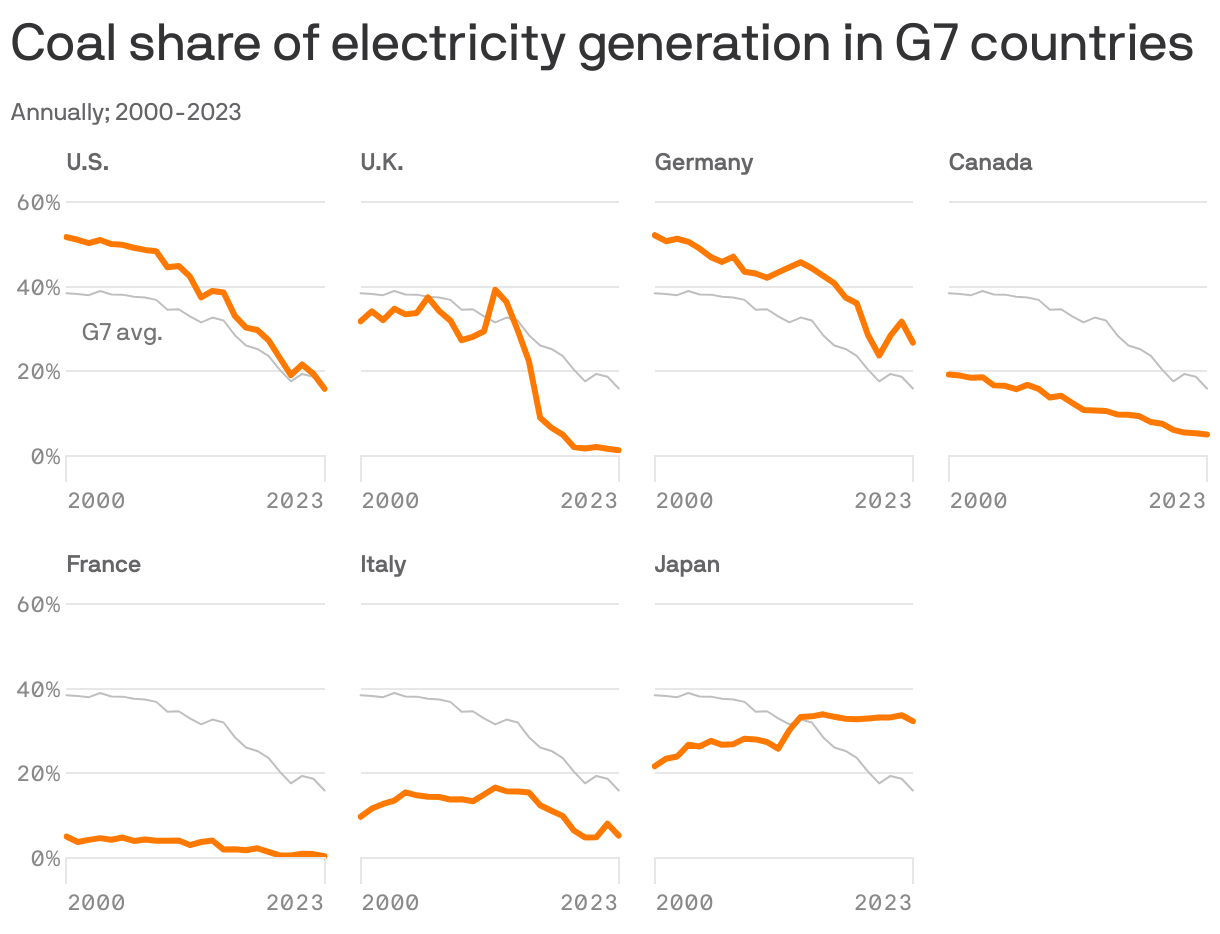
The G7 energy and climate ministers' new goalto phase out coal-fired power "during the first half of 2030s" will be easier for some members to achieve than others.
Why it matters: The DOE, with its national labs and supercomputing facilities, is uniquely positioned among government agencies to leap from research to applications.
Meta is pushing generative AI into every nook and cranny of its giant platforms — Facebook, Instagram and WhatsApp — frustrating some longtime users and threatening to worsen existing problems with spam and misinformation.
The big picture: Meta's fast-and-furious deployment of new AI features aims to make the technology's benefits accessible — but also risks degrading the experience for its billions of users.
Why it matters: T-Mobile, AT&T, Sprint and Verizon violated the Communications Act when they sold customers' location data without their consent and continued the practice without sufficient safeguards after being informed of the violations, the FCC said.
Elon Musk made an unannounced trip to China to discuss the rollout of self-driving software in China.
Why it matters: The Tesla CEO received quick approval on expanding Tesla's business in the world's largest auto market, as the company's sales and stock prices have slumped.
The Supreme Court on Monday declined to hear Elon Musk's appeal over the terms of a settlement agreement with the Securities and Exchange Commission regarding his social media posts about Tesla.
Why it matters: Musk had argued that the agreement's provision that a company lawyer review his public communications about the car company violated his free speech rights.
Major airlines are uniting in defense of the "sustainable" fuel credit created by President Biden's new climate law, Axios Pro Energy Policy's Jael Holzman writes.
Why it matters: It's a sign that companies are taking seriously the odds of a GOP victory in November that would threaten the climate law.
Not to mention the credit is going to be helpful for some airliners' climate plans.
Driving the news: More than 40 companies — including American Airlines, JetBlue and United — today are announcing the Sustainable Aviation Fuel Coalition.
The group is moving to "advocate for the incentives and policies necessary" to boost production of the now-in-vogue alternative jet fuels.
👀 G7 energy ministers meeting in Italy may endorse a sixfold expansion of energy storage deployment by 2030 to help accommodate growing renewables, per the FT and Nikkei Asia.
What we're watching: The ministers are also discussing a 2035 common target date for shutting down coal-fired power plants, Reuters reports.
Why it matters: While G7 statements are non-binding and symbolic, they offer a window into nations' ambition for following up on last year's UN climate summit.
🚗 China has "signaled its blessing for Tesla to roll out its advanced driver-assistance service in the carmaker's second-biggest market" following CEO Elon Musk's weekend visit, the WSJ reports.
Why it matters: China is the world's largest auto market. Tesla stock is jumping in pre-market trading as news emerges of progress toward deployment of "full self-driving" tech.
ExxonMobil is eyeing large-scale production of carbon-based materials used in battery storage, steel production and other applications, Ben writes.
Why it matters: The oil-and-gas giant sees potentially billion-dollar markets. On Friday Exxon revealed its first detailed comments on how it expects the playing field to shape up.
What's new: "If you look at the world's efforts to decarbonize, it's clear to us that carbon, over time, will become more and more advantaged feedstock," CEO Darren Woods said on Friday's Q1 earnings call.
Theysee opportunities to "transform the molecular structures of low-value, carbon-rich feeds from refining and petrochemical processes to create high-value products," he said in a written statement.
The guttural roar from a gas engine disappears in an EV — but some people want it back, Axios' Nathan Bomey reports.
Why it matters: Lacking engines, EVs are quiet, emitting only the sound of tires on pavement and the purring whir of an electric motor as it powers the vehicle.
State of play: Dodge has had enough.
The Stellantis brand is debuting what it's dubbed a "Fratzonic Chambered Exhaust" system in the new 670-horsepower 2024 Dodge Charger Daytona — the first EV version of the Charger muscle car.
What we're watching: Fake engine noises could catch on more widely.
Dodge isn't the first to realize that drivers might want fabricated sounds.
That's how much water oil and gas companies injected underground last year in the most prolific region of the Permian Basin, per the Wall Street Journal.
Why it matters: Managing massive "produced" water volumes are among the list of potentially dangerous geologic changes the region faces.














/2024/04/30/1714437025544.gif?w=3840)