Cable companies eye mobile as next frontier


Add Axios as your preferred source to
see more of our stories on Google.
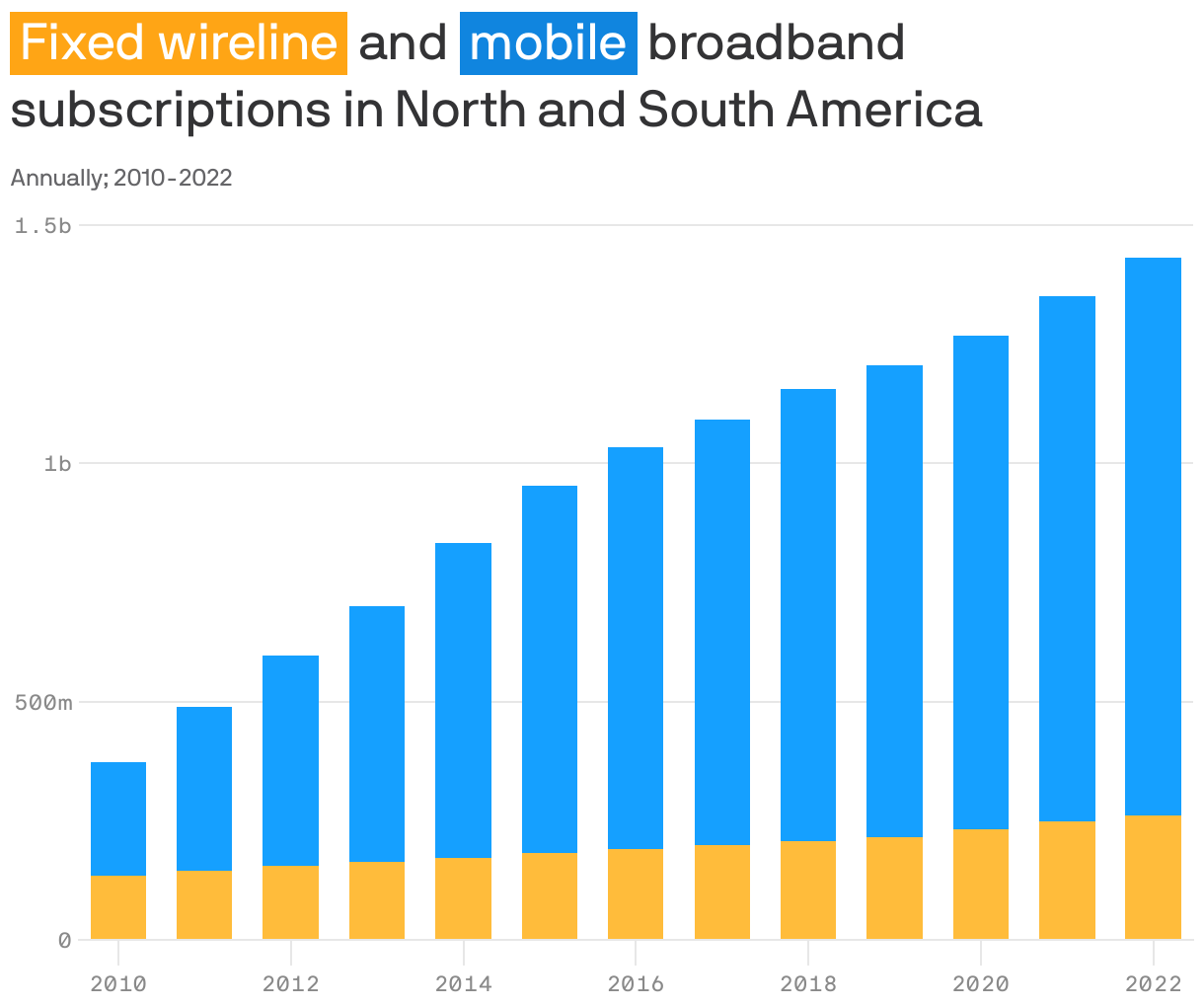
The country's biggest cable companies have been leaning into mobile plans as pay-TV subscriptions plummet and growth from broadband begins to plateau.
Why it matters: Cable operators are betting that mobile plans in their bundles will make it harder for consumers to quit their other services.
State of play: Several big cable companies, including Comcast, Charter and Altice, launched mobile plans to help offset legacy businesses challenges in 2017, 2018 and 2019 respectively.
- Cox Communications, a subsidiary of Axios' parent company, last week launched Cox Mobile, a new service that's available to all of its 5.6 million U.S. internet customers.
- Mobile giants like AT&T, Verizon and T-Mobile still have the biggest reach for mobile plans. But cable companies have won some market share with competitive pricing and flexible plans, per CNBC.
- The cable operators partner with mobile companies to use their networks to serve their customers. Comcast's Xfinity Mobile and Charter's Spectrum Mobile all use Verizon's network. Altice has a deal with T-Mobile.
Meanwhile: The mobile companies have eaten away at cable operators' businesses by creating their own at-home internet offerings, such as Verizon Fios and AT&T Fiber. T-Mobile launched a virtual cable bundle service called TVision in 2019.
The big picture: Fixed broadband businesses have helped cable companies stay afloat as cord cutting accelerated, but that safety net is beginning to fade as subscriber growth tapers off.
- Pricey plans have been a factor in broadband's slowed growth, along with mobile companies improving their speed and quality of coverage.
- According to a 2021 Pew Research Center survey, 45% of those who don't subscribe to a broadband at home said a reason was the monthly cost being too expensive and because their smartphone meets their needs.
The bottom line: The new cable bundle is a rollup of broadband and mobile internet services, with Pay-TV as an offering that exists only for those still interested in paying for linear TV.
