Nvidia founder and CEO Jensen Huang, Stanford's Fei-Fei Li ("the Godmother of AI") and OpenAI chief strategy officer Jason Kwon are among this year's Gold House A100 List honorees.
Why it matters: The list is published annually to coincide with the start of Asian American and Pacific Islander Heritage Month and recognizes individuals of Asian Pacific heritage who have had a significant impact on American culture and society.
Microsoft says it has managed to significantly curb certain types of harmful images being generated by its Designer text-to-image tool after implementing a number of fixes.
Why it matters: Text-to-image tools can produce a wide range of problematic content, from promoting stereotypes to the creation of deepfake nudes.
Investment giant Brookfield Asset Management will develop 10.5 gigawatts of renewable energy between 2026 and 2030 to serve Microsoft's power needs, the companies announced today.
Why it matters: The plan for projects in the U.S. and Europe is mammoth by corporate procurement standards.
And it comes amid concern that rising data center power thirst for generative AI and other uses will prolong fossil fuel reliance.
Stunning stat: The deal is roughly eight times bigger than the largest single corporate power purchase agreement in history, they said.
The big picture: It involves wind, solar, and "new or impactful carbon free energy generation technologies."
Next-gen aviation startup MightyFly says it's the first company developing a large, autonomous electric vehicle takeoff and landing (eVTOL) cargo drone that's been approved by the Federal Aviation Administration for a flight corridor, Axios is first to report.
Why it matters: It's a big milestone for the emerging company — and for the drone delivery world more broadly.
Some branches of the U.S. military are hitting the brakes on generative AI after decades of Department of Defense experiments with broader AI technology.
Why it matters: As businesses race to put generative AI in front of customers everywhere, military experts say its strengths and limitations need further testing and evaluation in order to deploy it responsibly.
A trio of Silicon Valley venture capitalists focused on enterprise tech are forming a new early-stage investment firm, Axios has learned.
The big picture: In a time of slowed fundraising and firms reconfiguring their teams, it's no surprise to see some established investors choose to start a fresh endeavor.
The federal government is overhauling parts of its hiring process to remove educational and years-of-experience requirements for a subset of tech and cybersecurity roles, the White House announced Monday.
Why it matters: The U.S. government's arcane hiring practices have made it difficult for federal offices to compete with the fast-moving, higher-paying Silicon Valley job market.
Databases storing approximately 550 gigabytes of secret data from a government artificial intelligence contractor were exposed on the internet until the end of last month, according to a report released Tuesday.
Why it matters: Plenty of attention has been given to protecting confidential information from entering AI models, but the new research suggests more focus needs to be given to how AI models' training data itself is stored.
The number of ransomware attacks on health care organizations continued to rise last year — prompting heightened attention from Capitol Hill this week.
As the looming electricity demand from artificial intelligence datacenters has lawmakers and grid operators scrambling for solutions, Bitcoin miners point to a partial solution: powering down when a utility needs them to.
Why it matters: AI is projected to be one of the most transformative technologies in decades, but only if it can access torrents of new electrical power.
Eight prominent U.S. newspapers owned by investment giant Alden Global Capital are suing OpenAI and Microsoft for copyright infringement, in a complaint filed Tuesday in the Southern District of New York.
Why it matters: On top of a similar case filed by the New York Times against both companies, the new suits add heft to publishers' claims.
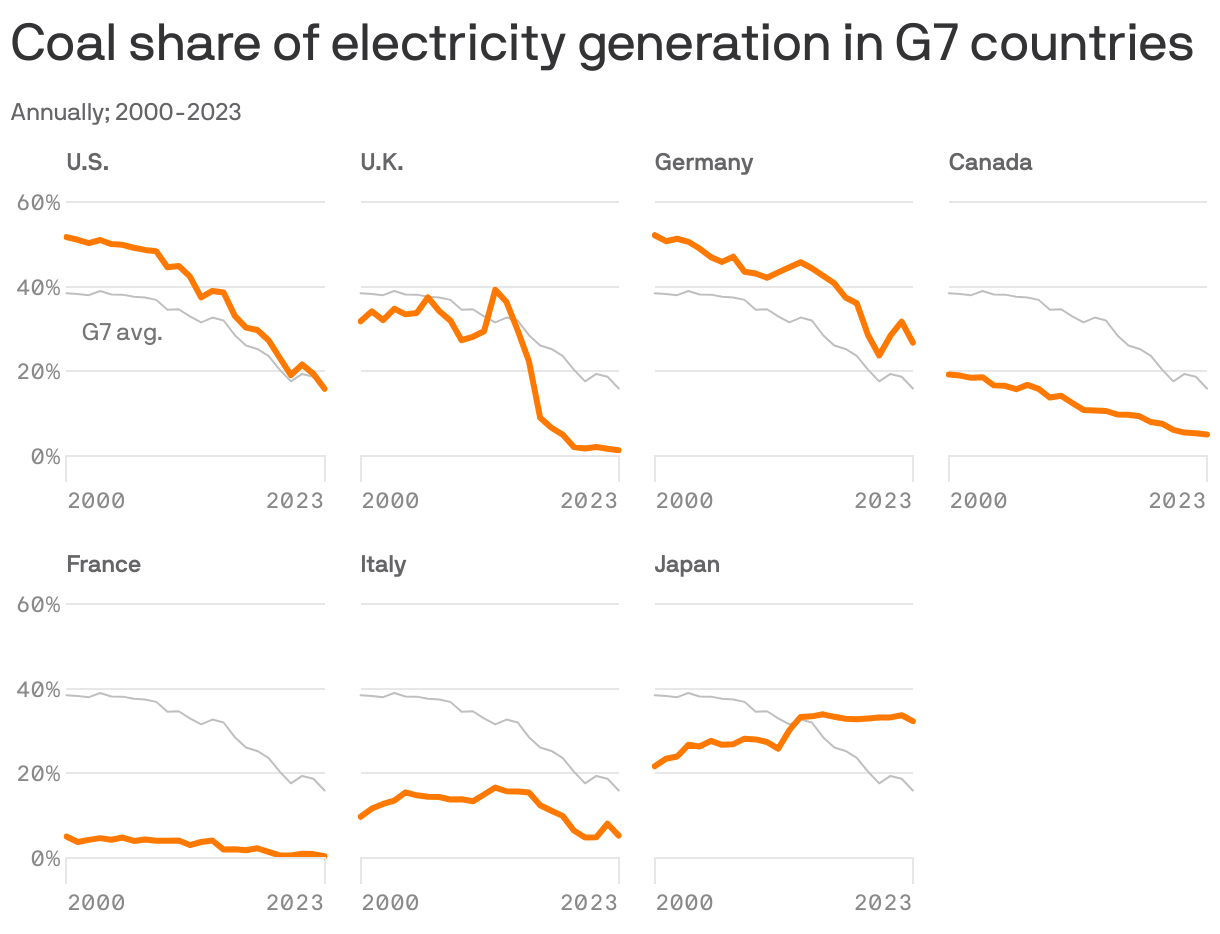
The G7 energy and climate ministers' new goalto phase out coal-fired power "during the first half of 2030s" will be easier for some members to achieve than others.
Why it matters: The DOE, with its national labs and supercomputing facilities, is uniquely positioned among government agencies to leap from research to applications.
Meta is pushing generative AI into every nook and cranny of its giant platforms — Facebook, Instagram and WhatsApp — frustrating some longtime users and threatening to worsen existing problems with spam and misinformation.
The big picture: Meta's fast-and-furious deployment of new AI features aims to make the technology's benefits accessible — but also risks degrading the experience for its billions of users.








/2024/04/30/1714517507593.gif?w=3840)













/2024/04/30/1714437025544.gif?w=3840)