A class action complaint over a Star Wars video game's missing content should be dismissed in part because the lead plaintiff already got a rebate, the game's developer has argued in court.
Why it matters: The novel suit is seeking damages because a game maker didn't deliver on the promise they offered when promoting their game.
Acclaimed and occasionally controversial developer Jonathan Blow is preparing to launch a commentary-filled "anniversary edition" remake of his 2008 game Braid.
Why it matters: Braid was a breakthrough indie game that helped make Blow something of a celebrity among developers. Blow hopes that the re-release will help explain how it came to be.
A new tool that uses artificial intelligence to quickly sift through thousands of videos is helping defense attorneys comb through mountains of police body cam footage to find videos helpful to defendants' cases.
Why it matters: Police departments nationwide now require officers to wear body cams that capture their interactions with the public — and take videos that have been used to prove or disprove police misconduct.
Apple Thursday took a small step toward opening up iPhone messaging by announcing that next year its phones would support a richer messaging standard called RCS, allowing for, among other things, better video calls with Android smartphones.
Yes, but: This doesn't mean Apple is opening iMessage — the popular instant messaging program that most iPhone owners use — to non-Apple devices.
The percentage of Latinos in households without a smartphone is highest in states with large rural areas where cell service is spotty and broadband access is low, according to an Axios analysis of data from the UCLA Latino Policy and Politics Institute.
Why it matters: Smartphones are one of the most essential communication devices in today's digital world, and households without them may fall significantly behind in obtaining information, emergency services and economic stability.
The Federal Bureau of Investigation is asking companies to share more details about the cyberattacks they're facing as the bureau continues to investigate the Scattered Spider hacking group, an official told reporters Thursday.
As TikTok draws more eyeballs, it also draws more criticism — prompting it to respond with forceful communications.
Why it matters: TikTok is the latest organization to deploy aggressive communication tactics to counter untrue or unflattering allegations as a way to influence public opinion and protect corporate reputation.
ExxonMobil boss Darren Woods is hoping for a vibe shift at COP28 and beyond.
Driving the news: Woods is seeking recognition that a wide array of parties and companies — including oil giants — are needed to cut emissions, he said in a response to a question from Axios' Hope King on the sidelines of the APEC summit in San Francisco.
Frontier, the group of business giants trying to juice carbon removal markets, has deals with two companies working to scale direct air capture (DAC) technology.
Why it matters: Contracts with Heirloom and CarbonCapture are Frontier's first major offtake agreements with startups using DAC, a method receiving a growing amount of federal and private sector finance.
Some of Toyota's future hybrid and electric cars will likely be powered by U.S.-built batteries made from recycled minerals stripped from old Priuses, under a deal announced today.
Why it matters: It's the beginning of what could become a circular domestic battery supply chain, helping to free the United States from its dependence on Chinese components.
Nearly every respondent (95%) in a new Axios-Generation Lab-Syracuse University AI Experts Survey described AI's audio and video deepfake capabilities as "advanced."
Driving the news: 68% said the capabilities are moderately advanced; 27% said they are highly advanced.
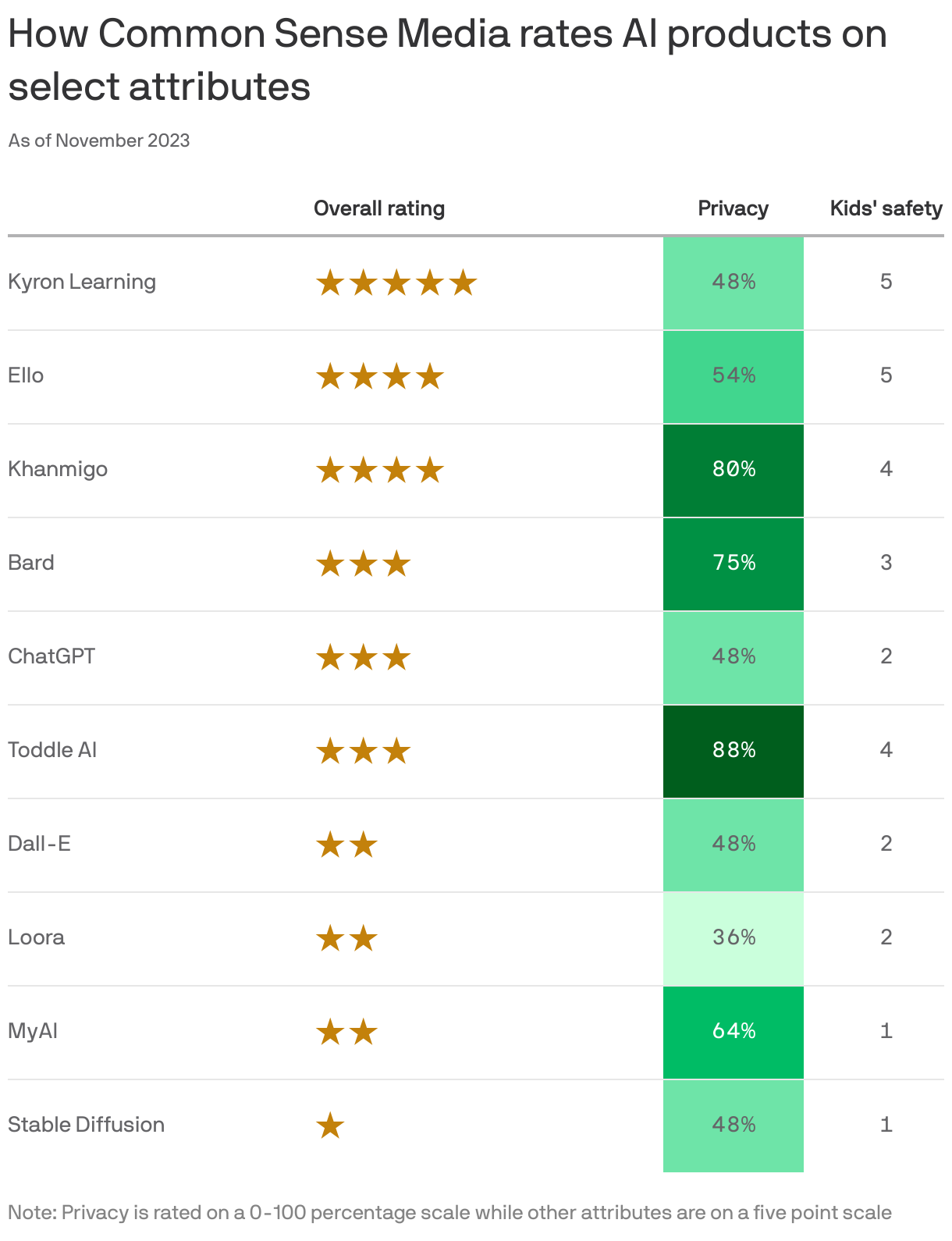
The more data used to train a particular AI tool, the less safe it's likely to be, according to a detailed study from Common Sense Media that rated 10 of the most popular AI products for privacy, ethical use, transparency, safety, and impact.
Why it matters: Leaders in AI like Google and OpenAI are racing to build ever-bigger models trained on increasingly massive mountains of data, but Common Sense's finding suggests that might be a risky plan.
Microsoft on Wednesday announced two homegrown chip designs that will be put to work in its data centers alongside processors from Intel, AMD and Nvidia.
Why it matters: Cloud powerhouses, including Amazon, Google and others, are increasingly offering customers their own silicon options in addition to those created by traditional chipmakers.