Former PlayStation employee Emma Majo is again suing PlayStation in a potential class action gender discrimination lawsuit, this time in California, after a federal judge dismissed her first lawsuit last month.
Why it matters: Sony, like other video game companies before it, faces allegations it had a sexist workplace.
Some top American game studios are taking stands on abortion, trans rights and the industry’s own responsibility regarding racism and extremism.
Why it matters: It’s a notable shift in a controversy-averse industry, and one that is shocking some players not used to the makers of the games they play taking a position on volatile political and social topics.
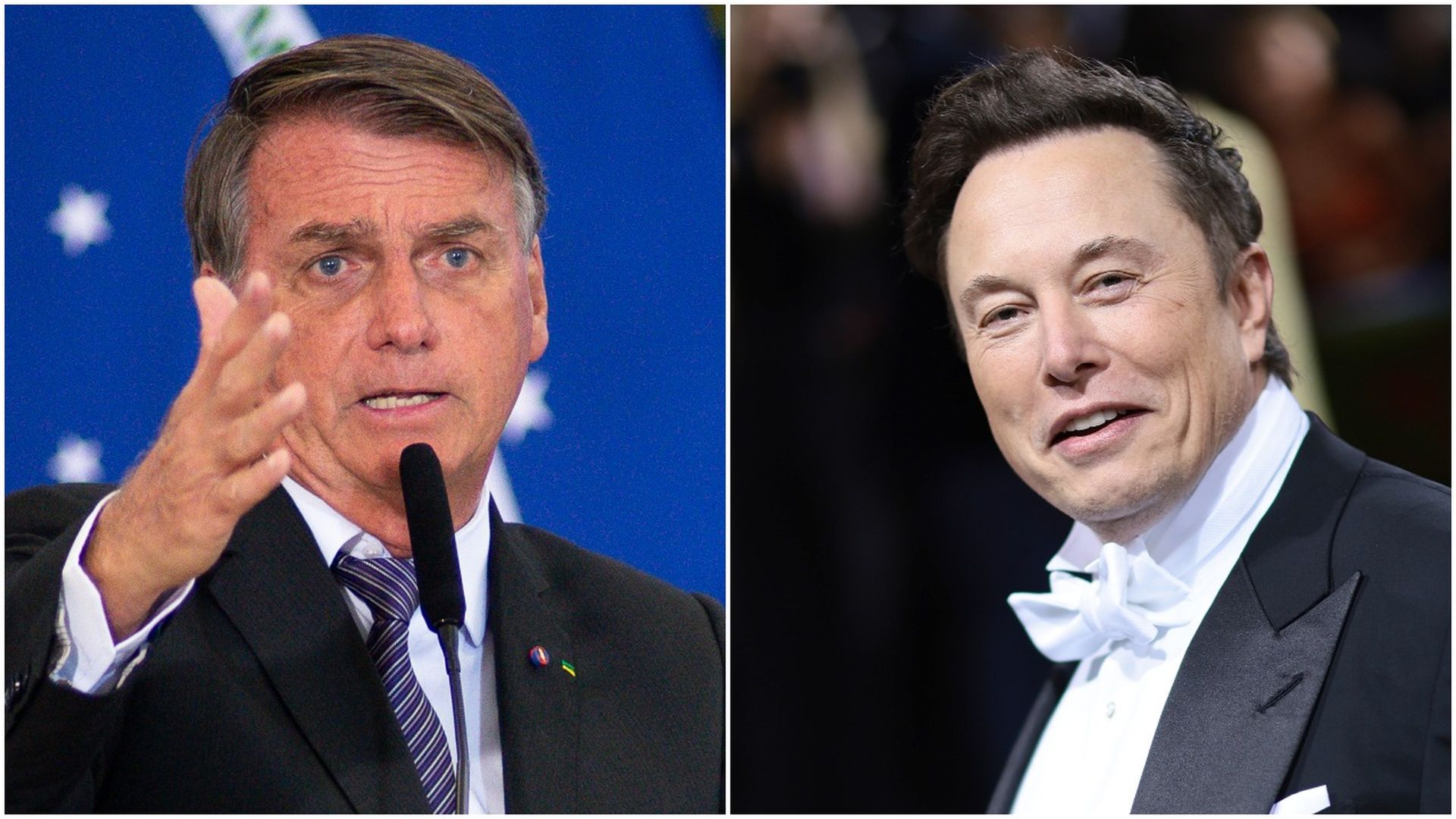
Elon Musk met with Brazilian President Jair Bolsonaro on Friday to discuss connectivity and other technology projects ahead of Brazil's election.
Why it matters: Musk traveled to Brazil as part of his satellite internet service Starlink's expansion in the region. The visit comes as Musk is increasingly engaged with global politicians, especially conservative leaders.
If you’re sick of making a mess every time you eat or make burritos, a group of Johns Hopkins University undergraduate students has come up with a fix: edible tape.
Driving the news: The Maryland students created a design for "Tastee Tape" and presented it as part of the engineering school's Design Day. According to the university, the team of students created the “edible adhesive comprising a food-grade fibrous scaffold and an organic adhesive” to keep the ingredients inside the wrap during cooking and consumption.
DISH Network, the wireless company, has already been through one major technological transition, and it's betting that cryptocurrency is part of its next one.
Driving the news: DISH recently invested in and partnered with two crypto-enabled grassroots wireless networks, fueling its long-term aim of becoming a competitor in 5G wireless services. "We don't have a venture capital arm," Chris Ergen, DISH's head of wireless innovation, tells Axios in an interview. "If you see us investing, it's more strategically central to what we're doing."
MiamiCoin, the first city-themed cryptocurrency, has lost nearly all its value over the past several months amid a broader crypto market collapse, Quartz reports.
Why it matters: Miami Mayor Francis Suarez hoped that the cryptocurrency, launched last summer, would help him raise revenue and reduce income inequality — and the eyes of other mayors were on the experiment.
Twilio CEO Jeff Lawson imagines that rather than have offices in each city where his firm employs a cluster of workers, he could just open a coffee shop where employees could work and gather.
Why it matters: Nearly everyone agrees that the future of work is hybrid, but everyone is still trying to figure out what that actually looks like.
Senate Majority Leader Chuck Schumer (D-N.Y.) intends to put bipartisan tech antitrust legislation up for a vote by early summer, a Democratic source familiar with the situation tells Axios.
Twitter on Thursday introduced a new policy aimed at making sure the social network doesn't amplify or recommend disinformation during an international armed conflict and crisis.
Why it matters: False material proliferated on Twitter and other social networks in the early days of Russia's invasion of Ukraine.
Campbell Brown, the veteran news anchor who has served as Meta's vice president of news partnerships since 2017, is being promoted to oversee a new global media partnerships team at the company, Meta sources tell Axios.
Why it matters: The new role will allow Brown to focus on broader media partnerships in addition to news. New regulations around the globe are forcing tech firms like Meta and Google to pay to host news content.
The Biden administration has charged the Federal Communications Commission with prohibiting digital discrimination — but without a third Democratic commissioner to break the agency's partisan deadlock, those plans are in trouble.
Why it matters: One of President Biden's key domestic priorities, improving internet access and affordability, can't advance unless the Senate confirms his FCC nominee.
The Federal Trade Commission on Thursday will vote on a measure meant to warn companies the agency will prioritize taking action against children's online privacy violations by education technology companies.
Why it matters: Remote schooling during the pandemic led to an explosion in the use of ed tech services, raising concerns about whether those companies are safeguarding children's data.



















/2022/05/16/1652732449581.gif?w=3840)