The race to 5G is forcing the world's biggest telecom giants to consolidate.
Why it matters: 5G is all about scale. When companies combine, they have more resources and capital to bid on spectrum and build out tools to get ahead.
TikTok's national security clash with the U.S. government may be nearing its conclusion, without the sort of shareholder overhaul that was previously proposed.
Driving the news: The social media company is in advanced talks with the Committee on Foreign Investment in the United States (CFIUS) to store all of its U.S. user information with Oracle, without Chinese owner ByteDance being able to access it, as first reported by Reuters and confirmed by Axios.
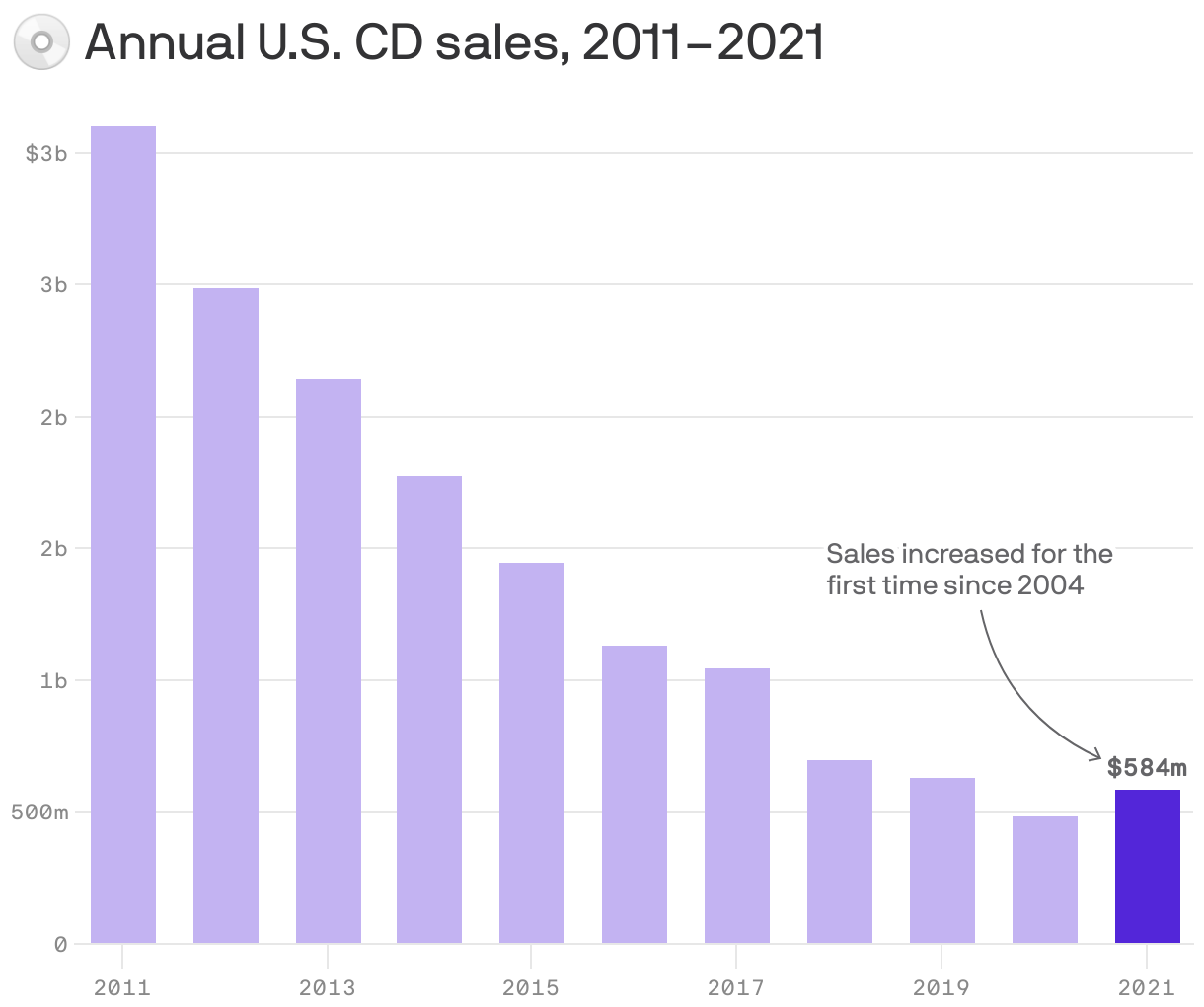
Dust off those plastic binders that lived in the back seat of your car and fire up the boombox, because compact discs are back.
CD sales enjoyed year-over-year growth for the first time since 2004, according to the Recording Industry Association of America's annual sales report.
Russia's invasion of Ukraine is forcing new dilemmas on social media's rulemakers, not just in their efforts to limit the spread of misinformation but also as they struggle to handle graphic images of violence.
Why it matters: Platform moderators face complex ethical and legal calls over photos of dead soldiers, images of teens taking up arms, and videos of prisoners of war criticizing the conflict. Everyday users are confronting them, too.
Facebook and Instagram have loosened some hate speech restrictions as a result of Russia's invasion of Ukraine, parent company Meta said Thursday.
Driving the news: "[W]e have temporarily made allowances for forms of political expression that would normally violate our rules like violent speech such as 'death to the Russian invaders,'" a Meta spokesperson said in a statement. "We still won’t allow credible calls for violence against Russian civilians."
The massive convoy of Russian military vehicles that was slowly heading toward Ukraine's capital, Kyiv, appears to have largely dispersed and redeployed elsewhere, new satellite images show.
Driving the news: The convoy was previously estimated to stretch for 40 miles. It massed outside Kyiv last week. But U.S. and U.K. officials said it had "stalled" due to fuel and food shortages, amid reports Ukrainian fighter jets have been striking the vehicles.
More than 60 companies, including some of the largest firms in tech and finance, are calling on Texas Gov. Greg Abbott to abandon an executive order that equates gender-affirming healthcare for transgender children with child abuse.
Driving the news: Apple, Google, Meta, Johnson & Johnson, Ikea, PayPal, Capital One, Electronic Arts and many more firms signed an ad running in the Friday edition of the Dallas Morning News calling the new order discriminatory.
A broad coalition of civil society groups is making the case that, as odious as Russia's invasion of Ukraine is, its citizens should not be deprived of basic internet access.
Why it matters: The U.S. has imposed strict sanctions on Russia and at least two internet providers have already cut off service to the country.
A group of blockchain investors has committed $165 million to make bitcoin more of a force in the decentralized finance and app development world.
Why it matters: Bitcoin has long been considered just a store of value, while most hardcore blockchain app development has been focused on ethereum and other chains.
Magic Leap has a new version of its augmented reality headset, this time specifically targeted toward enterprise use, particularly in medical, manufacturing and public sector settings.
Between the lines: The company was initially hoping to sell a consumer product but, like others in the VR and AR space, it realized that its product was still too expensive and bulky for mainstream consumers.
Google is plowing ahead with a $5.4 billion acquisition as it fends off a Justice Department lawsuit charging monopolistic practices and inquiries by lawmakers who argue the search giant is already too big.
Why it matters: An increasingly hostile regulatory climate over the past five years hasn't stopped Big Tech giants from making billion-dollar deals.


















/2022/03/09/1646864782557.gif?w=3840)