Lyft will raise $2.34 billion in its initial public offering, after offering more shares than expected and pricing them at the top of their upwardly-revised range.
This gives the ride-hail company an initial market cap of around $20.5 billion and a fully-diluted value of nearly $30 billion, which is approximately double Lyft's last valuation in the private markets.
Why it matters: Lyft is expected to be the first in a series of IPOs from highly-valued tech startups, and could help set multiples for where Uber is valued next month.
A U.K. body set up to evaluate the security of Huawei telecommunications equipment has "not yet seen anything to give it confidence in Huawei’s capacity to successfully" address cybersecurity flaws, according to a blistering report released Thursday.
Why it matters: The U.S. is currently pushing foreign allies to avoid the use of Huawei 5G products due to security concerns. While the U.K. report did not find any intentional security flaws intended for use in espionage — which the U.S. has been warning against — it did find systemic unintentional security flaws.
The Department of Housing and Urban Development filed charges against Facebook Thursday for violating the Fair Housing Act by encouraging, enabling and causing housing discrimination through the company’s advertising platform.
Why it matters: Facebook just reached a historic settlement with the ACLU and other advocacy groups around this same issue, so it's surprising that a settlement did not occur between HUD and the tech giant.
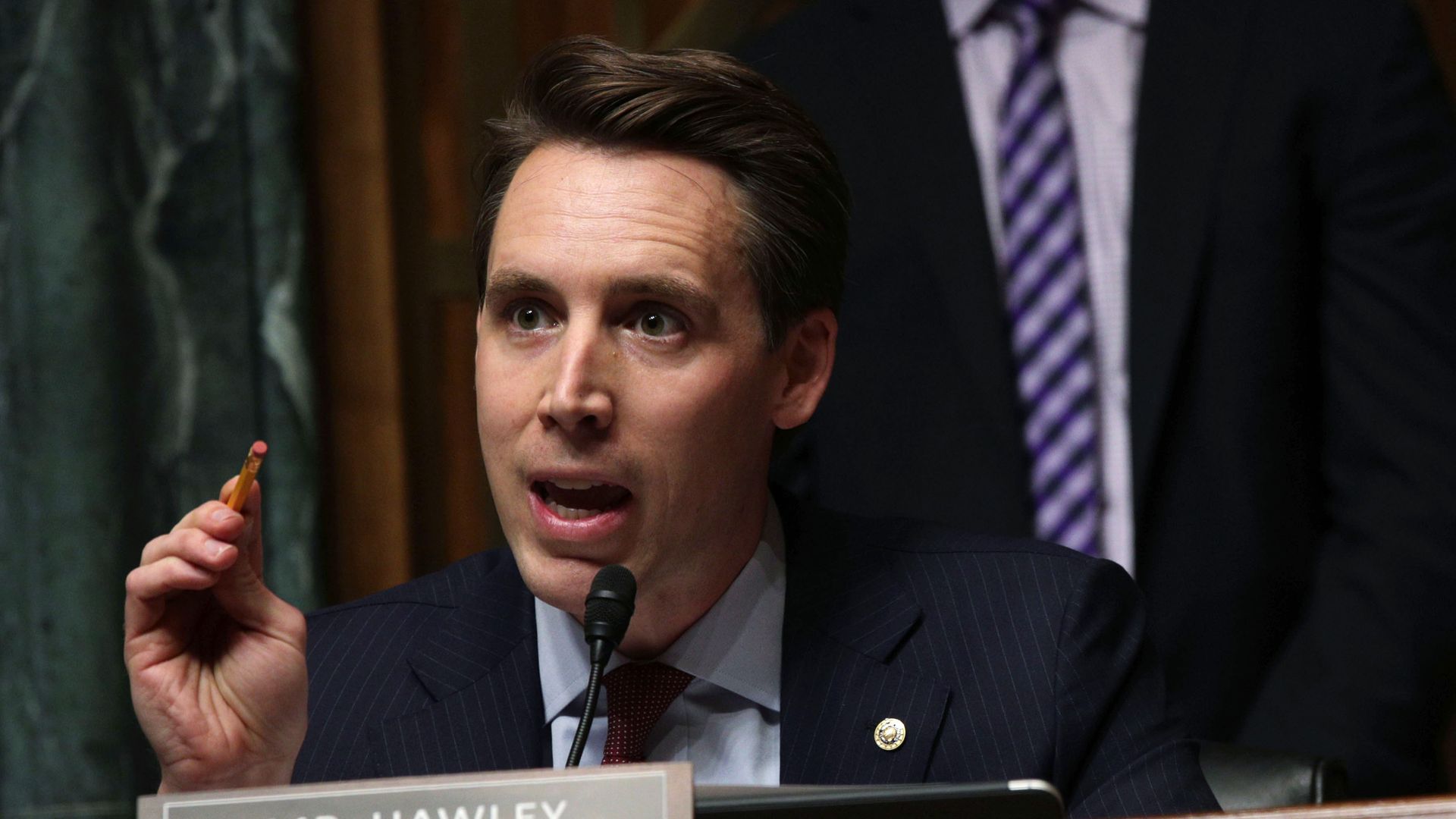
Sen. Josh Hawley (R-Missouri) called Thursday for Google CEO Sundar Pichai to further publicly address the company’s reported work in China.
Why it matters: Hawley has been aggressive in ramping up pressure on Big Tech from the right, including through allegations of anti-conservative bias at major web platforms.
Human Rights Campaign suspended Google from this year's Corporate Equality Index after the company failed to pull a controversial app that the LGBT rights group says equates to conversion therapy.
Why it matters: HRC's annual rankings are often touted by tech companies and have served as a valuable recruiting tool.
A group of women sued Salesforce this week on the grounds that the company allegedly worked with Backpage.com, a classified ad site whose founders were indicted last year on charges of facilitating prostitution.
Why it matters: There's been lots of talk about what the liability is for platforms that facilitate trafficking and other crimes. This is a different kind of case because Salesforce isn't a platform itself, but a vendor.
Ride-hail company Lyft on Thursday increased the price range for its IPO from $62–$69 per share to $70–$72 per share. At the high end of its range, the company would have an initial market cap of $20.5 billion, and a fully diluted valuation of nearly $30 billion.
Why it matters: This confirms prior reports that the company's offering was significantly oversubscribed and sets the stage for Lyft shares to become publicly traded on Friday.
Aurora Innovation and Zoox are two of the most ambitious companies working on autonomous vehicles, but their strategies couldn't be any more different.
The big picture: The Silicon Valley-based startups are bookends on a wide range of approaches to self-driving technology. No one has landed on the right model to bring them to market and consumers remain skeptical.
Facebook decided Tuesday to ban content that offers praise and support of white nationalism and white separatism on its platform, and it will redirect users who try posting racist content to a nonprofit that urges people to leave hate groups.
Why it matters: Although Facebook previously banned "white supremacy" content, it allowed content promoting "white nationalism" and "white separatism." Civil rights groups maintain that there is no difference between the ideologies, and Facebook's shift comes after considerable pressure from outside groups and reporting from Motherboard and other news organizations.
Microsoft announced Wednesday it had last week taken possession of 99 web domains used by a hacker group known as Charming Kitten, which has been linked to the government of Iran.
The big picture: Microsoft has waged one of the most effective and most intriguing defensive campaigns against nation-led hacking teams — challenging their right to use look-alike phishing web domains in civil court.
A month into her job as the new CEO of self-driving car startup Zoox, Aicha Evans is focused on one thing: Fulfilling the co-founders' mission to reinvent mobility for dense urban environments.
Why it matters: Evans, a former Intel executive, took over as CEO after the board's unexpected dismissal last August of Zoox's creative visionary, Tim Kentley-Klay. While co-founder Jesse Levinson remains president and CTO, it's up to Evans to commercialize the technology amid deflated industry hype about self-driving cars.
Despite the greater hype around fully self-driving cars, a growing number of companies are developing AV technology for industries like agriculture, construction, mining and maritime shipping.
Why it matters: Many of these sectors use human-operated vehicles in structured, repetitive, non-public environments: Think tractors driving down rows of crops or pickups shuttling materials across a construction site. Applying AV technology in such constrained settings could offer a more straightforward path to market — and an equally compelling business case.
Big tech companies like Alphabet and Amazon are finding that the most active efforts to rein them in are coming not from Congress but from the cities they want to call home.
Why it matters: Major cities have experienced the bulk of the tech industry's growth. That's brought jobs and wealth, as well as gentrification and skyrocketing housing prices.
By now, Big Tech is following a familiar pattern: launch in a single lane, expand, kill competition, capture more and more of your users’ waking hours, kill more competition, expand more, and all the while deaden any public suffering with free services.
The big picture: With immense, monopolistic power, Big Tech platforms — Apple, Amazon and Google — are behaving like governments, taxing competition with sky-high fees and marching across industries.













/2019/03/26/1553626209461.gif?w=3840)


/2019/03/26/1553623988727.gif?w=3840)