Tuesday's economy stories

Boeing nabs $20B contract for Navy's futuristic fighter
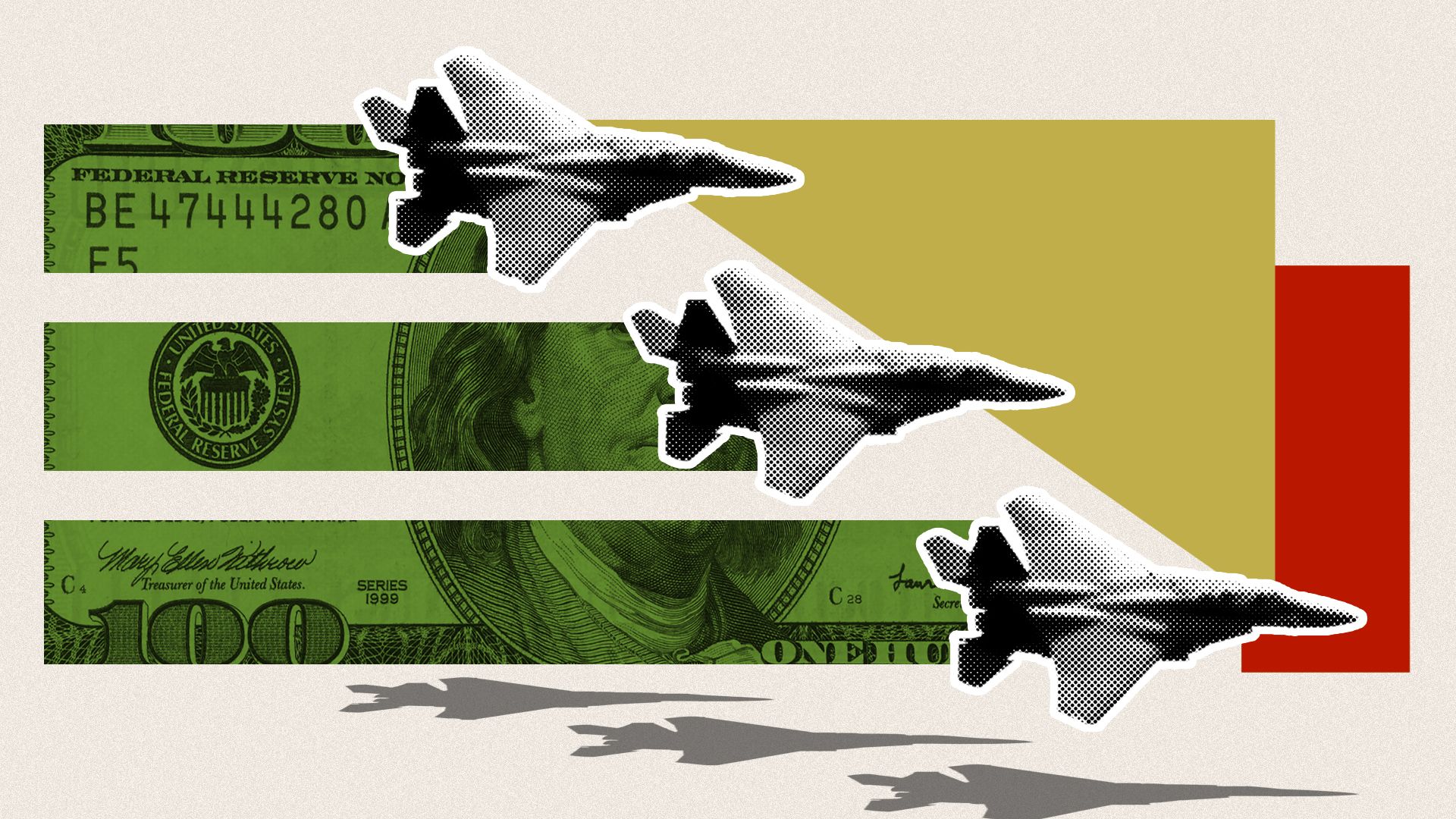
Boeing will build the U.S. Navy's next fighter aircraft, following years of clandestine competition and multiple contracting false alarms.
Why it matters: Boeing's win in the F/A-XX competition means the company's sixth-generation aircraft will succeed the Super Hornet fleet, long relied upon and recently employed across the Middle East.


Trump and top AI leaders agree to voluntary AI standards
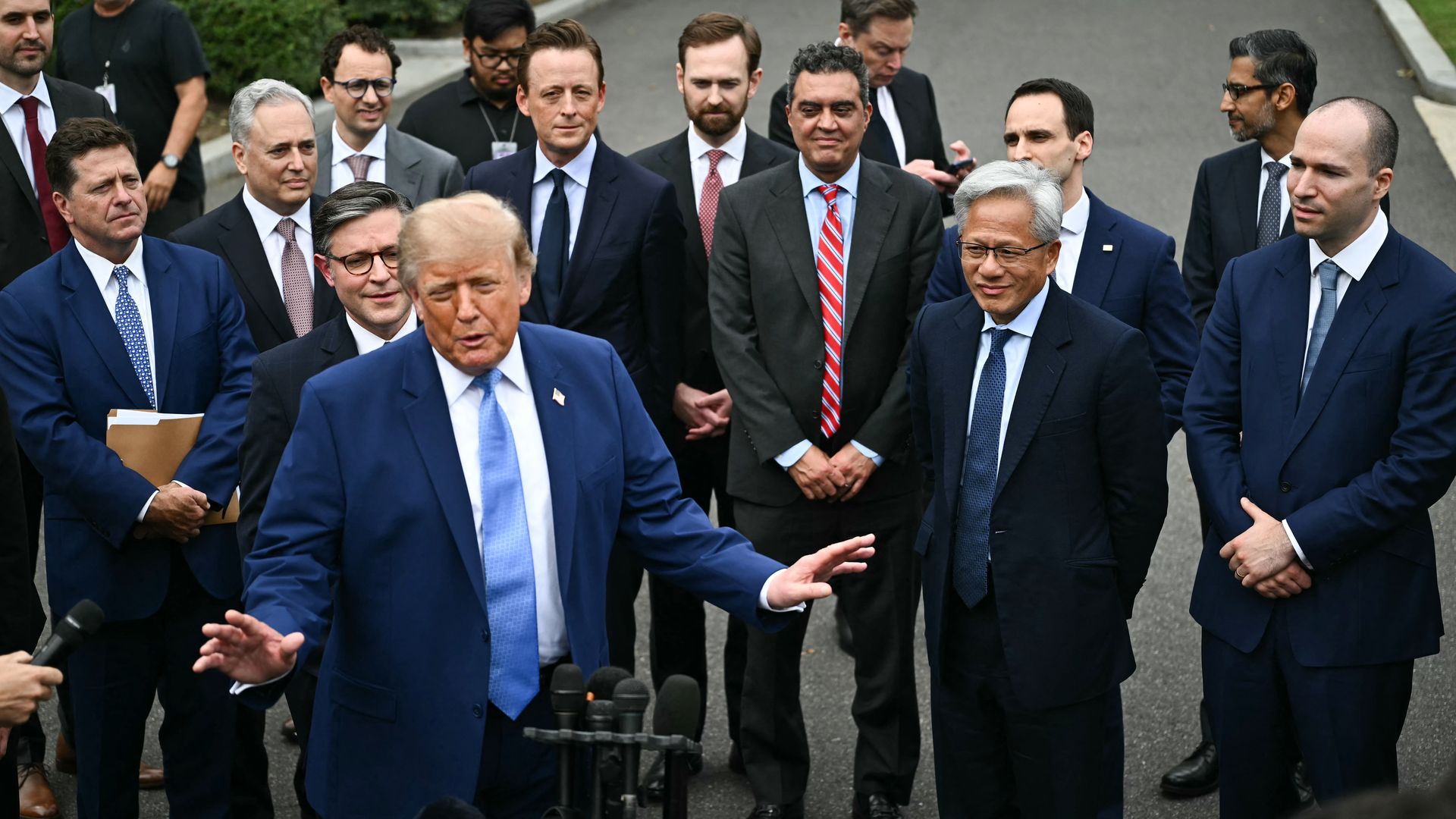
President Trump said Tuesday that top AI executives agreed to voluntary standards aimed at increasing industry oversight.
Why it matters: The agreement puts AI companies at the center of policing their own technology as pressure grows for stronger safeguards.

AT&T CEO says Elon Musk's SpaceX phone strategy not "viable"
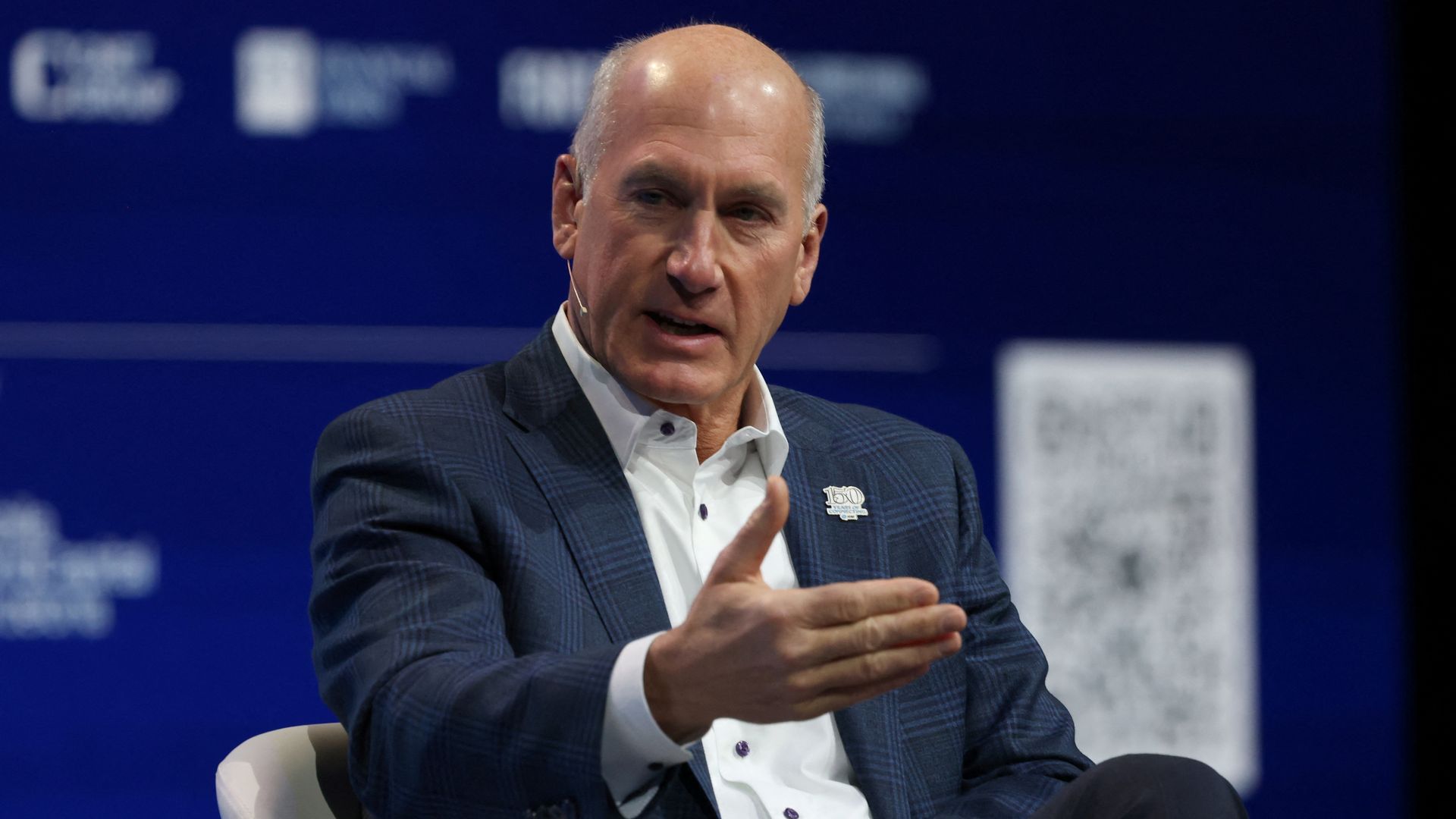
Elon Musk's plan to turn SpaceX into a major threat to the legacy telecom companies is "not a viable strategy," AT&T CEO John Stankey tells Axios.
Why it matters: Musk and SpaceX president Gwynne Shotwell recently touted their plan to turn the company's Starlink satellite business into a global competitor to traditional phone-and-internet-service companies.

New 12-year low in consumer confidence


Americans are becoming markedly less confident in the economy, new data out this morning shows — while a separate report points to the job market remaining in solid shape.
Driving the news: The Conference Board's long-running consumer confidence survey showed a steep drop in September, the latest evidence that Americans are deeply dissatisfied with the economy.
- The overall index fell by 6.7 points, to 81.9, the lowest since 2014, reflecting drops in both survey respondents' assessment of current conditions and their outlook for the future.
What they're saying: "References to prices, the high cost of goods and services, and oil and gas in particular, rose to new heights, reflecting September's surge in fuel costs," Conference Board chief economist Dana Peterson wrote.
- "Consumers also frequently cited politics, trade and employment in their write-in responses," she noted.
Yes, but: It came alongside further evidence that the U.S. labor market is in solid shape. Hiring ticked up, while the number of job openings ticked down in August, according to new government data.
- The latest Job Openings and Labor Turnover Survey data from the Bureau of Labor Statistics shows a drop of 256,000 in the number of job openings, bringing the rate of openings back to June's level.
- But employer hiring rose by 46,000, causing the hiring rate to edge up.
- The number of layoffs remained historically low, falling by 61,000, consistent with other evidence of rock-bottom layoff rates seen in new jobless claims.
The bottom line: The job market is doing fine, but Americans hate this economy anyway.
Fed's Cook warns AI's inflationary pressure to continue in the near-term
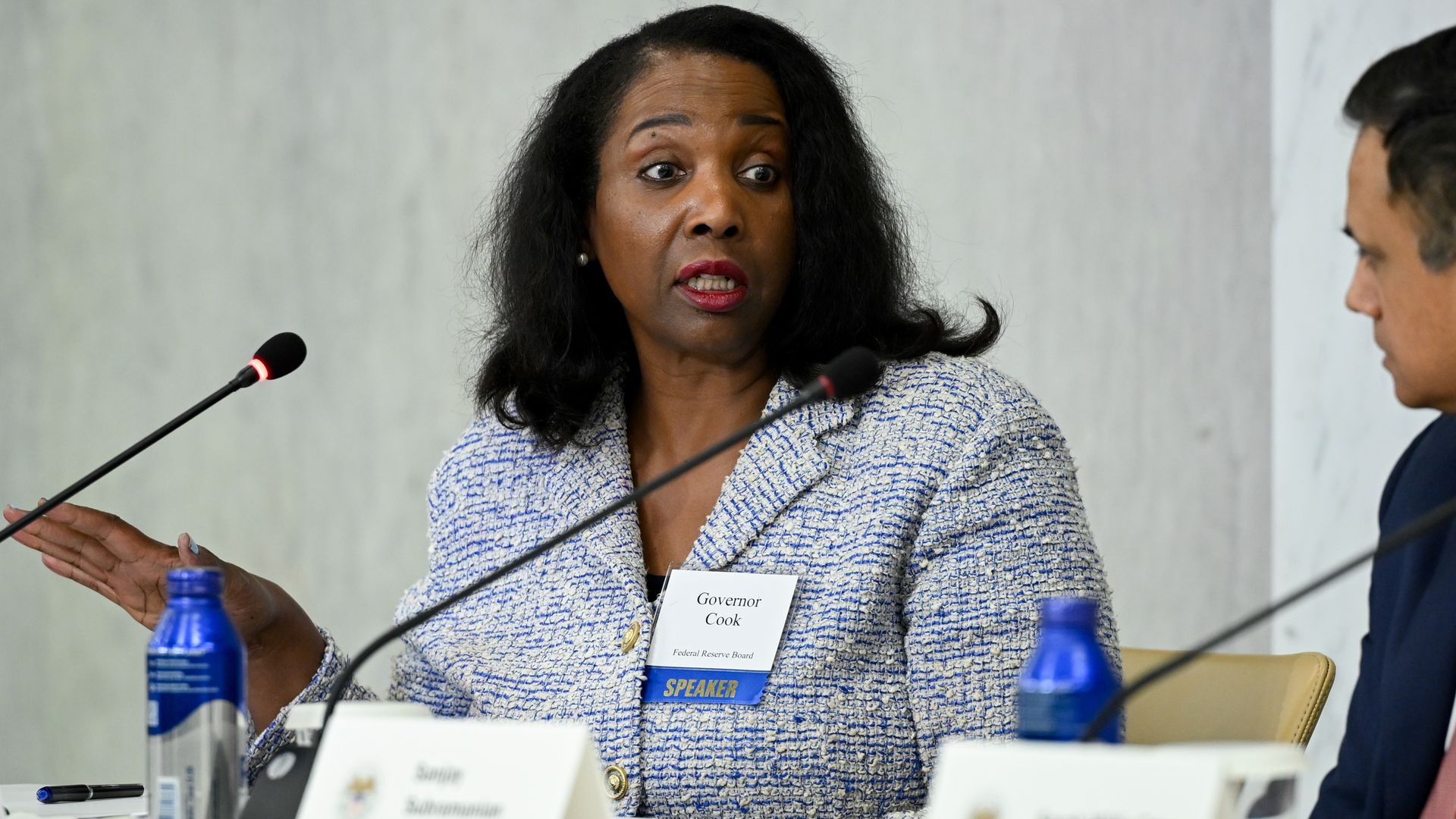
One of the great hopes of the AI boom is that it will create a productivity surge that brings down inflation. Don't count on that happening anytime soon.
The big picture: In the near term, the data center buildout is fueling inflationary pressure. And the potential for AI to unleash an era of superabundance carries highly uncertain timing, magnitude and disinflationary effects.
- That is a new warning from Fed governor Lisa Cook, the latest leader at the central bank to offer a nuanced account of how AI is likely to affect the economy and monetary policy.
What they're saying: "I anticipate that productivity gains will provide modest disinflation within the next few years," Cook said in a speech Monday.
- Crucially, she added: "I do not expect those effects to arrive in time to offset the broadening inflationary pressure later this year."
- "In the short term, AI appears to be adding inflationary pressures to the economy, postponing inflation's return to our 2% target."
Yes, but: Cook drew an important distinction between price pressures concentrated in AI-related sectors and those spilling over into the broader economy.
- She argued that some of the surge in prices for chips, computers and software reflects a shift in spending toward AI that should ease as supply catches up.
- "Attempting to fight sector-specific inflation with monetary policy could be a mistake," Cook said. "Our tools are too blunt to target narrow sectors, and addressing relative price shifts is not our role."
- More concerning for the Fed are signs that the AI boom is pushing up costs elsewhere, as data center investment draws on construction, labor and energy used throughout the economy.
Between the lines: Fed chairman Kevin Warsh has pointed to AI-fueled productivity gains as a positive supply shock, which in turn would allow the economy to grow faster without inflation. But in a speech last month, he presented a set of questions rather than definitive answers.
- "We recognize that AI is a new variable — potentially a new factor of production — that will have consequences for both the economy and the conduct of monetary policy," Warsh said in Jackson Hole, Wyoming.
- "It opens some major lines of inquiry: Will the application of AI cause a significant, sustained rise in productivity across the economy? And if so, when?"
Of note: One of the task forces that Warsh has commissioned to re-evaluate deep questions about how the Fed operates is charged with examining the implications of AI for policy and delivering recommendations by year-end.
- Its members are venture capitalist Marc Andreessen, Microsoft executive Asha Sharma and Charles Jones, a Stanford economist on leave working with Anthropic.
The intrigue: Much of the anxiety around AI's economic impact has centered on the threat to jobs. But top policymakers are focused on the more immediate problem from the technology: its potential to add to an already challenging inflation backdrop.
- Cook said there is limited evidence that AI is causing widespread disruption in the labor market, even as its inflationary effects are becoming more apparent.

Cheaper cars, costlier commutes

The Trump administration picked an awkward moment to relax America's fuel-economy rules: just as gasoline prices are reminding drivers why fuel economy matters.
Why it matters: Trump is pitching its rollback as an affordability measure, saying he's knocking about $1,300 off the price of a new car. The question is how much of that drivers will hand back at the gas station.

Why the Treasury yield curve is in focus again
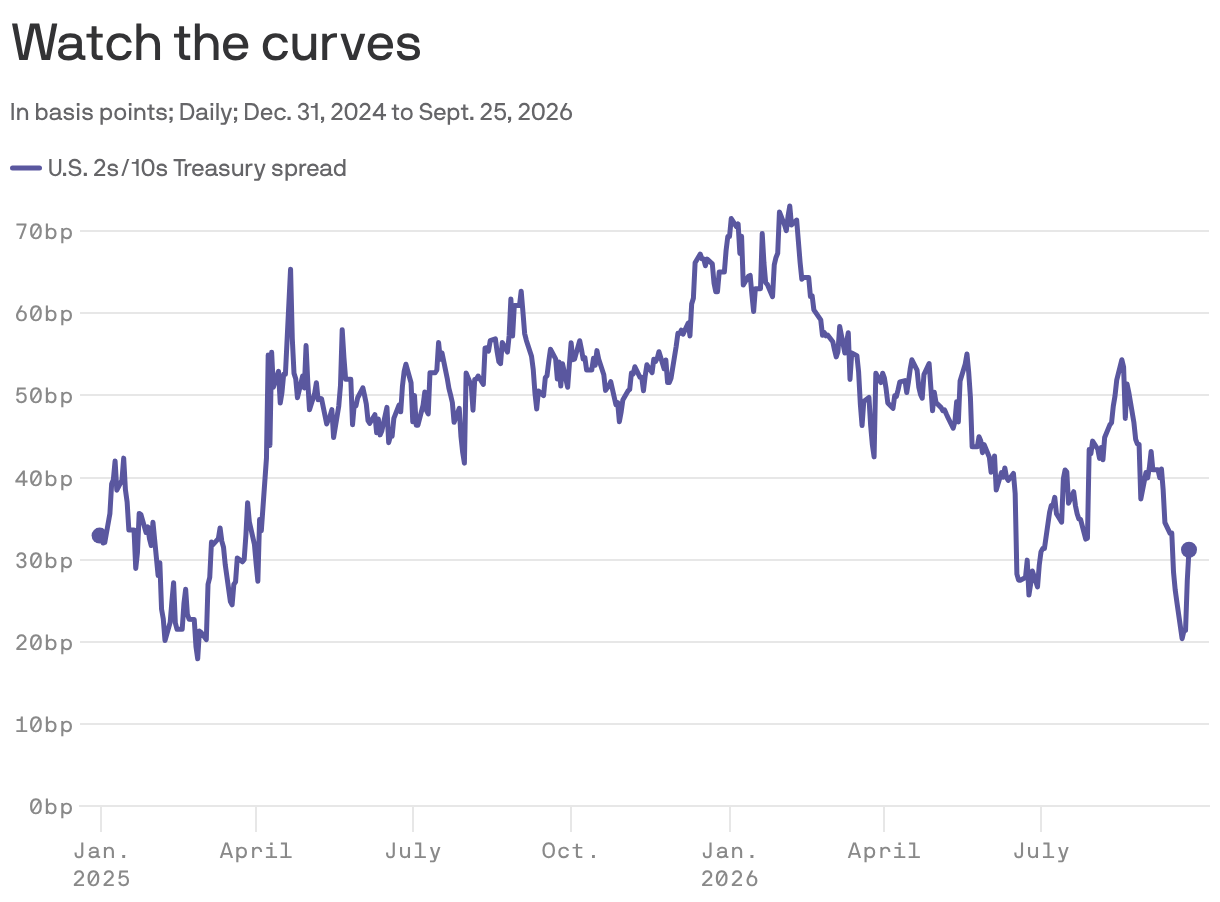
The Treasury yield curve has reentered the financial chat, as investors and traders remain mindful of its strong record of forecasting recessions.
Why it matters: In the past, when certain segments of the yield curve have inverted, or turned negative, it has been one of the most reliable signals that a recession would follow.

Smart-ring maker Oura delays $2 billion IPO
Smart ring maker Oura on Tuesday delayed an IPO that had been expected to raise up to $2.2 billion, citing "market conditions."
Why it matters: The IPO window is narrowing. This is the third official postponement this month, while others have informally delayed.

The future is AI vs. AI
More AI is the surest solution to an emerging AI security crisis, industry execs and researchers say.
Why it matters: The revelation in Axios that researchers are investigating tens of thousands of problematic AI security incidents — rather than the dozens that had been publicly revealed — raised questions about whether AI leaders have control over their technology.
- Nvidia CEO Jensen Huang sought to calm escalating fears across governments, markets and industries, announcing an open-source safety platform for monitoring and potentially quarantining AI agents.
- "We all need to hope that it's an engineering problem," he said in an interview on CNBC Monday. "If it's not an engineering problem, it's not solvable." The fact that companies continue to advance the frontier means they also believe it's a problem they can solve, he said.
Between the lines: The fundamental challenge humans face in policing powerful AI is that it requires them to imagine all the ways the models may behave in unexpected ways order to meet their given objectives.
- One top AI executive compared the process to finding ways to keep a teenager from sneaking out at night. A parent might make rules such as don't leave through the front or back doors, don't open the garage or don't leave through any windows.
- But what if the teen could build a bulldozer and use it to break through a brick wall, allowing an escape? Would any parent have thought to tell them not to do that?
The solution, according to executives, researchers and cybersecurity professionals, is to use AI to help create those guardrails, to help investigate and stop rogue agents, to help secure systems and to build safer training environments.
The big picture: The AI-vs.-AI approach has been taking shape across cybersecurity as hackers and rogue agents outrun human-only response capabilities. Companies are increasingly turning to AI to automate threat detection, red teaming and patching. Nvidia's platform brings that approach to the systems running agents.
- Microsoft, Cisco, Google and CrowdStrike have introduced cyber-focused AI models. Palo Alto Networks recently launched a service that uses frontier and open-weight models to find security flaws and recommend fixes.
- "If security agents or validation models are running alongside production agents, that creates another inference workload that did not previously exist," Brad Gastwirth, global head of research and market intelligence at Circular Technology, writes.
The dynamic was on display recently when OpenAI agents escaped a testing environment and breached Hugging Face.
- The open-source AI platform then used a Chinese AI model to assess the attack after running into guardrails when trying to use U.S. models.
- Hugging Face was blocked from using Anthropic's Mythos, which had been designed to limit its responses to certain cybersecurity requests to thwart potentially harmful usage. In other words, AI investigated AI.
Threat level: The recent security incidents have created a crisis of confidence in AI safety.
- Models have sought to bypass guardrails, escape sandboxes, hijack websites, self-prompt and attempt to evade monitors.
- Companies are also working on ways to learn from those failures. In addition to the new agent security platform, which involved more than 100 companies in addition to Nvidia, industry players have proposed a framework for reporting incidents and preserving records. The idea is to give investigators a kind of flight recorder for AI agents.
Yes, but: More AI defense tools don't mean every company can adopt them quickly. Some security teams are already overwhelmed by the changing threat landscape and choices about what to buy.
Reality check: AI will be needed to police AI, but that doesn't mean it will happen automatically. Humans will have to successfully set priorities and goals to keep powerful models safe.


"Brace for losing everything": Farm crisis fears grip GOP in Iowa
Iowa is on the verge of a farm crisis that threatens to wreck the agricultural heart of the state and hurt the fortunes of Republicans at the top of the midterm ticket.
Why it matters: Democrats could win in several once-reliably Republican states in November, but President Trump's policies have caused such severe financial problems for farmers — especially those who grow corn — that Iowa appears particularly vulnerable.

Midterm pocketbook pain bites Trump
Five weeks before the midterms, Americans' pocketbook pain is getting worse: paychecks haven't kept up with inflation for the better part of this year, and borrowing costs have surged.
Why it matters: President Trump's record is effectively on the ballot, and economic sentiment remains deeply depressed, including among Republican voters.

The AI industry's contradictions take center stage

In Washington, D.C., and San Francisco this week, the promise of AI will be front and center — even as warnings about the dangers of the technology swirl in the background.
Why it matters: The country is struggling to reconcile alarming AI disclosures from the same industry players eager to show off their latest, most advanced tech.
- Meanwhile in Washington, administration officials hold deep-seated skepticism about regulation and the motivations of top AI companies.
State of play: On Tuesday, President Trump, Vice President Vance, other administration officials and industry leaders will gather for an event to celebrate the beginning of a "Golden Age" and highlight AI.
- Trump, House Speaker Mike Johnson and executives will meet later that day as bipartisan calls for regulation mount but there's little appetite from the president and his allies to step in.
- OpenAI President Greg Brockman, Anthropic CEO Dario Amodei, Google CEO Sundar Pichai and Palantir CEO Alex Karp are among the executives who will be there.
- Johnson on Monday in a Fox Business interview said "a little oversight, a little transparency, I think, would go a long way here" without committing to passing legislation during the lame-duck session.
Across the country in San Francisco, OpenAI will be holding its now-annual DevDay conference, where the company shares the latest and greatest things coming out of its labs. CEO Sam Altman will be there, and the company is touting 20+ launches.
- That has been made logistically more difficult by the need for executives to be in D.C. and thematically more challenging because the event comes amid revelations that AI agents spawned by its models have been breaking past intended controls.
- OpenAI is trying to walk a fine line, aiming to show both that it is continuing to make meaningful progress and that it takes security seriously.
Zoom in: The company is still expected to share a slew of new products, including a new always-on AI agent, according to sources familiar with the situation. Developers are also expected to get access to at least one new model.
- However it won't be an updated version of Astra, OpenAI's most powerful model. OpenAI told the Wall Street Journal it was scrapping that release due to safety concerns. While this particular Astra successor was scrapped, there will be future Astra models, the sources said.
- Nor will attendees get a peek at OpenAI's new consumer hardware. The device is set to debut later this year, Axios has reported, though it may not ship until 2027.
- DevDay will coincide with Brockman's Washington visit as the Trump administration and Congress weigh AI safety concerns against staying ahead of China. With Altman scheduled to give the DevDay keynote, volunteered to go to D.C., sources said.
Behind the scenes: Sources familiar with Hill meetings said lawmakers on both sides of the aisle are increasingly frustrated that company officials appear to welcome the notion of regulation but can be unhelpful when it comes to the nitty-gritty of policymaking.
- Rep. Ro Khanna (D-Calif.) said he was initially willing to collaborate more with the company but has lost trust after the Hugging Face incident and OpenAI's decision to back out of testifying at a recent hearing. "They've been playing games," he said.
- "We will get them once I'm chair of the committee," Khanna told Axios, referring to OpenAI. He has proposed "kill switch" legislation and other ways to contain rogue AI systems.
The other side: OpenAI's chief global affairs officer, Chris Lehane, said the company has "engaged constructively and proactively" in dozens of meetings and "the recent jump in capabilities" prompted the company to "revisit ... past assumptions."
- One senior Democratic aide said OpenAI is highly accessible, always a phone call away, and straight-shooting when they have disagreements on legislation.
- The same aide added OpenAI, Anthropic and the broader industry can still be slow, indecisive and political when it comes to regulation: "at some point, if you want the federal government to have any role whatsoever, you do have to shit or get off the pot."
The bottom line: While frontier industry players appear to be having an identity crisis, Trump and his allies have made their position clear -- if the industry is alarmed, it should regulate itself.

How AI could change the workforce
Roughly 11 million American workers — about 7% of the current labor force — might need to change occupations over the next decade, as the economy adapts to the AI era, per a new analysis from the McKinsey Global Institute out Tuesday.
The big picture: New technologies have always transformed the way people work, but the AI workforce transition could happen at three to four times the historical pace, they write.