President Trump is, as one analyst put it, "still reliably unreliable" on policy pursuits — and the herky jerkiness is giving companies whiplash in the early days of his second term.
Why it matters: Businesses prize certainty — so unpredictability can make it hard for them to plan.
The potential for an escalating trade war and other supply chain disruptions threaten to drive up inflation as happened during the COVID-19 pandemic, the president of the Federal Reserve Bank of Chicago said Wednesday.
Why it matters: Supply chain problems were the biggest drivers of inflation over the past five years, according to Chicago Fed President Austan Goolsbee, who warned that it's "dangerous" for policy makers to ignore those risks in 2025.
Starbucks is set to serve its loyalty members a rare deal Monday — free coffee the day after the Super Bowl — despite recently reducing the number of discounts.
The big picture: The coffee giant has been promoting a "back to Starbucks" campaign to return to its roots to try to reverse a decline in foot traffic and sales.
If Elon Musk's Department of Government Efficiency succeeds in its efforts to seriously reduce federal employment, it would likely be enough to ding the overall U.S. labor market — but just create a little dent.
The big picture: Given the massive U.S. economy, even hundreds of thousands of people potentially losing their jobs isn't enough to significantly move the overall unemployment rate.
The U. S. Postal Service said Wednesday that it will continue to accept international mail and packages from China and Hong Kong, reversing a Tuesday announcement that it would halt the flow of inbound parcels from the areas.
The latest: The USPS in a statement Wednesday pointed to "new China tariffs," and said that it was working with Customs and Border Protection to implement an "efficient collection mechanism" for the taxes on imported goods.
Federal workers have one more day to decide whether or not to trust the White House, resign from their jobs, and take a controversial "deferred resignation" deal conceived with Elon Musk's input, unless a federal court postpones the deadline.
Why it matters: Three unions that represent more than 800,000 federal workers and the AFL-CIO filed a lawsuit on Tuesday seeking a restraining order to halt the deadline, calling the deal an unlawful, arbitrary and "short-fused ultimatum."
A trade war with China could shock fragile global health care supply chains, driving up the cost of medical supplies, intensifying shortages of common drugs and limiting U.S. medical device makers' ability to import critical parts.
Why it matters: While President Trump's tariffs are billed as a boon to America's public health for the way they'll cut off sources of fentanyl, experts say they risk upending a health network that buckled during the pandemic and relies on components sourced from around the world, with multiple intermediaries.
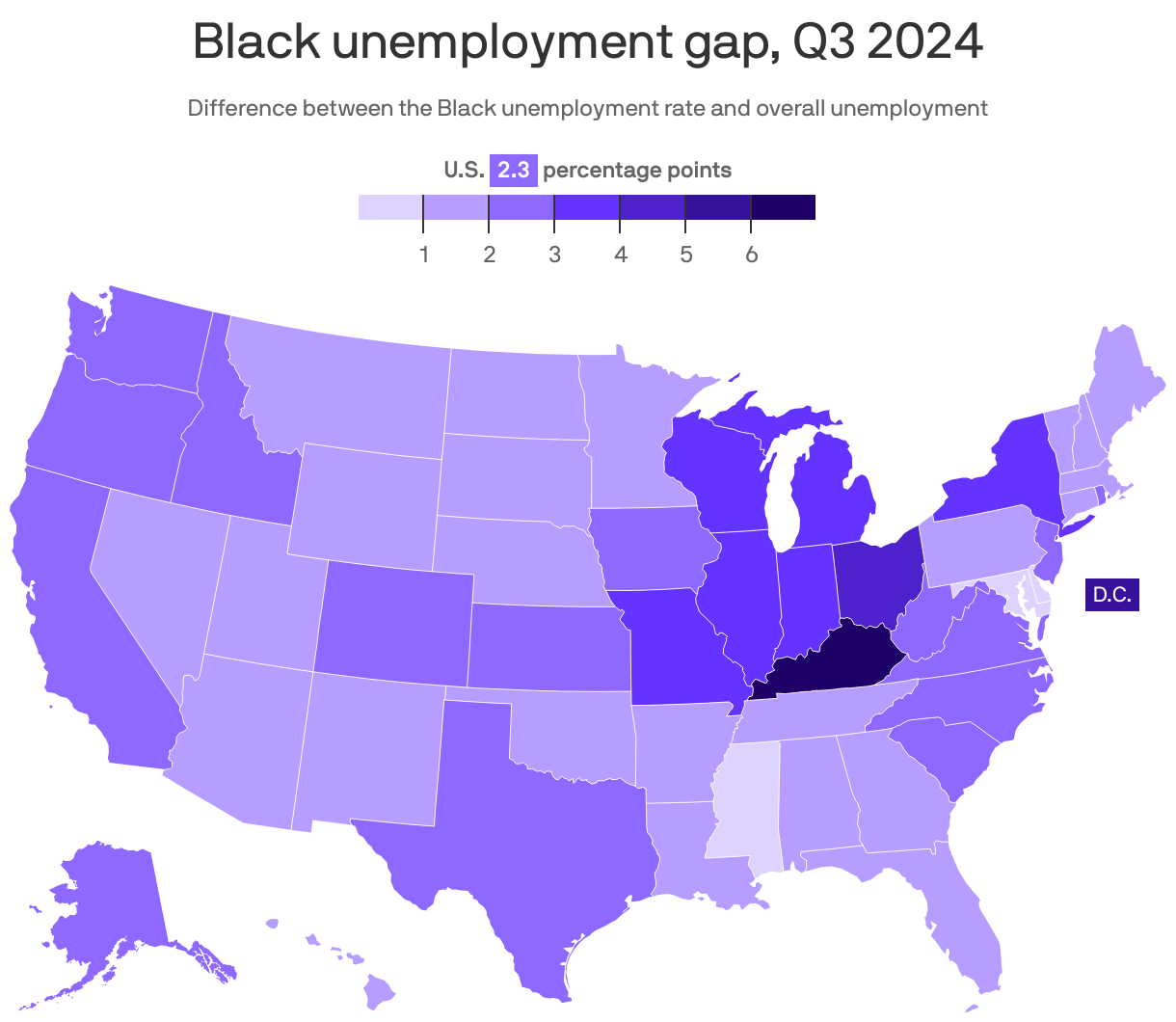
Data: Economic Policy Institute; Map: Alex Fitzpatrick/Axios
Sometimes overlooked in the big monthly jobs reports is a stark reality: The unemployment rate among Black Americans is consistently higher than the overall rate, and that gap is especially pronounced in some states.
Why it matters: Looking below surface-level at economic data can reveal important trends, differences and needs among specific groups.