Trump's perplexing tariffs goals

Add Axios as your preferred source to
see more of our stories on Google.
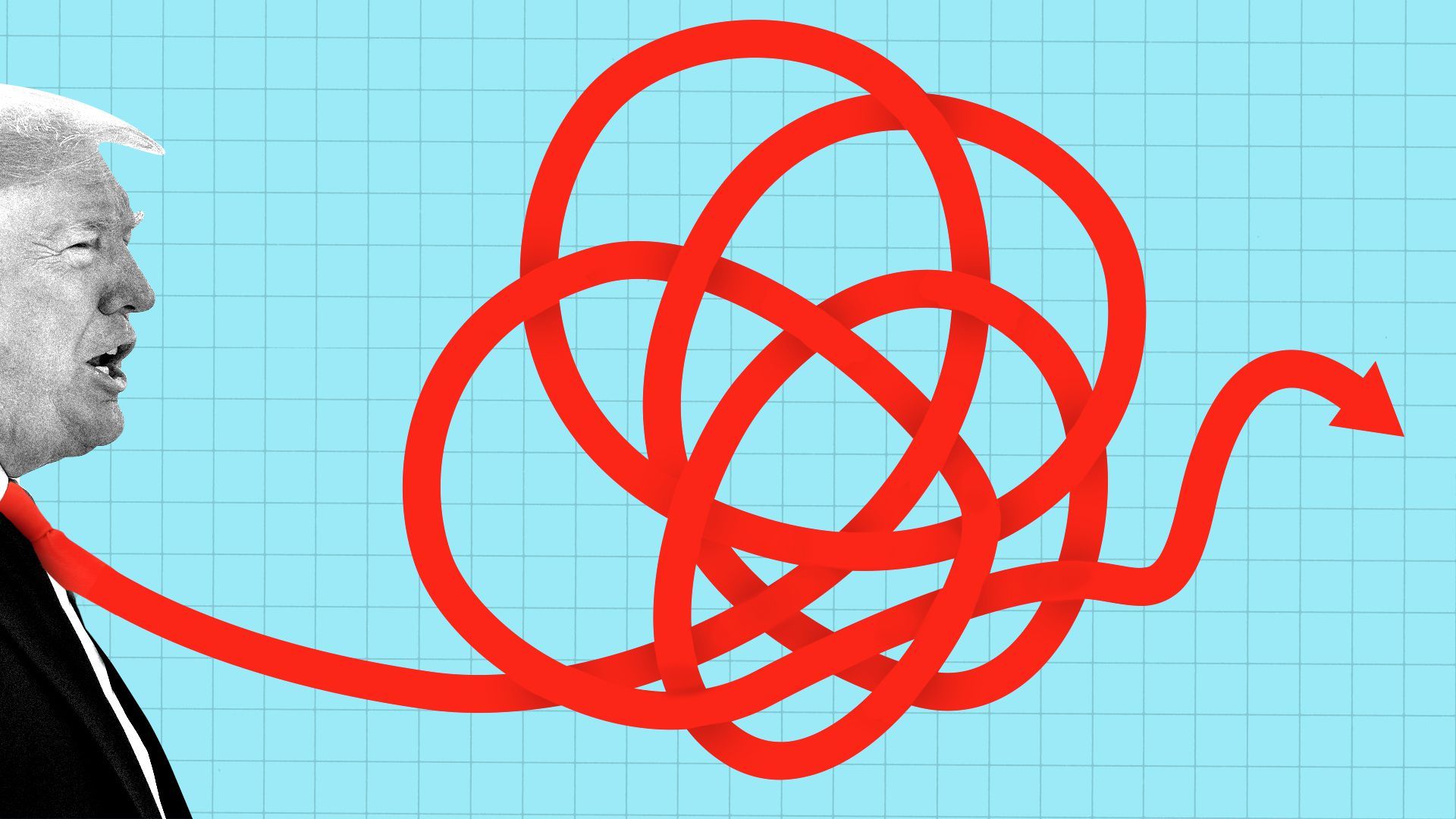
President Trump. Photo illustration: Aïda Amer/Axios. Getty Images photo: Nicholas Kamm/AFP
President Trump campaigned on using tariffs to revive domestic industry and fill America's coffers, but the tariff strategy now looks more muddled than ever.
Why it matters: Trump has sent mixed signals about why his administration is slapping tariffs on billions of dollars' worth of imports, sparking confusion about whether the measures are temporary threats or the new economic normal.
- A trade war is underway with China, though every instance of tariff threats before that — Colombia, Canada and Mexico — has ended with Trump backing off, following concessions on areas of policy unrelated to trade.
- The economic impact of tariffs might prove minor if they are merely a negotiating tactic to extract non-trade-related concessions. But if they become a permanent feature of U.S. policy, they'll have a more lasting impact on the economy, markets, and business decision-making.
What they're saying: "If you move the tax base onto imports, then you now need imports to generate revenue," Jason Thomas, head of global research and investment strategy at Carlyle, tells Axios.
- "But if you have tariff rates that are so high that it leads to more domestic production, well, now you can't generate revenue. These two things are not mutually consistent with one another," Thomas adds.
Catch up quick: Tariffs on most North American imports are temporarily on ice after Canada and Mexico notched a deal with Trump.
- But the 10% tariff on all imports from China took effect Tuesday morning. No product is exempted from the import tax, unlike in Trump's first term.
- Overnight, China hit back, threatening retaliatory 15% tariffs on a slew of U.S. imports, including farm machinery, coal and natural gas. It will also restrict exports of crucial minerals.
- Then there was a non-trade-related measure: Regulators in China opened an antitrust investigation into Google.
The intrigue: The White House warned that retaliation would result in stiffer tariffs.
- But China's retaliatory measures won't go into effect until next Monday. In theory, that offers a window for Trump and Chinese leader Xi Jinping to land a deal that could stave off the trade war — much like Canada and Mexico. (They are due to speak Tuesday.)
That appears to be the ideal outcome. Speaking in the Oval Office on Monday, Trump suggested the tariffs were a negotiating tactic.
- "China hopefully is going to stop sending us fentanyl, and if they're not, the tariffs are going to go substantially higher," Trump told reporters.
Yes, but: Trump also returned to a regular frustration about trade deficits when defending tariffs.
- "The USA has major deficits with Canada, Mexico, and China (and almost all countries!), owes 36 Trillion Dollars, and we're not going to be the "Stupid Country" any longer," Trump wrote, in part, on his social media site Truth Social.
- Trump has also said tariffs would be a source of government revenue that could help pay for his tax legislation.
- "I think that there is this presumption that revenue associated with tariffs will offset some portion of those tax cuts," Carlyle's Thomas says. "As we get closer to that, we'll have to see more evidence of what really intends to be permanent, as opposed to which tariffs are more trying to shape the behavior of foreign governments."
The other side: Conservative economist Oren Cass, who has supported Trump's tariff plans, said it was clear that these were negotiating tariffs — rather than a tariff that seeks to raise revenue, decouple economies or rebalance trade deficits.
- "Think of a negotiating tariff like an embargo or a loan—an economic tool of statecraft used to advance foreign policy aims," Cass wrote in a post Monday.
- Cass, however, admitted the Trump administration's negotiation-type tariffs are unclear: "[T]he actual demands remain unclear at best," he wrote.
