Apple and Nvidia have both discussed joining a new funding round for OpenAI, according to reports.
Catch up fast: The WSJ reported yesterday that OpenAI was in talks to raise new funding at a valuation north of $100 billion, led by a $1 billion investment from existing backer Thrive Capital, with Microsoft also returning.
Zoom in: Apple has ties to OpenAI, naming it as the first official partner for its coming Apple Intelligence system, which will bring AI features to its iPhone and other products, both Bloomberg and WSJ noted.
Both Apple and Nvidia declined to comment to Axios.
💭 Hope's thought bubble: You've got the three biggest companies in terms of market cap interested in the same startup for one main reason: FOMO, the fear of missing out on understanding the workings of OpenAI's technology and of the potential upside of a business that Sam Altman may one day take public.
Mounting pressure to show whose capital-intensive AI offerings are going to drive the market has sparked a public beef between software providers.
Driving the news: "This is not Copilot," Salesforce CEO Marc Benioff said yesterday on an earnings call, taking a shot at the AI-powered assistants that Microsoft has added to nearly all of its products.
"So many customers are so disappointed in what they bought from Microsoft Copilot because they're not getting the accuracy and the response that they want," he said.
Shots fired.
Context: By "this," Benioff was referring to Agentforce, Salesforce's generative-AI-based platform that it's readying for a formal launch.
Dollar stores are down in the dumps, struggling with strategic and operational breakdowns.
Why it matters:Traditionally a refuge for customers fleeing higher prices, the nation's leading dollar store chains are losing ground to big-box competitors.
The average 401(k) account balance, at $127,100, is still below its 2021 highs — but there are now half a million Americans with more than $1 million in their 401(k) accounts just at Fidelity alone.
Why it matters: It's a sign of how the wealthy benefit disproportionately from tax breaks on retirement savings.
Here's what's new on Hulu, Netflix, BET+, Prime Video, Apple TV+ and Peacock.
What we're watching: A new season of "Only Murders in the Building," a Greek mythology series set in the modern world and a film based on a family's alleged experiences with demonic possession.
Wyoming is all set to launch a stablecoin that will — if all goes to plan — help to fund education in the state.
Why it matters: An actual U.S. state getting directly into the cryptocurrency business is a real vote of confidence in the future of digital ledger technology.
The big picture: Stablecoins are thought of as the most successful blockchain product to date.
They're a huge topic in the payments space. For large, global transactions, their time to final settlement is attractive.
Their collective market capitalization is $169 billion.
How it works: Wyoming's version — which doesn't have a final name or ticker yet — will be backed by actual dollars, fairly short-term U.S. Treasuries and related repurchase agreements.
Look at a place that sufferedintensively from industrial decline earlier this century as imports from China displaced parts of U.S. manufacturing, and you're likely to find somewhere that's disproportionately benefiting from the wave of investments now underway.
Super Micro Computer todaysaid its annual report filing with the SEC will be delayed so it can "assess some internal controls."
Why it matters: The announcement comes a day after a report from short-seller and financial research firm Hindenburg Research that accused the server equipment maker of "glaring accounting red flags," including around its revenue accounting.
Super Micro's shares plummeted 19% today, wiping out over $6 billion in market cap.
SpaceX, the most valuable aerospace company in the world, has been on the brain a lot this week.
Catch up quick: The Elon Musk-led $210 billion startup has been tasked with picking up two astronauts from the International Space Station after their original ride — Boeing's Starliner spacecraft — was ordered by NASA this past weekend to return to Earth empty due to safety concerns.
A separate SpaceX rocket launch scheduled originally for yesterday was delayed again for two days due to weather, which means we'll have to continue waiting to witness the first-ever space walk by private citizens.
And overnight, Musk announced on X that SpaceX's Starlink satellite internet will be free for emergency services access.
The intrigue: All this, after a WSJ Opinion piece earlier this month argued for Musk to head NASA.
Nvidia, the most important stock in the world according to many on Wall Street, handily beat expectations Wednesday afternoon in an earnings report that reflects rising investments in AI across broad parts of the economy.
Why it matters: The company has become synonymous with AI, but that doesn't mean it can relax. Peers, startups and even its own customers are increasingly trying to encroach on its territory.
Cribl, a San Francisco-based data infrastructure startup, raised $319 million in Series E funding led by GV at a $3.5 billion valuation.
Why it matters: We rarely see rounds of this size anymore for Silicon Valley tech startups that aren't focused on artificial intelligence. In fact, Cribl's PR email to Axios explicitly said that it is not an AI company.
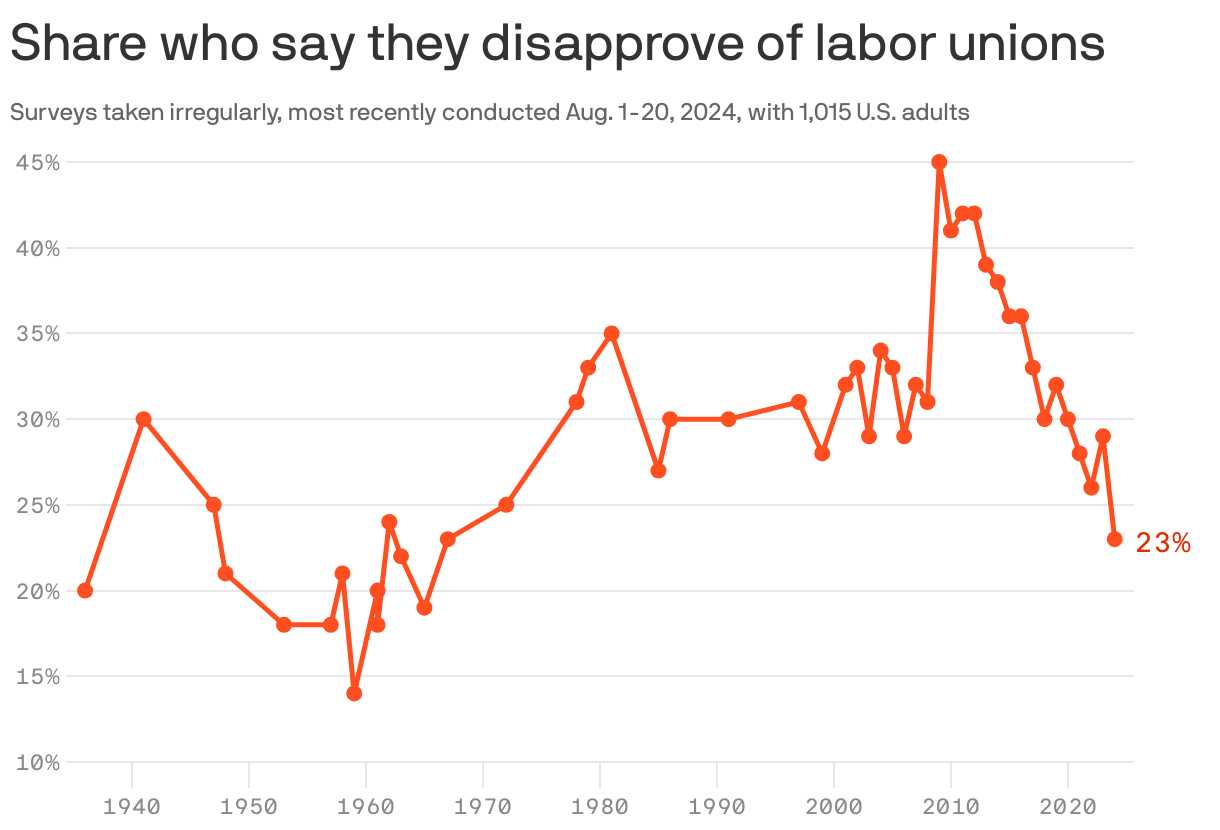
The share of Americans who say they disapprove of labor unions hasn't been this low since September 1967, per new Gallup data.
Why it matters: Unions have seen a resurgence in recent years, with an uptick in strikes and organizing efforts, helped along by more positive public sentiment and, until recently, a strong labor market that emboldens workers to push for more from their employers.
If it feels like everybody you follow on Instagram has traveled to Japan in the last couple of years, you may not be imagining it. A tourism surge since the pandemic goes a long way to explaining the nation's escape from decades of deflation and recent palpitations in global markets.
Why it matters: For years, Japan's government leaned on aggressive monetary policy — including negative interest rates, central bank purchases of all types of securities, and more — to try to end its cycle of too-low inflation and weak growth. Now, thanks in part to tourism, those efforts are paying off.
This is leading the Bank of Japan to end its era of monetary stimulus, and that in turn caused an unwinding of currency trades that led to a stock market plunge on Aug. 5.
Data: Japan National Tourism Organization; Chart: Axios Visuals
The cheap yen has caused Japanese citizens to face higher prices for imported goods, including food and energy.
Those costs are passed along to Japanese consumers whose wages were not rising as quickly as prices, leading to a slump in buying.
Data this month showed that changed in June: real wages rose for the first time in about 2 years.
The other side: While foreign tourism is at an all-time high, it's not so great of a time for Japanese travelers: For them, international and domestic tourism is expected to remain below pre-pandemic levels this year.

Checkout tech company Bolt Financial is just days away from learning if it persuaded enough investors to sign off on a Hail Mary fundraising round that would reinstall controversial founder Ryan Breslow as CEO.
The latest: There are new questions about one of its potential new partners, called The London Fund.