Super Micro Computer todaysaid its annual report filing with the SEC will be delayed so it can "assess some internal controls."
Why it matters: The announcement comes a day after a report from short-seller and financial research firm Hindenburg Research that accused the server equipment maker of "glaring accounting red flags," including around its revenue accounting.
Super Micro's shares plummeted 19% today, wiping out over $6 billion in market cap.
SpaceX, the most valuable aerospace company in the world, has been on the brain a lot this week.
Catch up quick: The Elon Musk-led $210 billion startup has been tasked with picking up two astronauts from the International Space Station after their original ride — Boeing's Starliner spacecraft — was ordered by NASA this past weekend to return to Earth empty due to safety concerns.
A separate SpaceX rocket launch scheduled originally for yesterday was delayed again for two days due to weather, which means we'll have to continue waiting to witness the first-ever space walk by private citizens.
And overnight, Musk announced on X that SpaceX's Starlink satellite internet will be free for emergency services access.
The intrigue: All this, after a WSJ Opinion piece earlier this month argued for Musk to head NASA.
Nvidia, the most important stock in the world according to many on Wall Street, handily beat expectations Wednesday afternoon in an earnings report that reflects rising investments in AI across broad parts of the economy.
Why it matters: The company has become synonymous with AI, but that doesn't mean it can relax. Peers, startups and even its own customers are increasingly trying to encroach on its territory.
Cribl, a San Francisco-based data infrastructure startup, raised $319 million in Series E funding led by GV at a $3.5 billion valuation.
Why it matters: We rarely see rounds of this size anymore for Silicon Valley tech startups that aren't focused on artificial intelligence. In fact, Cribl's PR email to Axios explicitly said that it is not an AI company.
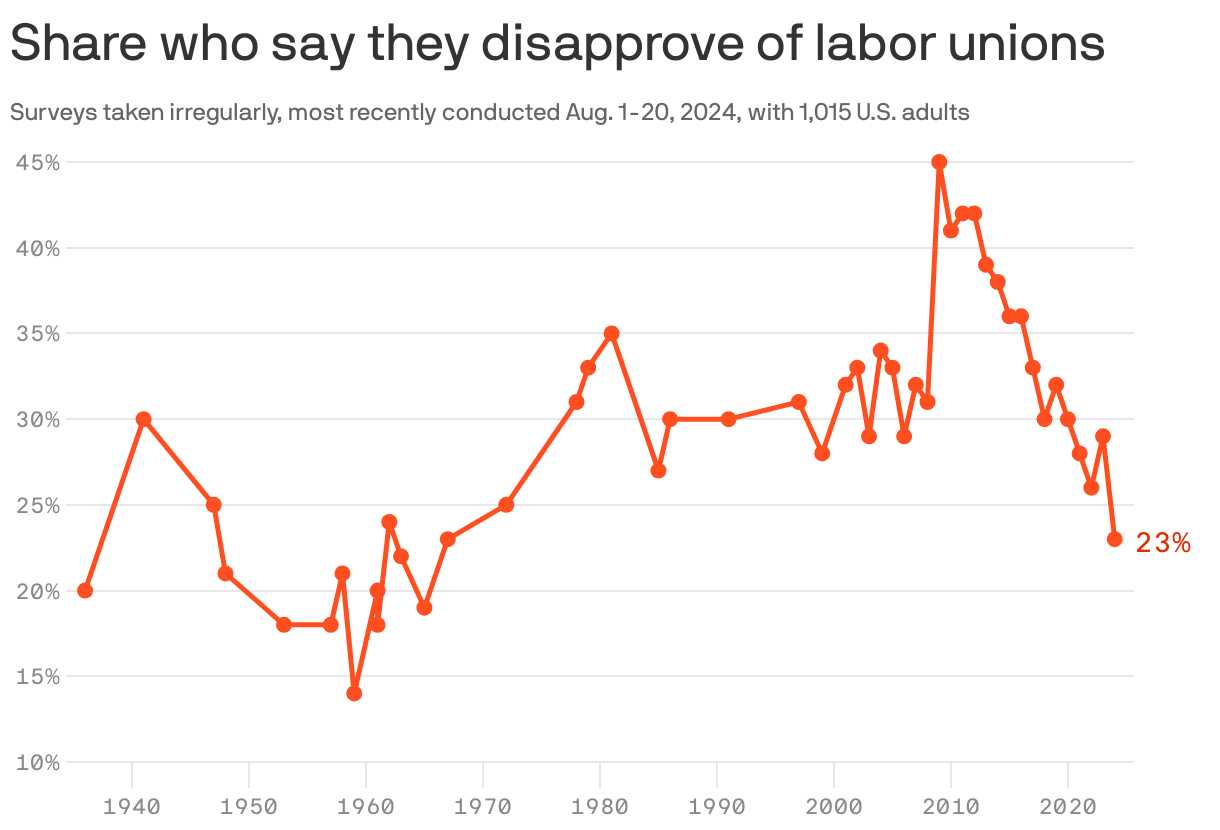
The share of Americans who say they disapprove of labor unions hasn't been this low since September 1967, per new Gallup data.
Why it matters: Unions have seen a resurgence in recent years, with an uptick in strikes and organizing efforts, helped along by more positive public sentiment and, until recently, a strong labor market that emboldens workers to push for more from their employers.
If it feels like everybody you follow on Instagram has traveled to Japan in the last couple of years, you may not be imagining it. A tourism surge since the pandemic goes a long way to explaining the nation's escape from decades of deflation and recent palpitations in global markets.
Why it matters: For years, Japan's government leaned on aggressive monetary policy — including negative interest rates, central bank purchases of all types of securities, and more — to try to end its cycle of too-low inflation and weak growth. Now, thanks in part to tourism, those efforts are paying off.
This is leading the Bank of Japan to end its era of monetary stimulus, and that in turn caused an unwinding of currency trades that led to a stock market plunge on Aug. 5.
Data: Japan National Tourism Organization; Chart: Axios Visuals
The cheap yen has caused Japanese citizens to face higher prices for imported goods, including food and energy.
Those costs are passed along to Japanese consumers whose wages were not rising as quickly as prices, leading to a slump in buying.
Data this month showed that changed in June: real wages rose for the first time in about 2 years.
The other side: While foreign tourism is at an all-time high, it's not so great of a time for Japanese travelers: For them, international and domestic tourism is expected to remain below pre-pandemic levels this year.

Checkout tech company Bolt Financial is just days away from learning if it persuaded enough investors to sign off on a Hail Mary fundraising round that would reinstall controversial founder Ryan Breslow as CEO.
The latest: There are new questions about one of its potential new partners, called The London Fund.
The Chinese parent company of online retailer Temu reported disappointing sales yesterday, sending the company's stock plunging.
PDD Holdings' U.S. shares plummeted 29% Monday and fell another 4% today.
The big picture: Despite year-over-year sales growth of 86% — the type of jump that would make most companies jealous — "we see many challenges ahead," PDD Holdings co-CEO Lei Chen said in a statement.
If the U.S. ever develops a coherent philosophy of how to regulate the cryptocurrency industry, it will likely emerge from the U.S. Treasury.
Why it matters: The blockchain industry's hopes and frustrations have for years been focused on the U.S. Securities and Exchange Commission, but the Treasury Department controls the big picture.
The Federal Reserve has pushed mortgage rates higher not just through its much-discussed interest rate policy decisions, but through two less widely understood channels, a new paper argues.
Why it matters: Since 2022, high mortgage rates have made homebuying an expensive endeavor for would-be borrowers and created dysfunction in the housing market.
The fast-food industry's pain is fast casual's gain. Chipotle, Cava and Wingstop are running circles around the likes of McDonald's, Starbucks and KFC.
Why it matters: The price gap is shrinking between fast-food and fast-casual restaurants.