Japan's tourism boom shows how monetary policy can work


Add Axios as your preferred source to
see more of our stories on Google.
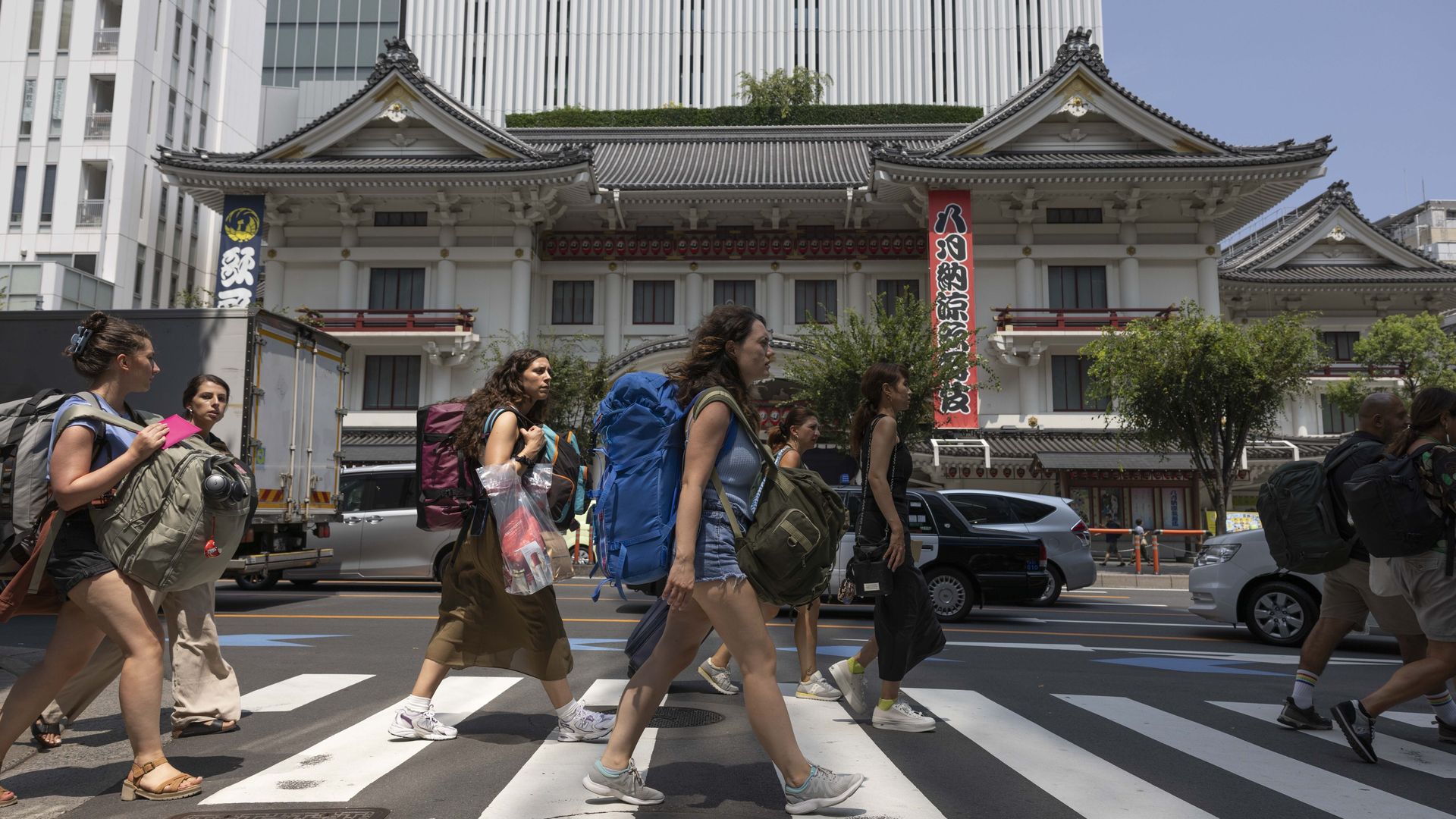
If it feels like everybody you follow on Instagram has traveled to Japan in the last couple of years, you may not be imagining it. A tourism surge since the pandemic goes a long way to explaining the nation's escape from decades of deflation and recent palpitations in global markets.
Why it matters: For years, Japan's government leaned on aggressive monetary policy — including negative interest rates, central bank purchases of all types of securities, and more — to try to end its cycle of too-low inflation and weak growth. Now, thanks in part to tourism, those efforts are paying off.
- This is leading the Bank of Japan to end its era of monetary stimulus, and that in turn caused an unwinding of currency trades that led to a stock market plunge on Aug. 5.
What they're saying: "The yen's depreciation had been effective in pushing up prices through an expansion in aggregate demand, including inbound tourism demand," Bank of Japan policymakers found, according to minutes of the central bank's June meeting released this month.
- "It's been a significant boost to demand," Marcel Thieliant, a Singapore-based economist at Capital Economics, tells Axios of the tourism boom.
- Spending in Japan by non-residents, one way to gauge tourist spending, is up about 40% since the pre-pandemic year of 2019, according to Thieliant. That accounts for about 10% of the increase in the country's GDP over the same period.
By the numbers: A record 3.3 million foreigners traveled to Japan last month, led by China and other Asian nations, according to data from the Japan National Tourism Organization released last week.
- Americans made up about 8% of inbound tourists in July, up roughly 2 percentage points from 2019. In June a record 296,000 Americans traveled to the country.
Between the lines: Most of the trips canceled or delayed because of the pandemic have been completed, "so the continued growth we are seeing this year is more likely due to the buying power of the dollar in Japan," Kay Allen, an executive at the Japan National Tourism Organization, tells Axios.
The big picture: The yen has been declining for years, a desired effect of the Bank of Japan's stimulative monetary policy. It hit its lowest level against the U.S. dollar in more than 30 years this summer, a result of the wide gap between its low interest rates and that of the U.S. (as well as the rest of the world).
- The currency has since rebounded a little, but remains near its multi-decade lows.
The intrigue: One difference from pre-pandemic days is that Japanese businesses are more likely to raise prices, a development welcomed by policymakers. Anecdotes show some restaurants charging higher prices for tourists.
The bottom line: "Given that firms' behavior has shifted more toward raising wages and prices, it is likely that movements in foreign exchange rates are affecting prices to a larger degree and at a more rapid pace," the Bank of Japan's deputy governor said in a speech this month.
