“Avatar: The Way of Water” dominated the U.S. box office over the weekend, earning $134 million in the U.S. and Canada to make the movie the top grosser ahead of the Christmas holiday weekend.
Why it matters: The weekend earnings are slightly below expectations for the long-awaited sequel from director James Cameron, who previously suggested the film needs to make billions in order to break even.
Elon Musk temporarilybanned another journalist over the weekend — after he brought some reporters back to the platform after suspending their accounts, using a Twitter poll to decide their fate.
The latest: Taylor Lorenz, a technology and online culture columnist at the Washington Post, on Sunday appeared to have her Twitter account reinstated after it was suspended on Saturday.
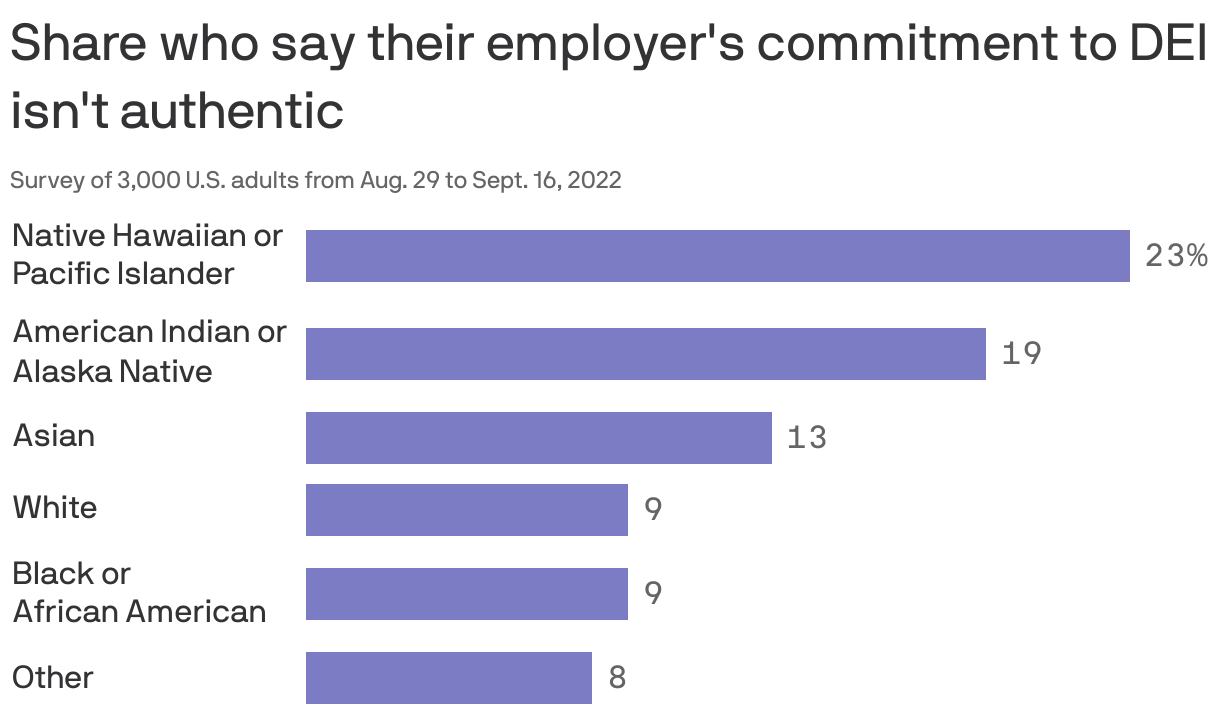
More Americans of Asian descent are speaking out when they feel unsupported or overlooked by their employers.
Why it matters: Past reluctance to do so is partly why Asian Americans, the fastest-growing racial or ethnic group in the U.S., have been included unevenly in corporate DEI programs.
Data: Society for Human Resource Management/Boston College National Study of Workplace Equity Report; Chart: Kavya Beheraj/Axios
Here's how human resources professionals ranked their organizations on a variety of equity measures, from hiring to "resources and supports" like employee resource groups and peer coaches, in a report released Dec. 9 by the Society for Human Resource Management and the Boston College School of Social Work.
Why it matters: "[E]quity often serves as the foundation for successful DEI strategies, improving employees’ job satisfaction, work engagement, perceptions of inclusion, as well as the retention of diverse talent," per the report.
Data: Ernst & Young LLP; Note: Categories were chosen from the U.S. Census, which defines race and Hispanic origin as separate data. Chart: Tory Lysik / Axios Visuals
There are stark contrasts in the ways different generations and groups of employees view diversity and inclusion efforts at work, according to a new survey, Axios' Eleanor Hawkins reports.
Why it matters: The corporate leaders grappling with how best to execute, measure and share their progress on DEI are often Gen X and baby boomers — but it's younger workers who are leading the charge for better efforts.
Nonprofits are working to prepare young people of color, those formerly incarcerated and tribal college students for career growth, especially in fields wherethey remain underrepresented.
Why it matters: Despite years of promises by companies, people of color are still not proportionally represented in a number of industries, including tech, media and venture capital firms.
Corporate recruiters who preached diversity for years are getting their chance to make their mark as companies promise sweeping changes to diversify workforces.
The big picture: They're now showcasing programs and plans that have worked — and where everyone needs to improve.
The last two years have brought scores of new hires, new ideas and new funding to corporate diversity, equity and inclusion — but not all of them are making a difference.
Why it matters: Racism and exclusion persist in the workplace, with higher turnover rates and lower promotion rates among people of color.
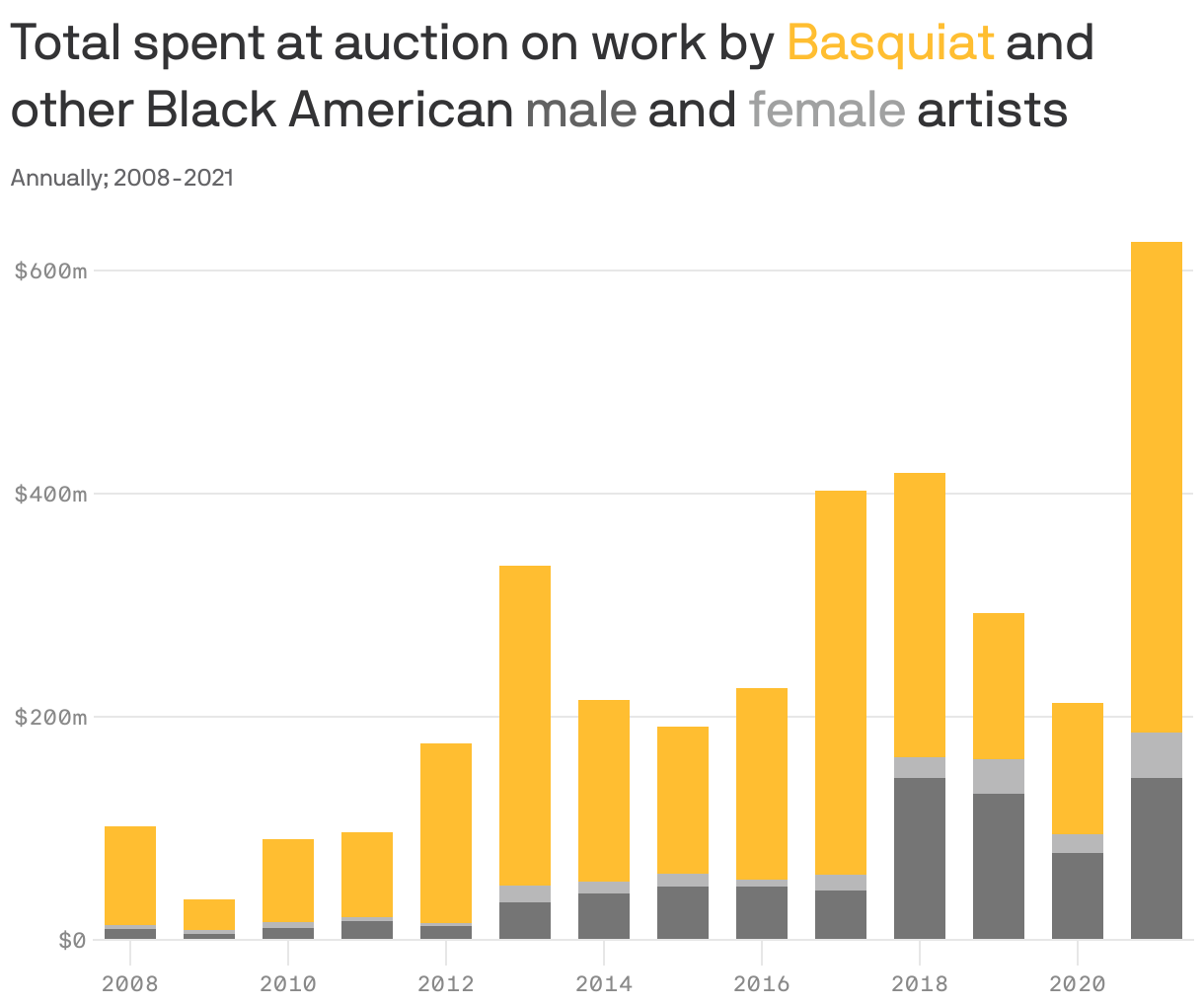
Data: Artnet via Burns Halperin Report; Chart: Tory Lysik/Axios
The art world has always resembled a winner-takes-all game where a few superstars dominate an enormous field of also-ran artists. When it comes to the market for Black American artists, that dynamic is supercharged, per a huge new report on art-world inclusion from journalists Julia Halperin and Charlotte Burns.
Why it matters: Recent years have seen dozens of records fall when it comes to prices for work by Black American artists, who represent about 8% of U.S. artists.
The crypto worldhas been asking a single question for the past decade: Who's in charge here? The answer has now emerged: It's the Americans.
Why it matters: U.S. authorities consider the whole world to be under their purview, to some degree. No one else behaves quite like that — so the U.S. ends up being the de facto global regulator.
There's something a bit oxymoronic about the idea of a cryptocurrency company. In the wake of the implosion of FTX, crypto is increasingly going back to its trustless roots — a world where companies have a much smaller role to play.
Why it matters: FTX's spectacular collapse, and the looming prosecution of its disgraced founder, Sam Bankman-Fried, has undermined confidence in the institutional crypto ecosystem.
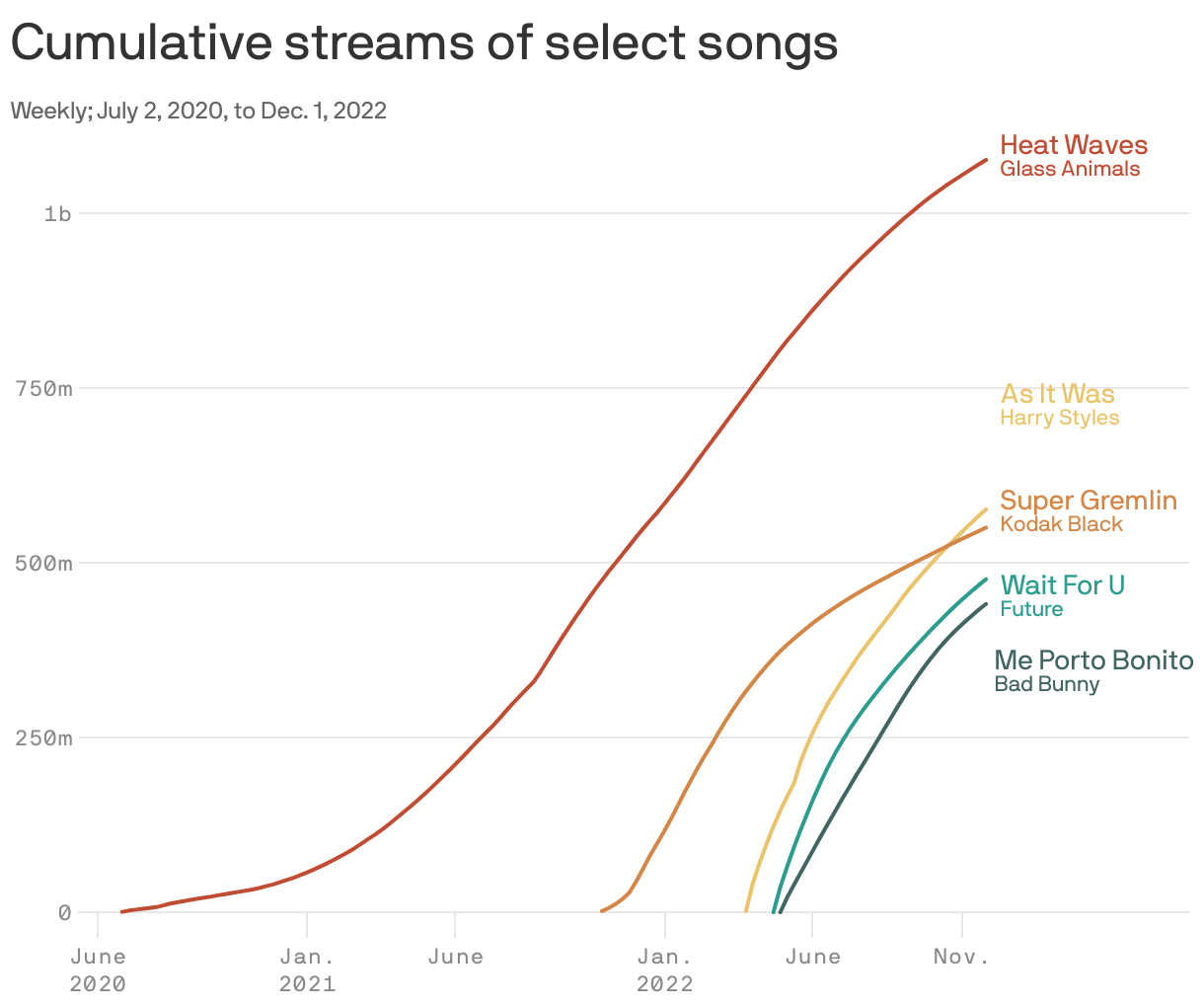
The second most-streamed song of 2022 in the U.S., at least through December 1, was "Heat Waves," by English group Glass Animals.
Why it matters: "Heat Waves" only really became a megahit after a snippet of it became ubiquitous on TikTok. As such, it's a prime example of how a song that almost no one loves can become huge just thanks to social media.













/2022/12/16/1671150561007.gif?w=3840)