The trajectory of a sleeper hit

Add Axios as your preferred source to
see more of our stories on Google.
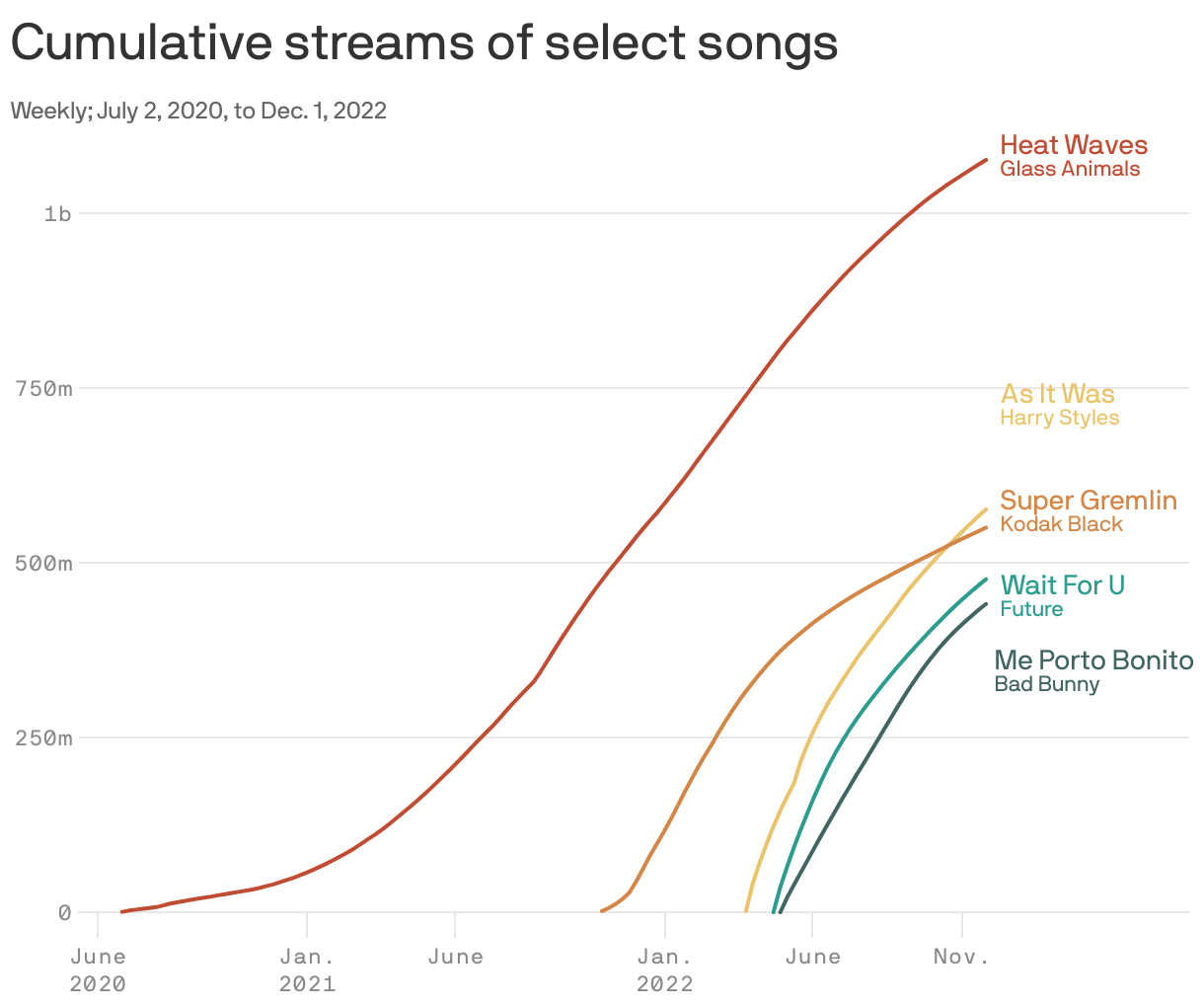
The second most-streamed song of 2022 in the U.S., at least through December 1, was "Heat Waves," by English group Glass Animals.
Why it matters: "Heat Waves" only really became a megahit after a snippet of it became ubiquitous on TikTok. As such, it's a prime example of how a song that almost no one loves can become huge just thanks to social media.
By the numbers: "Heat Waves" racked up 493 million U.S. streams in the first 11 months of this year, per Luminate, which powers the Billboard charts — on top of the 583 million streams it had already accumulated to that point.
Between the lines: "Heat Waves" didn't look like a megahit upon its release. By the end of its first full week on streaming platforms, it had managed 2.3 million U.S. streams — certainly respectable, but nothing earth-shattering.
- "As It Was," by contrast, the Harry Styles hit, came out of the gate with 42 million streams; "Anti-Hero", a new song by Taylor Swift, did even better with 51 million. It took "Heat Waves" six full months to get to that point.
The big picture: It's not uncommon for a song to reach 1 billion U.S. cumulative streams, as "Heat Waves" did in September. Many other songs have done so, including "Don't Stop Believin'", by Journey, which was released in 1981 and is still in the 200 most-streamed songs of 2022.
- That's the thesis behind a JKBX, a new service aimed at individual investors, allowing them to buy fractionalized royalty streams of hit songs. That market was very hot last year when interest rates were low, but has slowed dramatically now that future cash flows are in lower demand.
The bottom line: The biggest hit songs have very long legs, even when, as in the case of "Heat Waves," they're painfully bland. That's why the song catalogues of aging rockers like Bob Dylan or Bruce Springsteen are still worth hundreds of millions of dollars today.
