Axios' star political reporter Jonathan Swan is joining the New York Times as a political reporter, where he will continue to cover politics and the 2024 election.
Why it matters: Swan is one of the most well-sourced reporters in Washington. His ability to consistently break big stories and his sharp interview skills helped Axios expand its brand globally.
Sam Bankman-Fried resigned as chief of FTX.com, capping the insolvent crypto exchange's 11th hour hunt for capital to stay afloat, which ended Friday morning.
FTX Group companies, which includes FTX Trading Ltd as well as FTX US, started Chapter 11 proceedings in the U.S., according to a statement.
John Ray III has been appointed CEO of FTX Group. Bankman-Fried, known as SBF, will remain to assist in an orderly transition.
Why it matters: FTX.com and associated units have officially declared bankruptcy.
Sam Bankman-Fried knew exactly what risks he was taking; he explained them in some detail in a podcast last year. From his point of view, they were risks worth taking. From the point of view of other crypto-market participants now surveying the rubble, however, they most certainly were not.
Why it matters: FTX and Alameda Research were both fully controlled by a single man with a highly idiosyncratic risk appetite. The final result: Ingnominious bankruptcy.
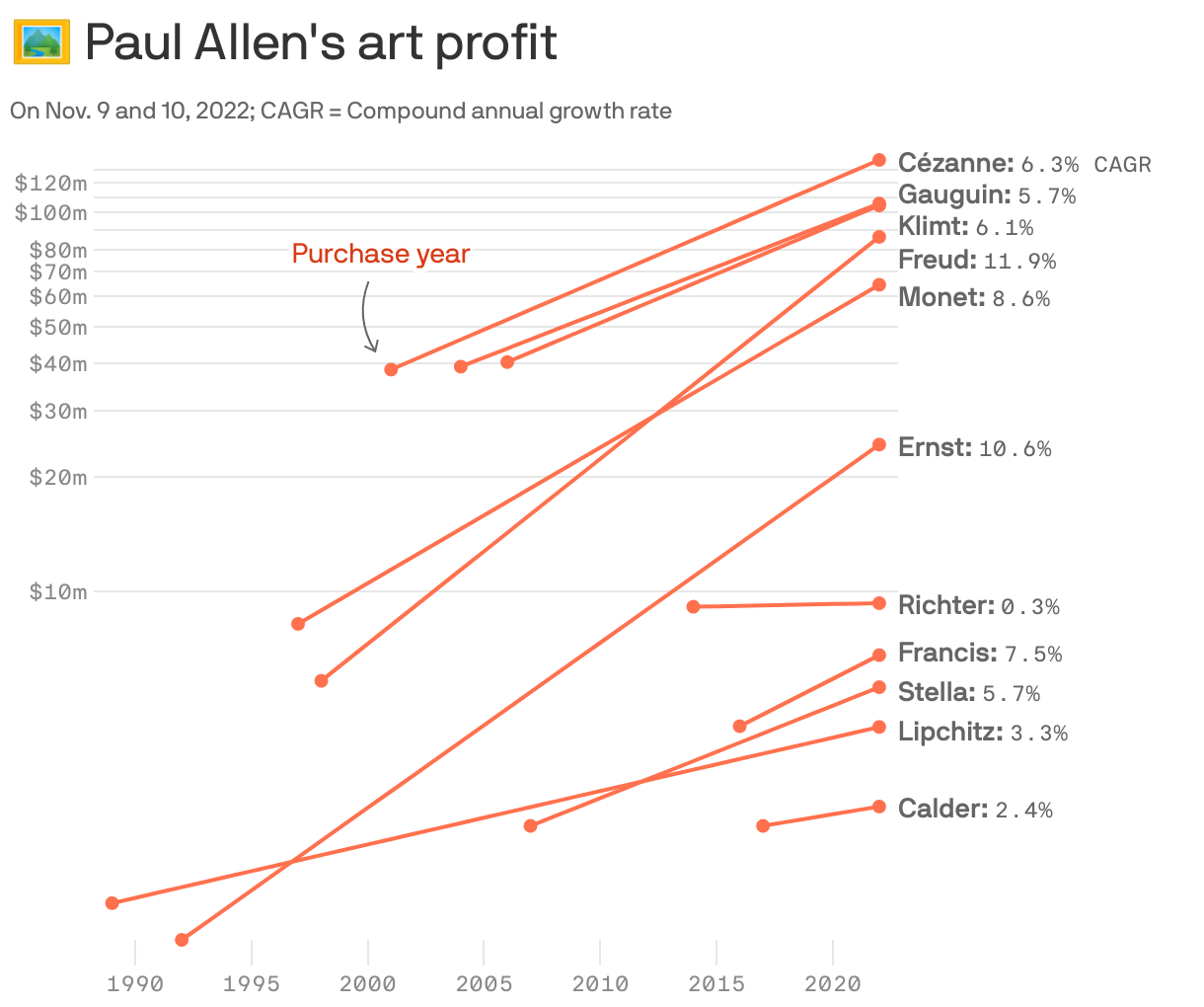
You might have heard that art is a fantastic alternative asset class that has outperformed the S&P 500. Microsoft co-founder Paul Allen, from beyond the grave, is here to say: Not so much.
Driving the news: In the biggest and most blockbuster art sale of all time, a selection of paintings and sculptures from Allen's collection was auctioned at Christie's in New York this week. In total, the art sold for more than $1.6 billion.
One of the main ways that Sam Bankman-Fried (also known as SBF) gained credibility was by finding a way to take the famous "greed is good" line from "Wall Street" and try to make it true.
Why it matters: SBF wasn't just the face of the crypto industry; he was also the standard-bearer of the effective altruism (EA) movement. That, too, has been damaged by his downfall.
The big picture: Many confuse Veterans Day with Memorial Day, the federal holiday held in late May that honors those who have died in military service.
Restaurants salute veterans and active-duty military personnel this Veterans Day with free meals, drinks and discounts Friday.
The big picture: The federal holiday honors those who have served in the military — past and present — by showing appreciation for those who have sacrificed for the country.
China's government eased some pandemic measures Friday — including reducing quarantine periods for travelers and close contacts of people infected with COVID-19 and ending penalties on airlines for bringing virus cases into the country.
Why it matters: The new rules are a notable adjustment to President Xi Jinping's zero-COVID policy. China is the last major economy to have retained the strategy of trying to keep out the virus with measures such as lockdowns and quarantines.
This article originally appeared in Axios Finish Line, our nightly newsletter on life, leadership and wellness.Sign up here.
Liz Jarvis-Shean lives, by choice, in pressure cookers — first at the White House, then Tesla, then Airbnb and now DoorDash, a high-growth, high-intensity startup.
Why it matters: Marinating in stress, chaos and wild unpredictability, Liz developed her own blueprint for leading through turbulence.
Call it the Liz Doctrine.
Here's my crack at distilling it, based on an interview we did this week for Axios HQ:
1. The 1% Rule: Push yourself to get 1% better each day, in good times and bad. No one changes radically overnight, but everyone can get a tiny bit better at something daily.
"Hold yourself accountable," Liz says. "Don't just throw up your hands and say it's not worth it." This rule is a core value at DoorDash, she tells us.
2. Find yourself: You can't guide others if you're lost yourself. Use tough moments to sharpen your core beliefs — the things that matter most — and then share them confidently.
3. Be real: "Nobody trusts a phony," Liz says. "People can smell insincerity a mile away."
In tough times, people crave clarity and directness. Deliver it.
"Don't try to be something you're not."
4. Don't hide: People too often let fear guide them to silence. Fear of screwing up. Fear of saying the wrong thing.
"A lot of people's natural instinct … is to be very, very guarded," Liz said. "I think there's enormous power in transparency."
5. Exploit crisis: When COVID hit, DoorDash could have collapsed. The company needed restaurants making meals — and drivers delivering them safely.
So everyone from the CEO on down had to phone relatives and friends to find enough masks and supplies to stay afloat. "Crisis focuses people if you handle it correctly."
Crypto lender BlockFi announced on Twitter that it would halt withdrawals per its terms and conditions, blaming "lack of clarity" into FTX — which has extended it a line of credit — and its affiliated companies.
What they're saying: "We are shocked and dismayed by the news regarding FTX and Alameda," a letter attached to the company's tweet said. "We are not able to operate business as usual."






/2022/11/11/1668124893113.gif?w=3840)








/2022/11/11/1668131444074.gif?w=3840)