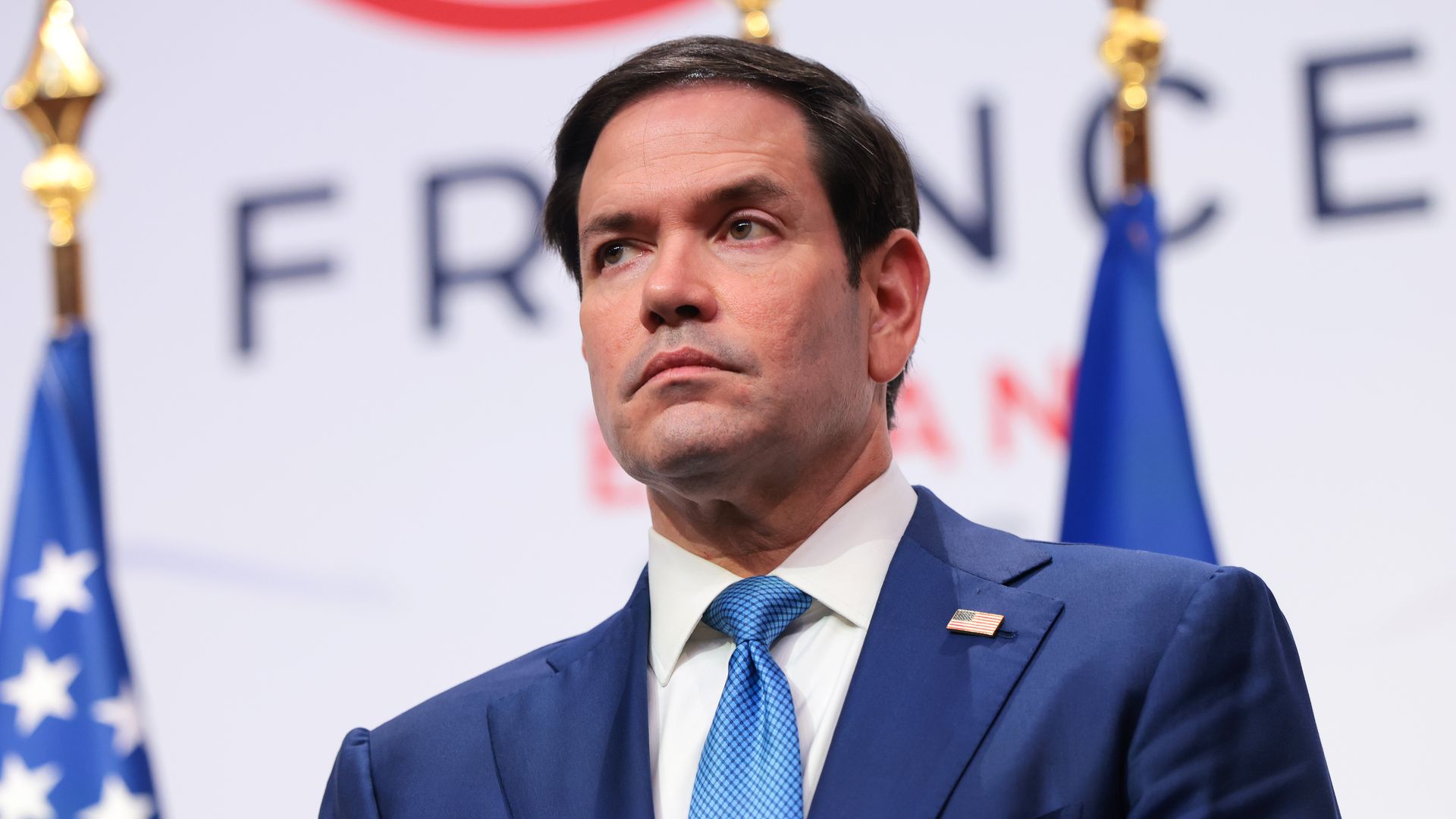
The top Democrats on congressional committees overseeing foreign, defense and intelligence policy are demanding Secretary of State Marco Rubio provide a briefing on the U.S.-Iran memorandum of understanding.
Why it matters: Unlike some of Congress' hawkish Republicans, these lawmakers aren't dismissing the deal out of hand.
The fallout from the Teamsters' affiliation with organized crime in the 20th Century is poised to end after President Trump's prosecutors agreed to cease federal monitorship of the union.
Why it matters: The International Brotherhood of Teamsters has been subject to oversight since 1989, when it signed a consent decree aimed at eliminating the mob's influence in the union.
Family travel is having a moment: 92% of parents say they are likely to travel with their children in the next year, according to data from the 2025 U.S. Family Travel Survey.
Okay, but: Planning a family trip that satisfies everyone can still feel harder than it should.
Parents want a real reset. Kids want adventure. And no one wants to spend limited vacation days juggling an itinerary that feels like work.
Waymo is the clear robotaxi leader, but if you thought Tesla and Zoox were close to catching up, think again — it's actually three Chinese companies, according to a new database shared first with Axios.
Why it matters: Autonomous vehicles are real, but it's still a hype- and headline-driven industry, so it can be hard to discern who's actually making progress toward commercialization.
The White House's move to restrict access to Anthropic's latest AI model — using what is known as export controls — could harm the long-term financial prospects of the entire U.S. AI industry.
Why it matters: Anthropic and OpenAI's valuations depend on the global adoption of their most advanced models, and government restrictions could limit that growth.
Inflation is surging. American consumers appear to keep spending anyway.
Driving the news: Retail sales rose 0.9% in May, the Commerce Department said this morning.
The data is not adjusted for inflation, so stronger spending is a function of higher prices, at least in part. For instance, spending at gasoline stations gained 3.4% last month alone, following a 2.4% jump in April.
Spending increased across most major retail categories, including furniture stores and e-commerce. Consumers pulled back on electronics shops and dining out.
The control group — which excludes volatile categories like gasoline, autos and building materials — rose by a stronger-than-expected 0.7%. That narrower measure will feed into the consumer spending calculations for second-quarter GDP.
Between the lines: A robust tax refund season has helped consumer spending, along with support from stronger job gains and stock market-related wealth gains for higher-income households.
What they're saying: "Consumption regained some momentum over the spring, but the sugar rush from bigger-than-usual tax refunds will wear off soon," Samuel Tombs, chief U.S. economist at Pantheon Macro, wrote in a client note.
Tombs estimated that households' real spending — that is, adjusted for inflation — increased 0.3% last month, including broader services expenditures that are not captured in the report.
The bottom line: "There does not appear to be any consumer demand destruction from higher gas prices during the first three months of the war," Brean Capital's John Ryding wrote this morning.
CME Group has named Lynne Fitzpatrick as its next CEO, the latest woman to nab a leading role atop a major financial exchange.
Why it matters: Women now run most of the country's financial plumbing — surprising, given that the rest of the finance industry's leadership continues to be male-dominated.
Leaders of America's biggest companies are the most optimistic they have been in 18 months — but see much stronger growth in capital spending and sales ahead than in hiring.
The big picture: That's the takeaway from the Business Roundtable's quarterly CEO survey, set to be released today. It points to continued bumpy conditions in the job market even as business conditions broadly improve.
At the same time, the results don't point to the kind of AI-pocalypse scenario of massive job losses that some technologists have predicted, at least for the remainder of this year.
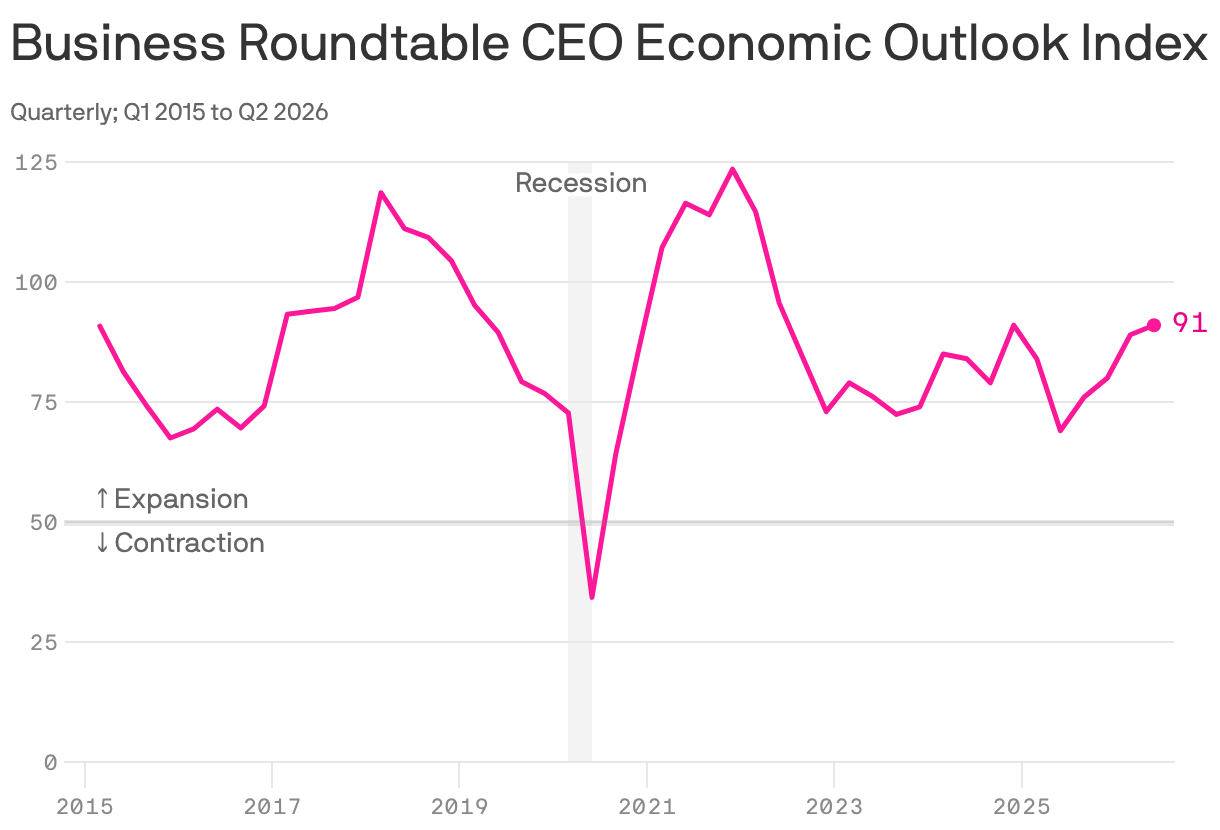
By the numbers: The overall outlook index rose 2 points, to 91. That's well above the long-run average of 83 and the highest since Q4 of 2024. The last time it was higher was four years ago, in mid-2022.
There was a 3-point surge in CEOs' expectations for the change in sales over the next six months and a 2-point rise in expected capital spending — with both numbers in rapid expansion territory.
Respondents, however, were balanced on expectations of employment, with an equal share of participants expecting to increase payrolls and decrease them over the next six months.
The employment index ticked up to 51; the line between expansion and contraction is 50, and historically that sub-index has averaged 61.
The intrigue: Usually the three sub-indexes move in tandem, rising together in booms and falling together in downturns. Right now, there is much more buoyancy in CEO attitudes toward capital spending than in adding to headcount.
The 42-point gap between expectations for capital spending and employment is the widest since 2005.
Between the lines: Companies are investing heavily in capital spending to take advantage of the AI boom — most prominently hyperscalers and the builders of the computing infrastructure to support them.
For now, it's not resulting in mass job losses, but it does translate into an absence of the kind of job creation you would normally expect to see when business conditions are so strong.
What they're saying: "Over the past year, the survey has showed ongoing divergence between capital spending and hiring plans," Joshua Bolten, CEO of the Business Roundtable, said in the survey release.
"As AI and other forces reshape the workforce, Business Roundtable member companies are investing in training programs to help employees succeed," he added. "It is increasingly important for policymakers to support that work by modernizing the federal workforce development system."
Strong readings on sales and capital investment plans reflect "the continued resilience of the economy," said Cisco Systems CEO Chuck Robbins, the chairman of the BRT.
"However, consumers and businesses continue to face some headwinds," he added, which Washington can help address by extending the U.S.-Mexico-Canada trade agreement, modernizing permitting and "adopting a federal framework for AI regulation that protects U.S. technology leadership."
The bottom line: These are boom times for U.S. business — but not for job creation.
Private equity sure does love itself some pizza. But it doesn't always turn dough into dough.
Driving the news: LongRange Capital on Tuesday agreed to buy the non-China operations of Pizza Hut from Yum Brands for $1.5 billion (plus up to $75 million in earnouts), with Yum China buying the rest for $1.2 billion.
PayPal Ventures is shutting down and may sell off some of its portfolio on the secondary market, according to Fortune.
Why it matters: It was one of fintech's most active corporate venture investors, pumping more than $850 million into companies like Anchorage Digital, Divvy, and Plaid.
The U.S. government's move to stop Anthropic's Fable 5 and Mythos models turns a long-theoretical debate into a real-world test of who should have the power over world-changing AI.
Why it matters: Handing the reins to companies means trusting firms with huge commercial incentives. Leaving decisions up to governments could lead to secretive high-stakes decisions with little public approval.
Frontier, the group of big companies trying to jump-start carbon removal, just unveiled $915 million in new purchase plans and added AI heavyweight Anthropic to its roster.
Why it matters: New or accelerated ways of pulling CO2 from the atmosphere could become a weapon against global warming — but massive scale-up is required to move the needle.
Uber has signed a long-term lease for a 50,000-square-foot Houston depot, with plans to house 40 EV chargers and 15 maintenance bays, laying the groundwork for a robotaxi launch in the Bayou City in 2027.
Why it matters: Behind every robotaxi fleet is a lot of physical infrastructure — and Uber's race to secure it is taking place in cities well before its driverless cabs ever hit the streets.
HighGround has scored a $6.5 million seed round, chief executive and former Green Beret John Price tells Axios.
Why it matters: The startup, straddling Washington and New York City, aims to equip advisors, researchers, investors and the generally curious with defense-and-aerospace market insights.
"I care about defense, and I care about Wall Street and investment, specifically into this sector," he says.
America's cities are seeing a socialism surge, but it's not the post-Cold War boogeyman that schoolchildren were warned about.
The big picture: It's called sewer socialism, and is the cornerstone for policies from New York's Zohran Mamdami, Seattle's Katie Wilson and Washington D.C. mayoral candidate Janeese Lewis George.
Just over half of parents in families with a mom and a dad both worked full time last year, setting a record high, according to a new Pew Research Center analysis out Tuesday.