It's a woman's economy now

Add Axios as your preferred source to
see more of our stories on Google.
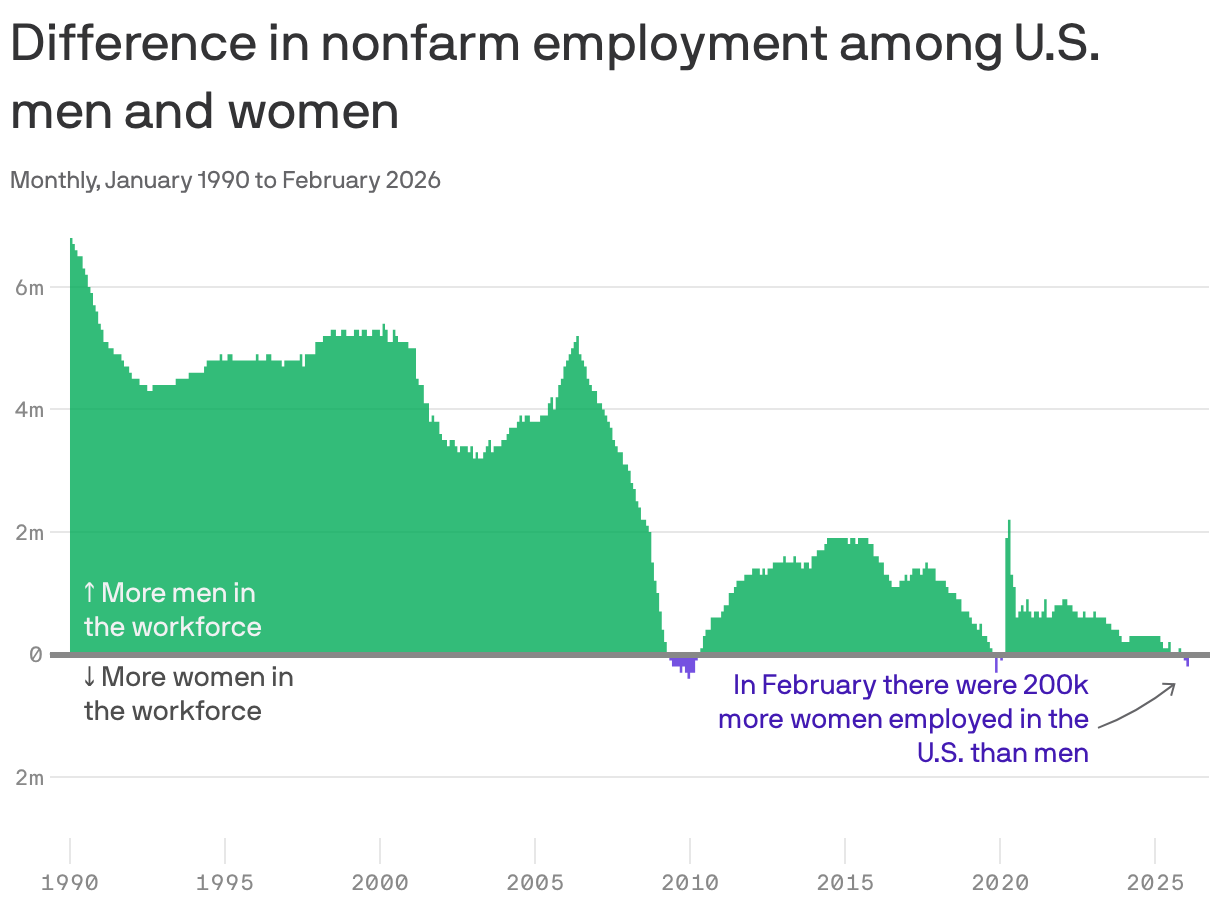
For only the third time ever, there are more women employed in the U.S. than men, according to federal data highlighted in a report from Indeed, the jobs site.
Why it matters: This isn't quite a women's empowerment story — what's happening in part is that traditional male-dominated occupations are shrinking, while female-led jobs are growing.
Between the lines: Overall, those jobs pay less than ones held by men.
- "If you're seeing a shift toward more female employment, all else equal, you would see a shift toward lower wages," Laura Ullrich, economic research director at Indeed, tells Axios.
Two dynamics are driving the shift:
1. The fastest-growing sector of the job market, particularly over the past year, is health care, where women dominate. Job growth in construction and manufacturing has been relatively flat or negative.
2. Men's participation in the job market has been declining. Male employment fell overall by 142,000 jobs from February 2025 to February 2026, Ullrich notes.
- That's also partly because the immigration crackdown pushed a lot more men out of the workforce and restricted their entry into it.
Friction point: It would seem like a no-brainer for more men to move into health care, but they so far have been reluctant to take jobs that can be perceived as "women's work."
- "There's no inherent reason that 95% of speech language pathologists are women," Ullrich says. "That's a good job. It pays six figures."
- "Men are missing out in the labor market because there are too many 'no-go' zones for male workers," economist Richard Reeves, founder of the advocacy group American Institute for Boys and Men, tells Axios.
Zoom out: For a long time, there was a big push to get more women into STEM (science, technology, engineering and math).
- But there's been less of an effort to push more men into health care, or what Reeves calls HEAL professions: jobs in health and education that require literacy.
- Getting more men into jobs in health, social care and education matters for gender representation in those vital fields and would address labor shortages, he says.
- "It is also essential for improving job prospects for men themselves."
Flashback: The first time women outnumbered men in the job market was in the wake of the recession after the financial crisis. Male-dominated positions in construction and manufacturing were hard hit.
- The second time, the economy was booming just before the pandemic. Women who had made gains in education — with a growing share of college degrees — seemed better positioned to take advantage of the changing economy, as the New York Times noted then.
- What's happening now is basically a return to that trend line.
