McDonald's on Wednesday pushed back against the premise that recent price increases have been unreasonable, arguing the Golden Arches offers "meaningful value" for what it charges.
Why it matters: The fast-food industry as a whole is under pressure from a public frustrated by inflation, and is struggling to retain customers as rising prices drive more people to dine in, or find better ways to save money.
Driving the news: In a rare open letter, McDonald's USA president Joe Erlinger said the assertion the chain has hiked its prices "significantly beyond inflationary rates" is "inaccurate."
He bashed "viral social posts and poorly sourced reports" about price increases, while acknowledging the company has faced "inflationary pressures." He noted that franchisees set prices in the 95%+ locations they own and operate.
Erlinger said "prices for many of our menu items have risen less than the rate of inflation – and remain well within the range of other quick service restaurants."
The average Big Mac price is $5.29, he said, up 21% from $4.39 in 2019, which the executive said accounts for "historic" hikes in wages, costs and supply chain issues.
Flashback: Last year, the Golden Arches was pushed into damage control mode after reports of an $18 Big Mac meal (it was at one location) exploded on social media, something Erlinger addressed in his letter.
"More worrying, though, is when people believe that this is the rule and not the exception, or when folks start to suggest that the prices of a Big Mac have risen 100% since 2019," he wrote.
By the numbers: McDonald's overall prices are up 20% since 2022, Bank of America analyst Sara Senatore wrote Tuesday in a research note.
That compares to 15% at Wendy's and 16% at major Burger King franchisee Carrols.
What to watch: McDonald's and Burger King are reportedly poised to debut $5 value meals following heightened attention to their price hikes.
"MCD is responding with urgency: we see the $5 bundle as a placeholder for a more permanent value offer," Senatore wrote.
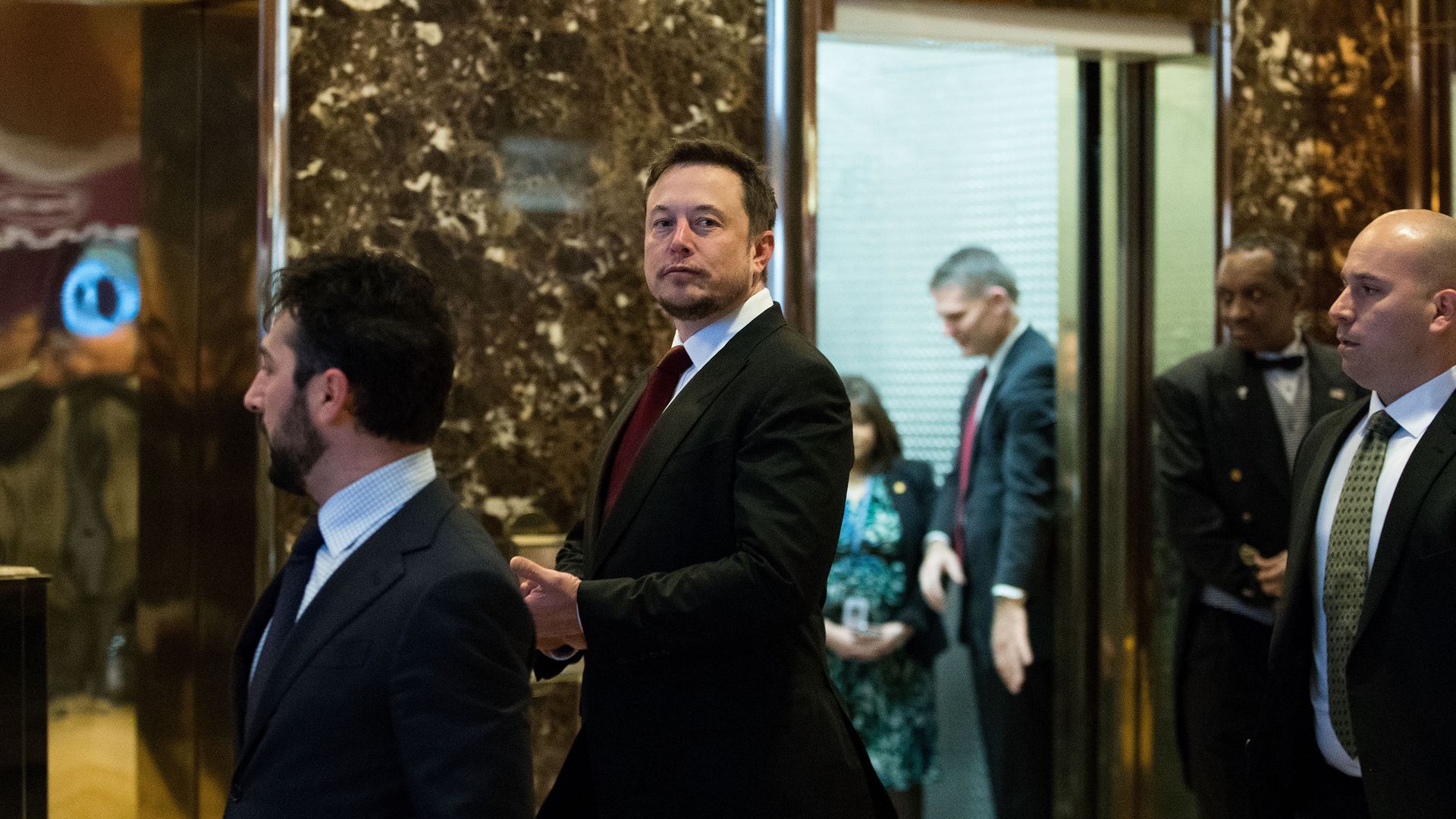
Former President Trump and Elon Musk have begun speaking on the phone several times a month, including about a potential advisory role for the Tesla CEO in a second Trump administration, The Wall Street Journal reports.
Why it matters: Musk has become one of President Biden's most prominent online critics, leveraging his massive X platform to attack Democrats and promote Trump's messaging on the 2024 election's top issues.
A top White House official says the world needs to understand how and when the U.S. will weaponize its economic might in global conflict — and offered a sneak peek of what such a doctrine might look like if President Biden wins another term.
Why it matters: Global policymakers warn we may be in the most fragile era in decades, with persistent conflict among world superpowers. There is already evidence that these battles will be waged with economic tools that could spill out across the globe.
Nissan issued a "Do Not Drive" warning Wednesday for roughly 84,000 older vehicles that have recalled and unrepaired Takata air bags, the National Highway Traffic Safety Administration said.
Why it matters: The warning is for certain 2002-2006 Nissan Sentra, 2002-2004 Nissan Pathfinder and 2002-2003 Infiniti QX4 vehicles that have open Takata air bag recalls.
The Atlantic, one of the oldest magazines in the U.S., and Vox Media, one of the nation's largest digital media holding companies, have both inked separate licensing and product deals with ChatGPT parent OpenAI.
Why it matters: The deals give OpenAI added momentum in its quest for credible content to train its algorithms and inform its chatbots — and could also protect the Microsoft-backed company further from future copyright liability.
A federal judge in Ohio last week dismissed a closely watched case filed by America First Legal, the anti-diversity, equity and inclusion group founded by former Trump White House senior adviser Stephen Miller.
Why it matters: The decision seems like a victory for corporate DEI initiatives, but Miller and his allies still appear to be winning the broader war against these programs.
Payments giant Ripple announced this morning that it donated $25 million in Fairshake and its affiliated political action committees.
Why it matters: CEO Brad Garlinghouse tells Axios the donation was made with an eye on moving the crypto sentiment needle back to somewhere near neutral, or better.
Addressing the roots of Black economic inequality has the potential to unlock as much as $1 trillion per year in domestic U.S. economic growth, according to a new study by the Black Economic Alliance Foundation.
Why it matters: The study arrives at a time when public and corporate commitments to diversity-based initiatives — many of which were a response to the turmoil of 2020 — are being questioned or seemingly in full retreat.
Why it matters:Restaurants have largely recovered from their pandemic-era swoon, but they're still working overtime to keep customers interested and coming back in the age of price inflation and fast-changing TikTok food trends.
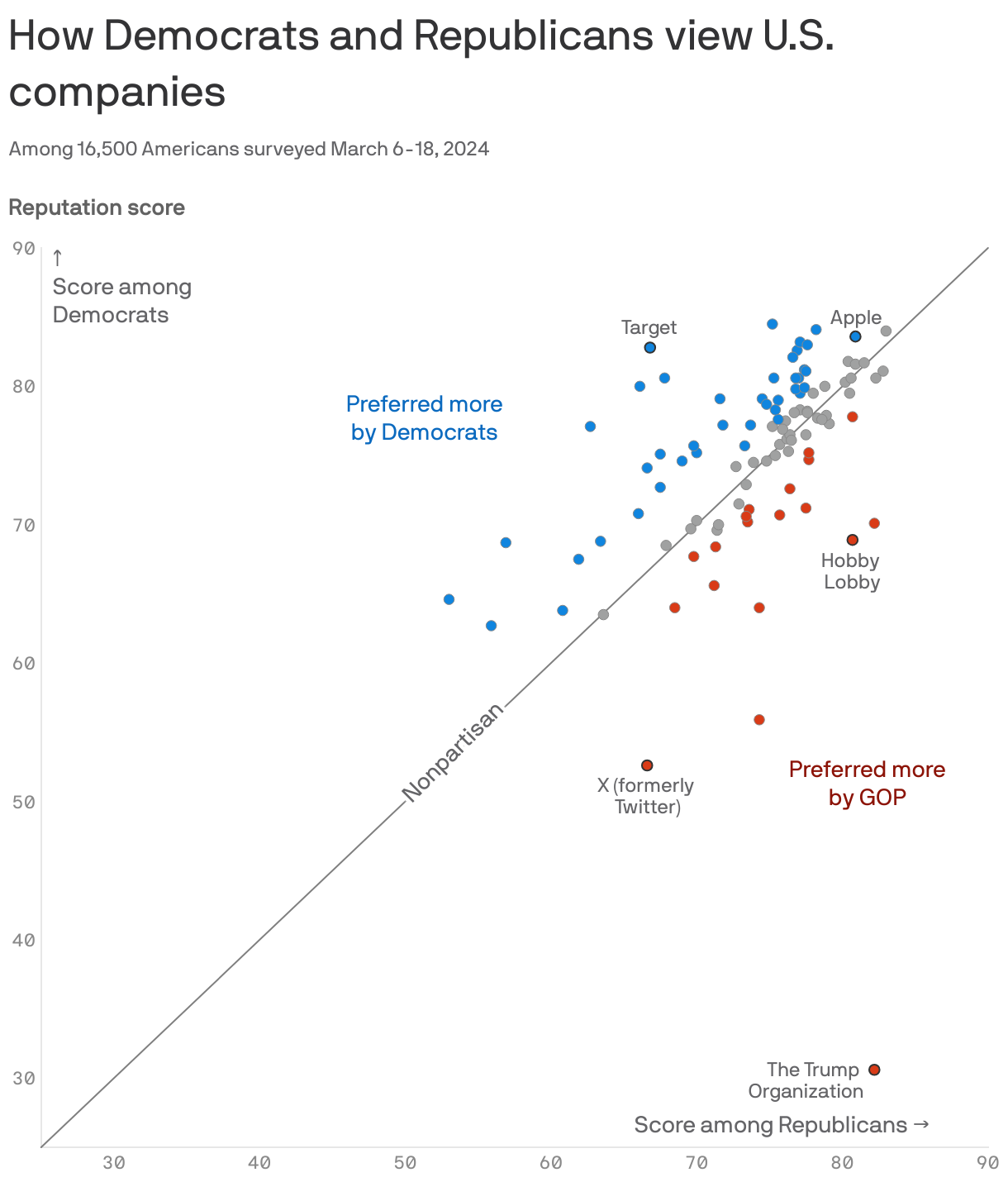
Consumers see twice as many brands as left-leaning as they do right-leaning, according to this year's Axios Harris Poll 100.
The big picture: Corporate America, long seen as aligned around capitalism and lowercase-c conservative behaviors, is increasingly viewed by consumers ascatering to progressive ideals.