Our tinderbox moment: Four flashpoints

Add Axios as your preferred source to
see more of our stories on Google.
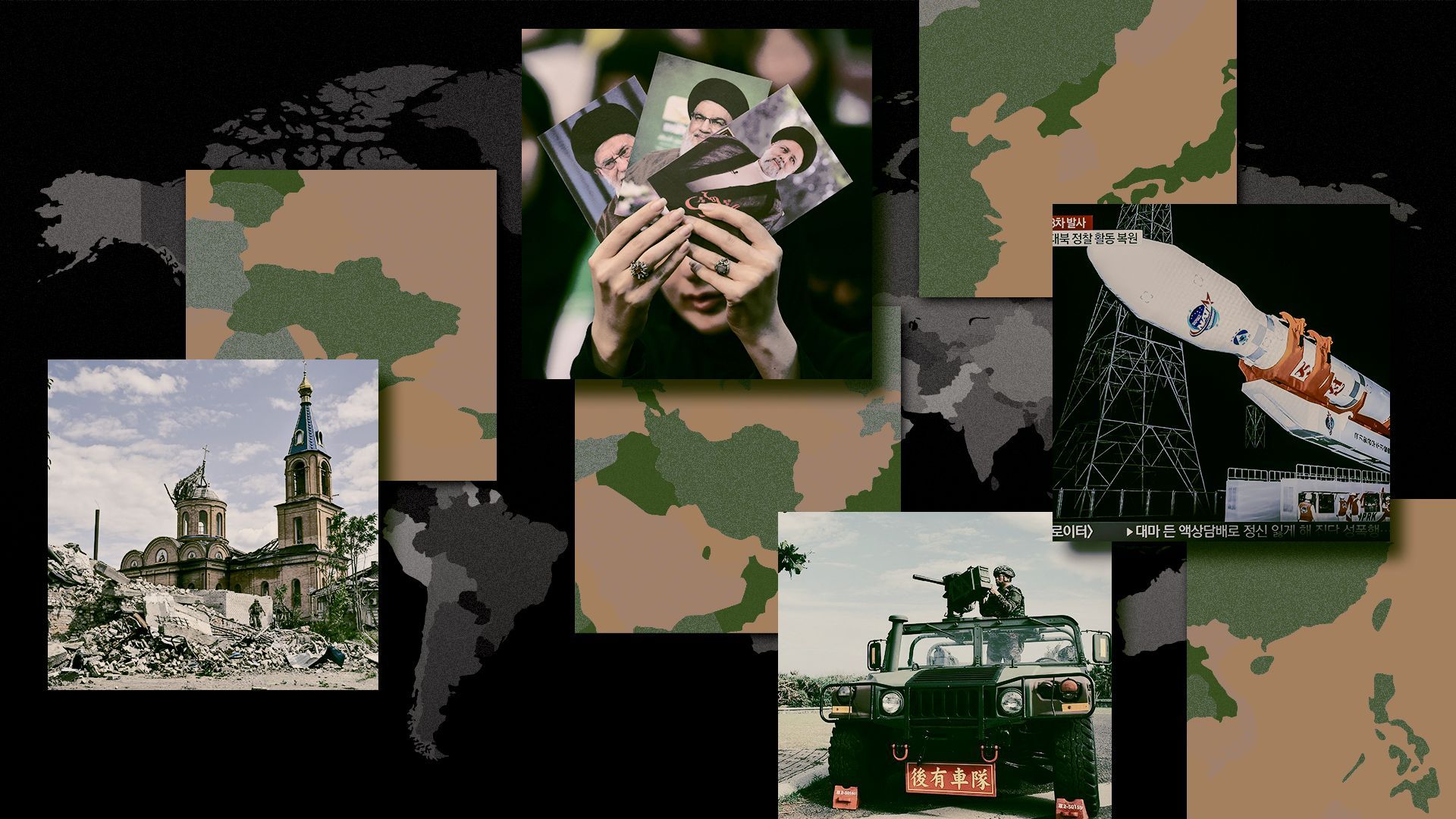
Photo illustration: Annelise Capossela/Axios. Photos: Kim Jae-Hwan/SOPA Images/LightRocket, Taiwan's Military News Agency/Anadolu, Anwar Amro/AFP, Ukrinform/NurPhoto via Getty Images
This election year could be turned on its head by an international crisis — and it won't necessarily come in the Middle East.
Why it matters: The war in Gaza continues to attract the attention of the world and President Biden's foreign policy team. But the past few days have also been peppered with worrying headlines from other global hotspots like Taiwan, North Korea, Ukraine and Iran.
The big picture: Global alliances have shifted over the past few years. China and Russia — joined by other autocracies — have deepened a partnership that's heavily focused on challenging America and the West.
- There are snapshots of that competition all over the world: Pacific Island countries being aggressively courted by both Beijing and Washington; West African nations booting out the U.S. and France and welcoming in Russia; Chinese President Xi Jinping visiting Europe this month for the first time in five years.
- Then there are the much-feared scenarios that could see the "new cold war" with autocratic powers turn hot: a Chinese move on Taiwan, escalation by Russia beyond Ukraine, North Korean brinksmanship and a nuclear crisis with Iran.
- None of those appear imminent. But the past week offered reminders that all remain plausible.
Driving the news: China has conducted large-scale military exercises around Taiwan in the week since President Lai Ching-te, a proponent of close ties with Washington whom Beijing condemns as a "separatist," took office — part of a pattern of intimidation that some experts and officials see as a prelude to eventual invasion.
- Lai also faces divisions at home. Parliament, controlled by the more Beijing-friendly opposition, voted Tuesday to strengthen its powers at the expense of the presidency, defying mass protests.
Russian troops are clawing back territory in eastern Ukraine and menacing the country's second-largest city, Kharkiv, in Moscow's most significant battlefield successes in more than a year.
- Kyiv hopes long-delayed shipments of U.S. weapons will help stem the losses, but President Biden is facing growing pressure from NATO allies to allow Ukraine to use U.S.-provided weapons to strike inside Russia. He's refused up to now, fearing escalation.
A North Korean spy satellite exploded in a failed rocket launch on Monday, but U.S. officials are expecting more — and potentially more serious — provocations this year from Kim Jong-un.
- They're also monitoring Kim's burgeoning partnership with Russia's Vladimir Putin, with the two U.S. adversaries allegedly exchanging military hardware and technology.
Iran has increased its stockpiles of near-weapons grade uranium, the UN's nuclear watchdog warned Monday.
- The country's June 28 presidential election to replace Ebrahim Raisi, who died in a helicopter crash, comes amid fears of a clash with Israel and with Tehran's proxies active all throughout the region.
- A missile strike on a ship in the Red Sea on Tuesday underscored the Iran-backed Houthi rebels' ability to throttle international shipping.
Then there are the global crises that have largely fallen off the international radar.
- The civil wars in Sudan and Myanmar have taken particularly brutal turns in recent weeks, with the UN warning of potential genocide in Sudan and members of Myanmar's long-suffering Rohingya minority once again forced to flee.
- A Kenyan-led international security force is preparing to deploy to Haiti in response to gang warfare that has devastated the country. Two young American missionaries were among those killed in a gang attack last week.
What to watch: Israel's escalation in Rafah poses a major test for Biden and his foreign policy team, with fellow Democrats urging him to enforce his threat to withdraw military support over the operation after an Israeli strike killed 45 displaced Palestinians on Sunday.
The bottom line: Developments in the past week suggest there are more tests coming from elsewhere on the globe.
