More companies viewed as liberal as public sentiment shifts


Add Axios as your preferred source to
see more of our stories on Google.
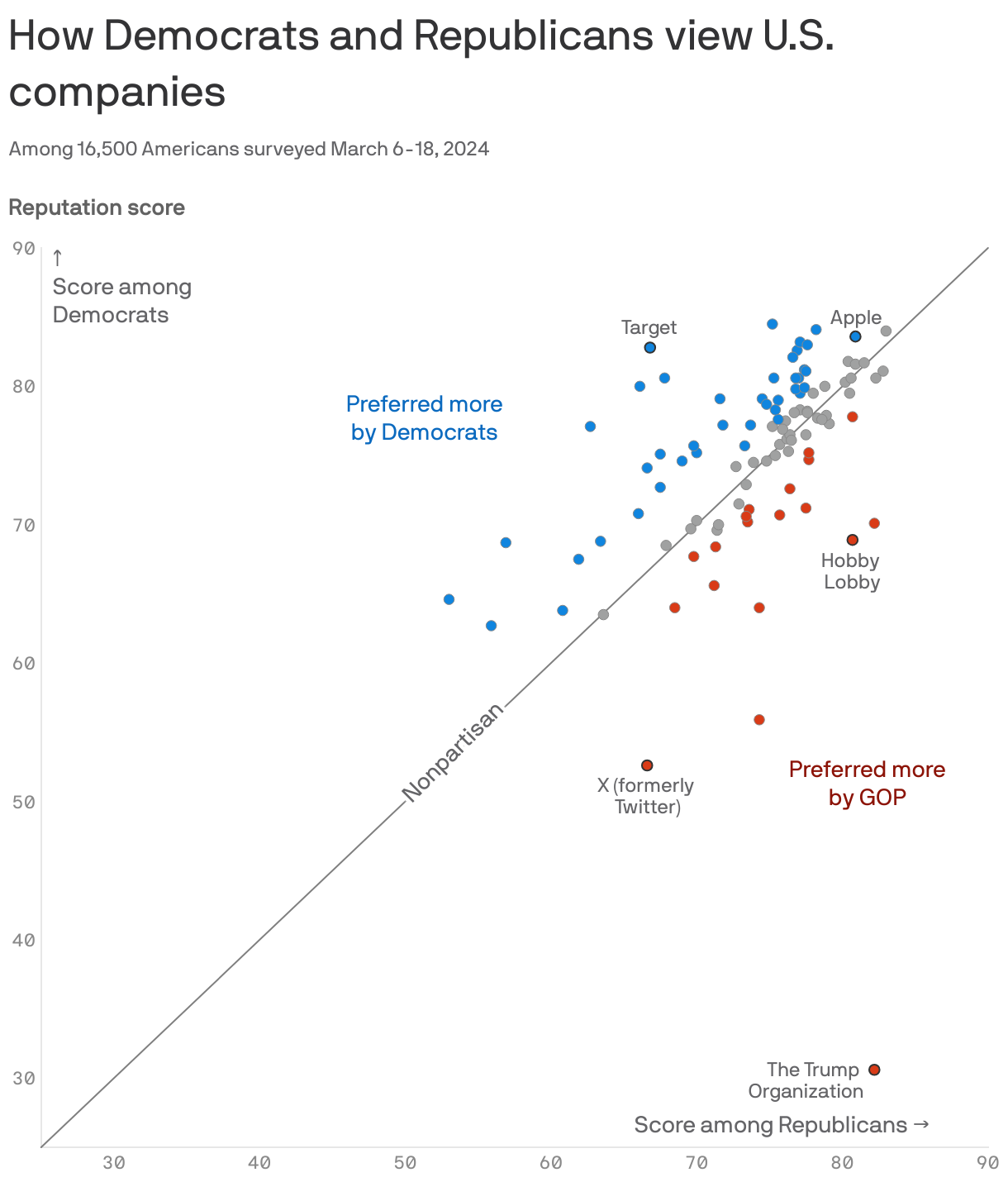
Consumers see twice as many brands as left-leaning as they do right-leaning, according to this year's Axios Harris Poll 100.
The big picture: Corporate America, long seen as aligned around capitalism and lowercase-c conservative behaviors, is increasingly viewed by consumers as catering to progressive ideals.
- 41 companies on this year's 100 list were viewed as left-leaning, while just 19 were seen as right-leaning.
- Procter & Gamble, Aldi, Lululemon and Geico were deemed the least polarizing, with zero partisan divide reported.
Why it matters: Trending left has brought upsides to many companies, as the U.S. population has become more diverse and younger, and college-educated consumers have embraced more progressive causes.
- Companies perceived as more liberal-leaning tend to have higher reputation scores than the conservative-leaning companies.
- But appearing to lean left also has put some companies at risk of alienating consumers and spurred demand for a return to center, as a red wave in this year's data suggests.
- Republican consumers are five times more likely than Democrats to think less of a company for focusing on societal issues, according to the Harris Axios poll.
State of play: Brands that have been vocal in recent years on social and geopolitical matters — including Target, Anheuser-Busch brewer AB InBev, Pfizer and the Walt Disney Company — were seen as skewing more to the left.
- Seven of the top 20 most Democratic-viewed companies — Google, Nike, Patagonia, Adidas, Honda, Microsoft and USAA — received a "very good" rating from survey respondents, compared to just two — Hobby Lobby and Chick-fil-a — on the Republican side.
- On the other end, four of the more right-leaning companies — the Trump Organization, X, Fox and Dollar Tree — drew "poor" or "very poor" scores, compared to three — ByteDance, Wells Fargo and Spirit Airlines — on the left.
Between the lines: While fewer companies were perceived as skewing to the right, they saw the greatest partisan split.
- The Trump Organization is considered the most politically polarizing company, with a partisan split of 51.6, more than six times the average of 8.9.
- Fox is seen as the second-most polarizing brand, followed by Target, AB InBev and X.
What we're watching: Conservative lawmakers and activists are paying closer attention to how companies engage in diversity, equity and inclusion strategies and environmental efforts.
- Because of this, companies must be more clinical in how they communicate around these initiatives, says Paul Argenti, professor of management and corporate communications at the Tuck School of Business at Dartmouth.
What they're saying: "It is really important to understand the gap between the reality of what your organization is doing and the way your organization is perceived," Argenti said.
- "Whether it's related to purpose, sustainability or any kind of political matter, [the backlash] is typically more about rhetoric and public relations than it is about actions."
The bottom line: Perception can sometimes be reality, and the way a company or brand is perceived by Americans varies greatly depending on their political affiliation.
Go deeper: Corporate America is rebranding ESG
Editor's note: This story was corrected by removing a reference to Reddit as being in the "poor" or "very poor" category, when it is in the "fair" category.
