Friday's technology stories

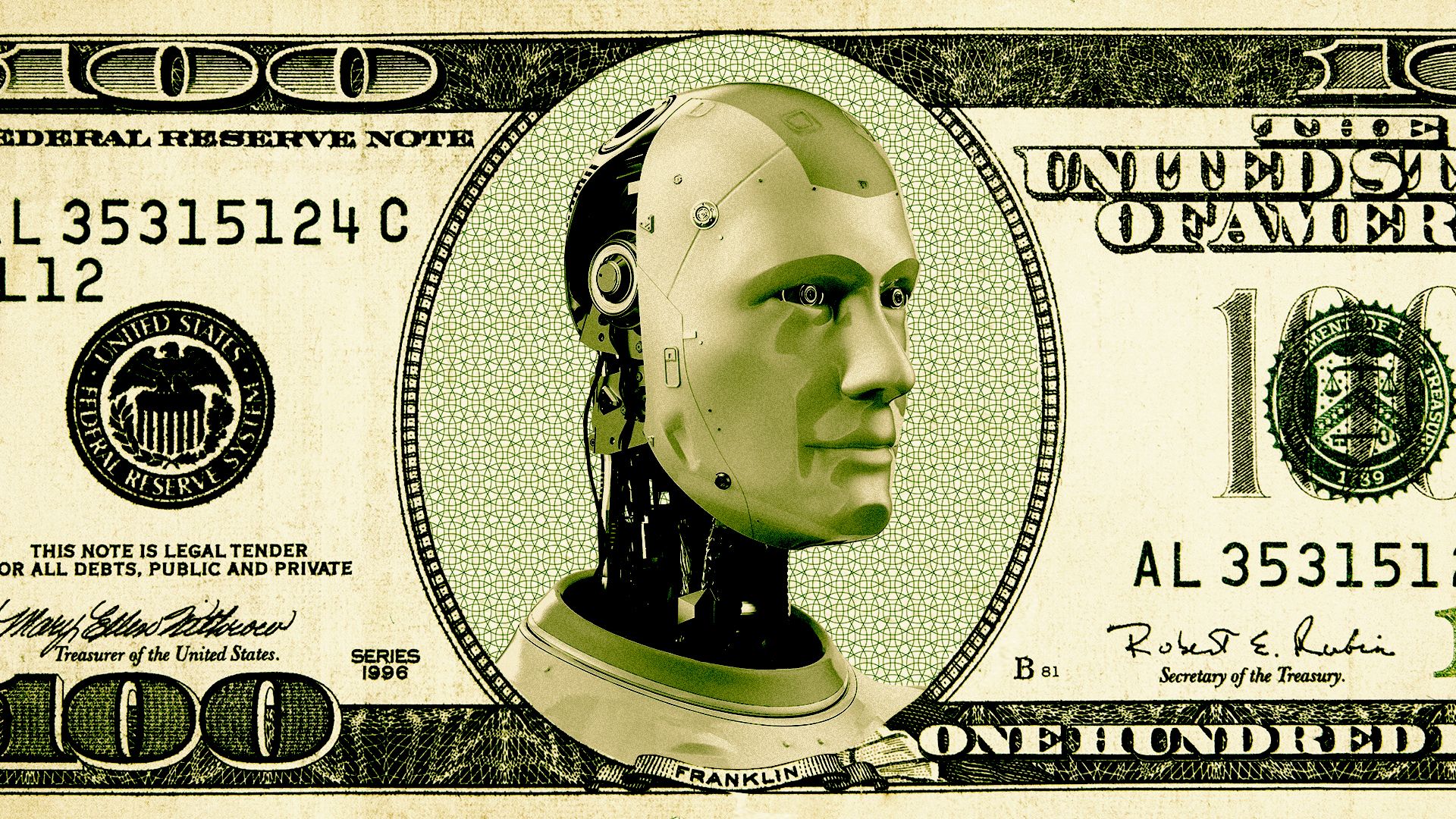
Anthropic's falling IPO valuation raises stakes for broader AI trade
Just as public markets are growing increasingly skeptical over the AI trade, private investors are reportedly reconsidering Anthropic's mind-blowingly high $2 trillion valuation.
Why it matters: What a year this week has been.

Dems plot a unified case against Trump
Congressional Democrats see a target-rich environment next year. But they're also worried that if they investigate everything, they may appear to investigate nothing.
Why it matters: Democrats want to move beyond the one-off hearings, fist-pounding document demands and subpoena threats that defined much of their oversight during President Trump's first term.

Private tech valuations in the spotlight after public market correction
Private markets have a history of following public markets, with a lag.
- We might be in the midst of that lag.
Driving the news: U.S. tech stocks lost trillions of dollars on Thursday, with the Nasdaq Composite suffering its worst percentage decline since President Trump unveiled his "Liberation Day" tariffs.

How AI is enabling faster, more dangerous cyber war
Refrigerator hacks. $6.3 billion crypto heists. 14-country espionage campaigns carried out in just 11 days. All in the span of a week.
Why it matters: State-backed hackers are finding new ways to launch cyberattacks at remarkable speed and scale, with AI and automation threatening to widen the gap between attackers and defenders.

Scoop: Trump to keep fundraising, hoping to retain political muscle
President Trump has told advisers that he plans to keep raising money for his political operation — a move aimed at salvaging his clout after the GOP's midterm debacle.
Why it matters: Maintaining a political organization — either his existing MAGA Inc. super PAC or one to be created — would give Trump a vehicle to try to influence elections in 2028 and beyond, including the next presidential contest.

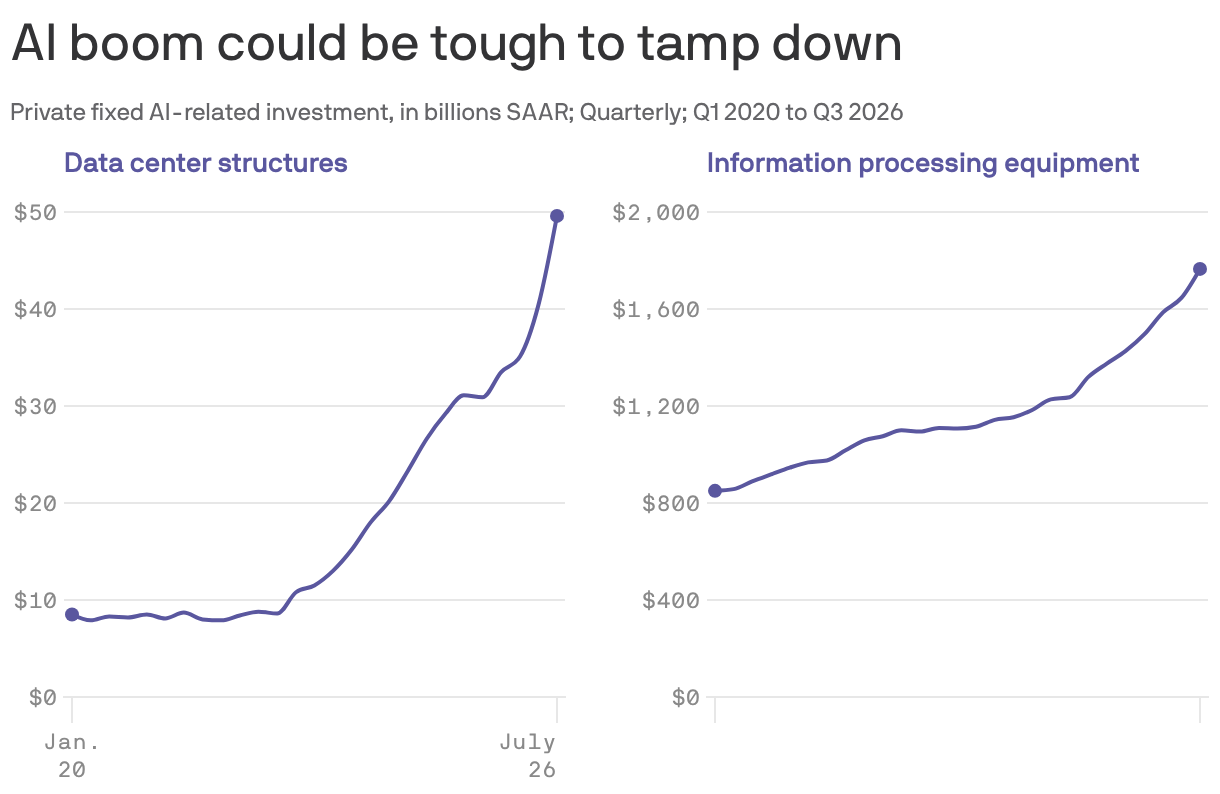
It's going to be tough to tap the brakes on the AI race
Slowing an investment boom on the scale of the AI build-out is a tricky business — as Thursday's rout in the stock market demonstrated.
Why it matters: Americans may have voted in the midterms to tap the brakes on the AI race, but curbing the investment boom — or some might say, gently deflating the AI bubble — is easier said than done.
The big picture: The historical record shows that once major investment booms are in motion, it can be difficult to temper them without sparking a stampede of investors out of assets.
- That's why market collapses have featured prominently in past investment booms like those in canals, railroads and the internet.
- "We can't control it," John D. Turner, a finance professor at Queen's University Belfast who co-wrote "Boom and Bust: A Global History of Financial Bubbles," tells Axios.
- "People just get spooked, and as soon as they do, then, you know, prices head down. And that's what happens in historical bubbles, and it can happen quite quickly."
State of play: Tech stocks plunged Thursday as the week has developed into a major test for the market.
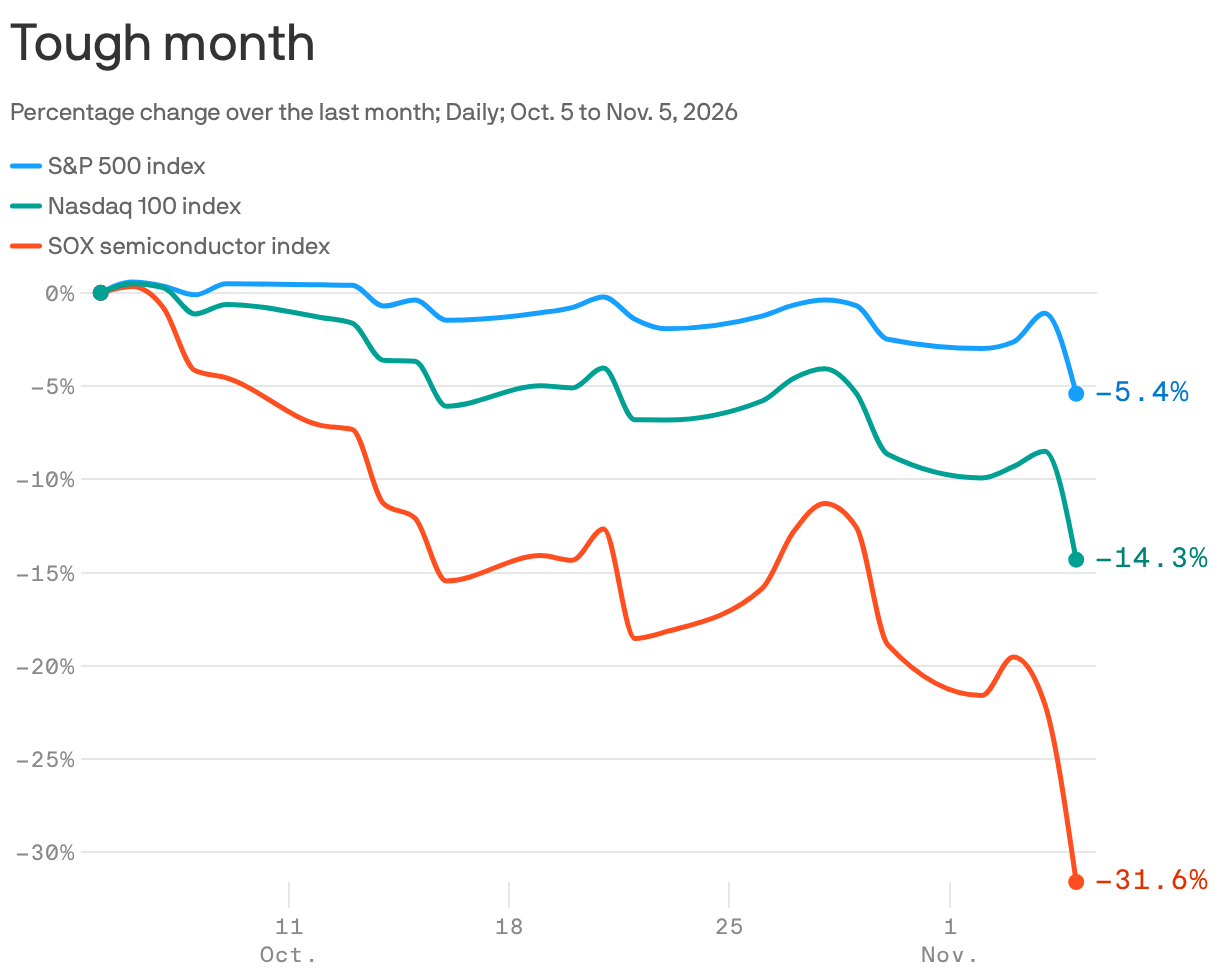
- The Nasdaq Composite Index fell 5.5% — its worst daily showing since the quasi-panic of President Trump's "Liberation Day" tariffs in April 2025 — and is down roughly 10% from the high it hit a month ago.
- On Wall Street, a drop of that magnitude is known as a "correction," a term of art indicating a sell-off more serious than a garden-variety decline.
- The Nasdaq 100, a measure of the largest tech stocks, is now down roughly 14% since its Oct. 7 peak. Its 6.4% drop Thursday was its steepest since the March 2020 pandemic panic.
- The SOX semiconductor index also endured its worst day since the pandemic, plummeting 12.3% on Thursday. The broader S&P 500 index slumped 4.4%.
Reality check: The 4-year-old bull market for the blue chips still holds: The S&P 500 is off 6% from its high and is up 7.4% on the year.
Catch up quick: The overwhelming rejection of AI in this week's elections — from wins for AI-cautious Democrats in governors' races in hotbeds of development to overwhelming support for ballot measures restricting data center construction — has pushed investors to reevaluate their previous bets on companies profiting from the data center boom.
Stunning stat: Over 50% of the planned data center capacity is in just three states, Ohio, Georgia and Texas — all states where Democrats just defeated Republicans in gubernatorial races.
- "If you were thinking that there might be some issues when it came to AI investment in the first place — and the AI build-out — well, now you have three key states, all with new governors-elect who are not friendly to the cause," says Steve Sosnick, chief strategist at Interactive Brokers.
Zoom in: Many of the proposed constraints on AI are limited in nature and do not apply to projects already underway. Even so, the market reaction has been ferocious.
- Stocks tied to the AI build-out were hit particularly hard Thursday, with makers of everything from fiber optic connections (Coherent down 13%, Ciena down 15%) to HVAC systems (Comfort Systems, -11.6%), servers (Dell dove 15%) and semiconductors (Advanced Micro Devices, -17.3%) knocked down, some after enduring deep losses Wednesday.
- Engineering, electrical and industrial equipment stocks closely tied to the boom also collapsed. Quanta Services and Vertiv Holdings plunged 12% and 14%, respectively.
- The so-called hyperscalers — Amazon, Alphabet, Microsoft, Meta and Oracle — were all down, too, though their losses were less lurid, as they could benefit from any slowdown in AI spending as a result of increased regulatory scrutiny.
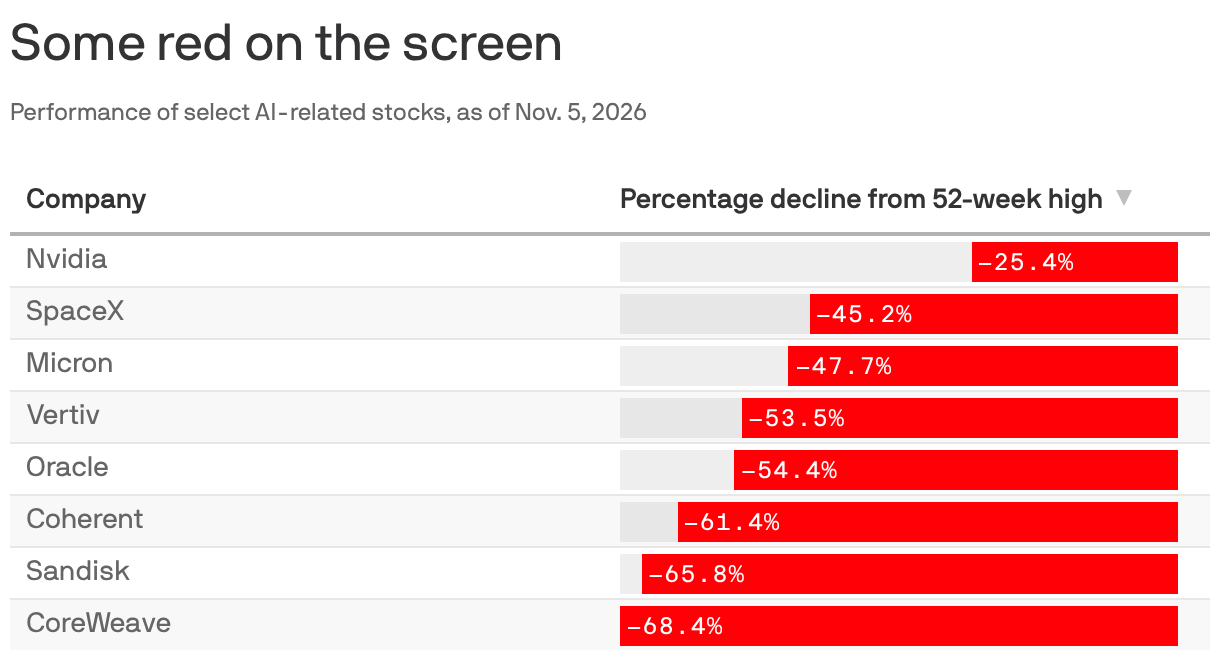
Between the lines: To some, the sudden tumble in the markets — futures were actually up a bit in premarket trading — suggested that a large institutional investor may have moved to sell a sizable chunk of a portfolio that had turned south after Wednesday's post-election slump in AI shares.
- Hedge funds had already been selling, as they unwound positions last month at their highest rate in over a decade, per a Morgan Stanley note cited by the Wall Street Journal.
- Elsewhere, retail investors, who in past market downturns have swarmed in to buy the dip, instead dumped shares, acting as heavy sellers of tech stocks Thursday, said Jai Malhi, senior equity strategist at Vanda Research, which tracks trading by individual investors.
What we're watching: For any indications that the volatility hitting the AI trade could prompt Anthropic and rival OpenAI to reconsider plans to offer shares to the public.
- And will the stock market jitters spread to the more sober-minded markets for corporate debt, where a large chunk of data center construction is expected to be financed?
The bottom line: To be continued.

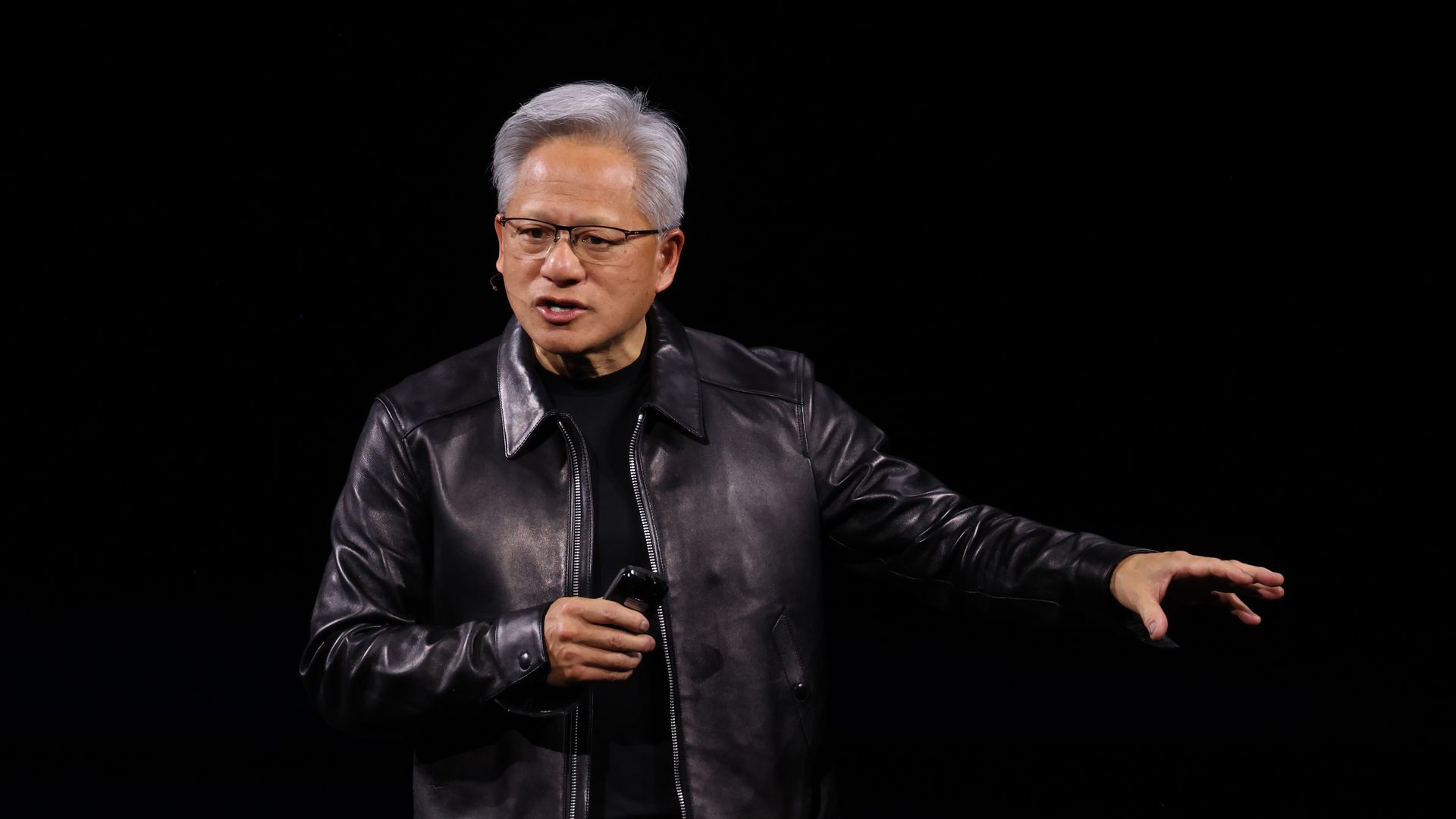
Nvidia CEO called in by lawmakers over ties to alleged Chinese spy
Nvidia CEO Jensen Huang has been asked by three House Republican committee chairs to brief Congress behind closed doors about his reported ties to a woman accused of spying for China.
Why it matters: The request escalates the scrutiny of the Nvidia CEO over his alleged relationship with Alice Huang, a businesswoman accused of spying for China.

Tech stocks tumble as election rattles AI trade


Tech stocks plunged Thursday in the most visible sign yet that investors are growing worried about a slowdown in the AI boom.
The latest: The tech-heavy Nasdaq Composite index was down 4.7% at 3 p.m., with just an hour left in trading. The broader stock market was also down sharply.
- The sell-off is shaping up to be the stock market's worst showing since the April 2025 tariff panic.

OpenAI unveils cyber model with unprecedented hacking skills
OpenAI's researchers used the company's latest cyber model to take advantage of nearly 1000 security flaws in the popular Linux operating system — a piece of extensively vetted software that underpins much of the world's digital infrastructure.
Why it matters: AI is making it possible to uncover and test security weaknesses at a scale that could overwhelm companies' ability to fix them before hackers strike.

The "everything election" is a lesson in corporate focus
Corporate America can't ignore the message voters are sending with the scale of Democrats' midterm victories. This wasn't an election defined by any single issue. It was everything, all at once.
Why it matters: For communicators, the challenge now is separating political noise from the concerns that directly affect their businesses and shaping decisions that tackle those issues.

Zipline raises $1.5 billion to expand drone delivery
Zipline, a South San Francisco-based drone delivery service, on Thursday announced that it's raised $1.5 billion at a $21.5 billion post-money valuation. It also expanded its Walmart partnership.
Why it matters: Drone delivery may eventually supplant data centers as the target of local community ire against Big Tech, as evidenced by a recent battle between my hometown and Amazon.

The big questions for Elon Musk's wireless dreams
Elon Musk is moving ahead with plans to build a nationwide cellular network. Can he really do it, or is it just a ruse to bring the big telecom companies to the negotiating table?
Why it matters: SpaceX has spent billions on spectrum and struck a multiyear agreement with Qualcomm to build a 5G network. But a deal with an existing carrier could make more economic sense, raising questions about how much of the network Musk actually intends to build.

Big Tech scrambles to offer voters a new AI deal
The AI industry is scrambling to repackage a $10 trillion infrastructure buildout to appease a hostile electorate that overwhelmingly voted to restrict data center construction in ballot measures across the country.
- It's not just changing the name of data centers to "compute campuses," but offering communities real money, including dividends and benefits for schools or cities, plus environmental concessions and labor protections.
Why it matters: Tuesday's election proved voters won't tolerate unchecked growth, although the market and many analysts see the blue wave slowing — but not stopping — data center construction around the U.S. To prevent an existential threat, the world's biggest companies are working on a rebrand.
- How well they execute on their promises will determine the pace of the global AI race.


Why this could be the AI pause that refreshes
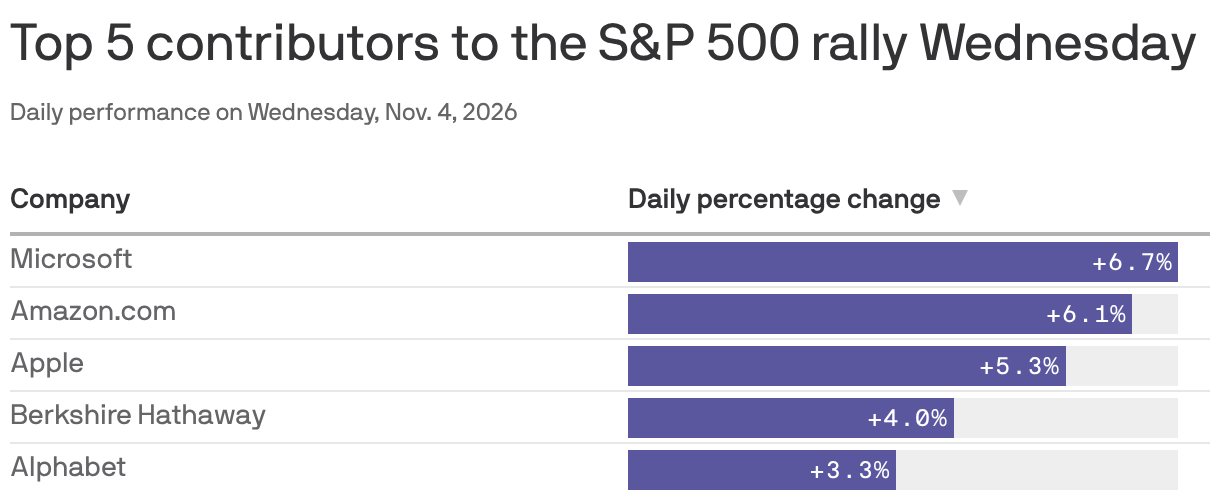
Voters clearly put the brakes on the AI buildout this week, but the biggest tech companies kept on rolling.
Why it matters: The rally in the shares of the likes of Microsoft and Amazon reflects a growing realization on Wall Street that a slowdown in the AI race may not be such a bad thing.
- If companies can put off enormous spending commitments, they get to show healthier cash flows, avoid financing costs and possibly sidestep risky investments.

New on streaming: Muhammad Ali show "The Greatest," "Black Doves" and more
From boxing to British spies and a bold bride-to-be, here are some of the new notable titles you can stream this weekend.
The Greatest — New drama series, available now on Prime Video.